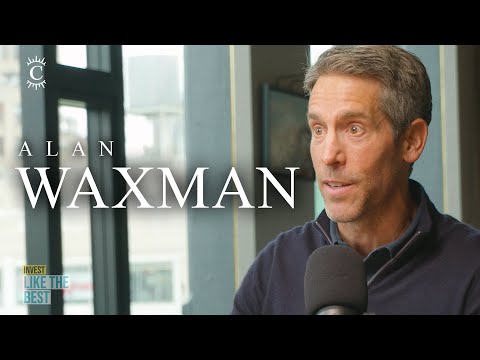
Alan Waxman
Frontier Insights
Core Frontier Thesis: Sixth Street treats capital allocation as an agnostic, multi-asset risk-clearing engine, unitizing risk across geographies and capital structures to pit 10–12% yields against 20–25% returns on a single platform.
Strategic Decisions: They run 15–25 dynamic themes across moderate-scale funds, deploying continuous deal volume (~500/month) to front-run theme decay while integrating AI-driven re-underwriting into investment decisions.
Risks & Warnings: Private credit faces calibration shocks from “factory-model” over-fundraising, leverage misuse, and degraded underwriting. Long-term alpha demands strict liquidity discipline and managing AI workforce disruption.
Key Views & Dialogues
What 100 Years of American Finance Tells Us About Today
- 🗓️ Date:
2026-04-08| 🎙️ Show:Invest Like the Best
Waxman attributes private-credit stress to a factory model that industrialized fundraising and investing after 2018, with FRE multiples rising from 10–15x to 25–30x+ as underwriting standards weakened. Perpetual private BDC redemptions exceeding the 5% limit are not yet systemic in his view, but AI could reprice every industry, making matched liabilities, governed inflows, and strategy breadth critical.
View Dialogue Notes & Key Takeaways
Waxman’s core frame: everything in the private credit news cycle — perpetual BDC redemption limits, stuck assets, wobbling stock prices of asset managers — is “the symptoms, but not really the root cause.” The root cause is the factory model: the industrialization of fundraising first, then of investing, a behavioral shift he dates precisely to 2018 that went “game on” after COVID.
The 125-year setup matters because incentives, guardrails, and market structure determine fate. System one (Glass-Steagall, 1933–1999) proved “with really good guardrails, you can get long stability” but not growth; system two (1999–2008) proved the opposite — repeal, banks at “20, 30 times leverage,” and nine years later the GFC. His crisis framework emphasizes retail money next to principal risk-taking, mismatched assets and liabilities, leverage, and incentives/guardrails/market structure.
System three “has the potential to be the best system American finance has ever had”: Basel III-constrained, government-backstopped banks doing safer lending, with private capital — grown from ~$2T pre-GFC to $14–15T, private credit from $500B to ~$2T — providing risk capital on matched assets and liabilities. “Up until 2018, the system was working great.”
Follow the incentive: FRE (fee-related earnings) multiples went from 10–15x in the early 2010s to 15–20x in 2018 to 25–30x+ before the current moment, paying firms to raise fast, narrow, and simple. On the asset side the tell is underwriting decay — lower your standards and your deal hit rate goes from half a percent to 2–3%, “literally all in your control” — and terms like getting levered from 50% to 120% LTV for a capped 10% return.
The current noise: wealth-channel perpetual private BDCs where redemption requests have exceeded the 5% limit. His flat rule: “There’s no semi-liquid… there’s liquid and then there’s illiquid.” But he doesn’t think it’s systemic — only 5 years in, strong economic backdrop, and in a true distressed environment redemptions “would be two, three x what they are.” His verdict: “this is a gift to the industry to recalibrate.”
The best answer is the market mechanism: LPs defunding bad behavior, wide-aperture multi-strategy vehicles with governed inflows, and honest suitability — assume you can’t get money back in a 2008/1929 scenario. Legislation risks the wrong guardrail and “creates like the next crisis.” Sixth Street’s receipt: a direct-lending franchise dating to 2001 and zero dollars of perpetual private BDCs. “It’s not that we couldn’t have, we just didn’t think it was the right thing.”
On AI, the catalyst that started the redemptions: “This is not just software. This is every industry” — once one company in a sector cracks agentic capabilities and higher margins, slow adopters inherit the same problems the market now perceives in software. Which is also why a narrow strategy in a fast-changing world is “just crazy” unless you govern the capital raised.
🔗 Original source & video: What 100 Years of American Finance Tells Us About Today
The Investment Firm That Can ‘Do Anything’ | Sixth Street CEO Alan Waxman
- 🗓️ Date:
2025-07-15| 🎙️ Show:Invest Like the Best
Alan Waxman’s edge is unitizing risk by business quality, capital-structure attachment point, and documents, letting Sixth Street compare disparate deals across asset classes. With 450-500 monthly deals, 15-25 live themes, and a $30B TAL vehicle, the firm can migrate as themes decay over 12 to 36 months, but leverage-driven returns, AI labor disruption, and wealth-channel structure remain watchpoints.
View Dialogue Notes & Key Takeaways
Waxman’s entire method reduces to one skill: unitizing risk and return across every asset class, sector, geography, and duration — the framework is business/sector quality, capital-structure attachment point, and documents — so a consumer-goods buyout at 20% with 70% leverage can be compared against a hyperscale data center with a 15-year take-or-pay contract, or the same 15% structured-equity deal in Australia versus Ukraine. “Everyone thinks their baby’s the prettiest” — single-strategy investors can’t make that comparison, and it’s why Sixth Street runs capital from 10-12% up to 20-25%/2-3x under one roof.
Every good theme has a shelf life of 12 to 36 months: “there’s a lot of smart people out there,” so a good theme becomes less good, then okay, then bad, “then people overcorrect, they start putting leverage on it, and then you have a correction.” Sixth Street sees 450-500 deals a month, runs 15-25 themes at a time, and most of the 2025 list didn’t exist in 2022 — the firm is built to migrate rather than ride a theme down.
His implicit macro warning: investors are back in behavioral tunnels — direct lending flooded with new money, nominal returns manufactured through leverage, LPs still bucketed by asset class asking for “20% returns” without asking how much leverage produces them. The 2001-02 fiber bust and the 06-07 signs “were all right in front of you,” and the siloed-vision pattern is “what we’re going to be talking about sometime here in the next two to three years.”
Two overlooked risks he names for mid-2025: the AI labor transition — productivity gains are coming, job losses with them, and “it should be code red people talking about it and that’s not happened” — and the wealth channel, where private-alt allocations of 3-5% versus 40% for pensions should rise but must be structured responsibly: “just because you can raise it in the wealth channel doesn’t mean you should.”
The structural edge is TAL, a ~$30B “synthetic Goldman Sachs balance sheet” sitting across ten deliberately modest platform funds — the growth fund stays at $3-4B instead of $8B, yet the firm can still “consistently write billion dollar plus checks across asset classes.” That architecture came from case-studying every faded GP brand: the killer was raising ever-larger funds past the opportunity set.
The track record is built on restraint: SSG paused in 2006-07 and was, he thinks, the only principal group (maybe one other) that didn’t lose money in 2008 on a lot of capital — without which Sixth Street’s first fund never gets raised. “Sometimes the best thing you can do as an investor is not invest”; in 2017 they passed on 15-20% deals because the risk was too far out on the spectrum.
Culture is presented as the business model, not decoration: multi-strategy investing dies with fiefdoms, so Sixth Street hires people who are “over themselves” (borrowed from the Spurs), trains them to “face the tiger” when deals go wrong — a fraud recovery that returned 50 cents on the dollar “when we should have gotten two cents” — and has never lost a partner.
🔗 Original source & video: The Investment Firm That Can ‘Do Anything’ | Sixth Street CEO Alan Waxman