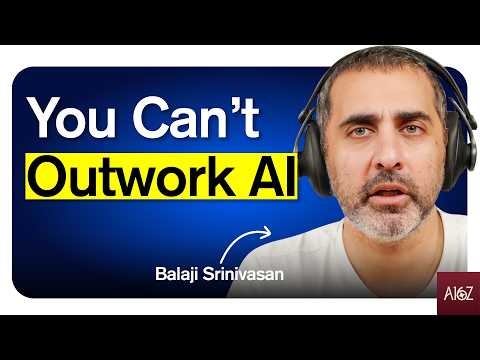
Balaji Srinivasan
Frontier Insights
Frontier Thesis: AI evolves not into a singular godhead, but a multipolar “polytheistic” system spanning the US, China, and open-source models, tied together by crypto and social networks. As generation commoditizes via distillation, value shifts from intelligence to verification, proprietary context, and distribution. Humans become high-value physical sensors directing AI actuators.
Strategic Decisions: Build around trusted communities, defensive distribution, and mission-critical verification rather than raw model development. Adapt exit strategies to regulatory hostility by navigating “acqui-hires” and sovereign jurisdiction competition.
Key Risks: Antitrust suffocating startup liquidity, defensive SaaS distribution moats, and political/copyright barriers stifling model compounding.
Key Views & Dialogues
Balaji Srinivasan on The Future of AI | The a16z Show
- 🗓️ Date:
2026-04-07| 🎙️ Show:The a16z Show
Srinivasan expects models to commoditize while trusted tribes retain personal, private, programmable context, shifting economic value from generation toward verification and expertise. AI may expand generalist agency and biology’s sensing potential, but physical bottlenecks, political resistance, distribution, and generic models limit the path to unconstrained autonomy.
View Dialogue Notes & Key Takeaways
Srinivasan’s base case is a decentralized AI economy: models are expensive to create but easy to distill, while valuable operating context stays “personal, private, programmable” inside trusted tribes. Labs face both technical difficulty stopping distillation and moral difficulty protesting copying after training on the public internet. Within tribes AI raises productivity; between tribes it generates spam and verification expense.
AI cuts generation costs while raising verification costs, making expertise—not raw output—the bottleneck. Visuals, testable code, and physical tasks benefit because humans can see, unit-test, or observe the result; unbounded verbal work remains fuzzy. “AI is a shortcut,” but users who never learned the long way cannot debug it.
Srinivasan rejects the idea that LLMs simply get us to AGI, arguing that economically useful systems are “designed for the leash,” lack direct worldly sense, and cannot reproduce without closed-loop physical supply chains. Markets and politics also fight back against learned strategies, while competitors receive the same generic models. His operating formula is therefore “humans are the sensor, AI is the actuator.”
The labor call is “AI doesn’t take your job, AI makes you the CEO”: more people can direct cheap agents and reach competence across functions. Chairmakers become managers and technicians; founders become six-or-seven-out-of-ten generalists, while specialists retain an edge in vocabulary, polish, and verification. AI also takes “the job of the previous AI,” turning model selection into recurring procurement.
Biology may be AI’s clearest knowledge and sensing opportunity because it can unify facts scattered across thousands of papers and act on telemetry the user never verbalizes. Srinivasan calls this potentially “the century of biology,” yet draws a line between synthesizing “everything we knew” and discovering what nobody knows. “I’m not sure whether AI will be able to read your mind, but it can read your body.”
Existing SaaS is pressured, not automatically guillotined, because AI copies interfaces but not distribution. Figma, Notion, and Replit can ship faster too; local data compounds in tools such as Obsidian, while stale incumbents are more exposed. A perfect facebook2.com clone still has no users.
His crypto division of labor is explicit: AI is the attack, ZK the defense; Bitcoin becomes “provable, global, institutional collateral,” while Zcash pursues private digital cash for individuals. He sees Bitcoin’s institutional addresses as able to migrate most funds quickly under a quantum threat, while billions of small holders could not. Zcash’s pitch is fungibility, privacy, Tachyon scaling, greater quantum safety, simplicity, and a 10-year security record.
🔗 Original source & video: Balaji Srinivasan on The Future of AI | The a16z Show
Steven Sinofsky & Balaji Srinivasan on the Future of M&A, AI & Tech
- 🗓️ Date:
2025-08-08| 🎙️ Show:The a16z Show
Blocking Big Tech exits can starve startups of capital and strengthen incumbents: DOJ intervention in JetBlue’s acquisition of Spirit was followed by Spirit going bust, while acquisitions fund challengers through incumbent “surrenders.” AI’s platform shift is driving faster acqui-fires, including Google’s Windsurf deal, while copyright litigation, energy constraints and restrictions on Chinese models could squeeze US leadership.
View Dialogue Notes & Key Takeaways
Blocking exits does not discipline Big Tech; it starves startups, reduces capital available to them, and ultimately strengthens incumbents. Balaji traces the squeeze from Sarbanes-Oxley—public companies and IPOs declined, forcing startups to stay private—through four years of blocked M&A, citing DOJ interference with JetBlue’s acquisition of Spirit, after which Spirit went bust, and Roomba’s difficulties. His investable mechanism: acquisitions are incumbent “surrenders” whose proceeds fund challengers, so “the actual way of regulating big companies is with a thousand startup piranhas.”
Corporate M&A is a power-law venture portfolio, not a series of retrospectively obvious monopoly grabs. Steven says acquisitions are provably net destroyers of value and that big companies make the wrong strategic bet roughly 90% of the time; yet successful outliers get retconned as inevitable. Instagram had no revenue, had just raised at a $500 million valuation, cost Facebook $1 billion—about 25% of its cash—weeks before its IPO, without prior board consultation; “everybody wants a piece of the reward” while accepting none of the original risk.
Antitrust pressure has created an “acqui-fire”: selected talent moves and money remains in the left-behind entity, but the company itself is not acquired. Balaji groups Scale, Character, Inflection, Adept, Covariant and Windsurf into variations on this structure, which can execute faster than conventional M&A. In his account, Google took roughly 40 Windsurf people while leaving about 200 employees and more than $100 million in the company; the missing consideration was status, prompting the remainder to seek a second transaction with Cognition.
AI is a platform shift in which strategically irrational spending on tools and exceptional people can still be economically rational. Steven compares today’s coding-tool proliferation with DOS, BASIC and the overinvestment that consolidated PC operating systems: tooling may never be the largest standalone business, but every aspiring platform “has to have it.” Balaji adds that AI amplifies the best researchers and engineers, making selective talent deals more attractive even when integrating whole companies would not be.
The speakers see a fundamental mismatch between dynamic software markets and regulation built for railroads, coal and geographically constrained distribution. HHI-style market definitions break when an iPhone is simultaneously a phone, camera and programmable internet device, or when Apple, Google and Facebook compete across overlapping product sets. Balaji’s “network versus state” framing adds the political mechanism: Uber, YouTube and other platforms became practical regulators, while governments remain monopoly platforms whose users lack comparable exit.
US leadership in AI could be squeezed simultaneously by copyright litigation, energy constraints and restrictions on Chinese models. Balaji rejects “this is the worst it’ll ever be,” pointing to Napster and Google Books as products degraded by legal attack; Kimi, Qwen and DeepSeek, he says, are already good open-weight models even if not fully open source. Erik frames China’s strategy, in Christensen’s terms, as commoditizing American strength. Steven compares it to Google releasing Google Docs for free, while Balaji pushes back that copyright and intellectual property also helped create the technology industry.
Their policy prescriptions converge on markets but differ in scale: Steven favors predictable rules and letting transactions fail, while Balaji wants organized jurisdictional competition. Steven calls predictive merger blocking statistically indefensible and compares it to “rent control on investing.” Balaji proposes model legislation for all 50 states and 190 sovereign countries, backed by 10 CEOs, founders or investors—or a broader group representing stated revenue or AUM—promising capital where it passes: build at “the speed of physics, not permits.”
🔗 Original source & video: Steven Sinofsky & Balaji Srinivasan on the Future of M&A, AI & Tech
Balaji Srinivasan: How AI Will Change Politics, War, and Money
- 🗓️ Date:
2025-07-28| 🎙️ Show:The a16z Show
Srinivasan’s “polytheistic AGI” thesis points to American, Chinese, and decentralized models forming culturally specific systems alongside crypto and social networks, rather than one unitary intelligence. Because AI output remains difficult to verify in backend code, law, and mathematics, spending may shift toward prompting and proctoring as drones, searchable surveillance, and labor arbitrage intensify political and security pressures.
View Dialogue Notes & Key Takeaways
Srinivasan’s core macro call is “polytheistic AGI”: not one unitary intelligence taking off to infinity, but American, Chinese, and decentralized open-source models multiplying into culturally specific systems. Each internet-first society could combine AI as its probabilistic “oracle,” crypto as deterministic law, and a social network as connective tissue—the “reactor core” of a network state—making model plurality and customization more consequential than a single AGI winner.
The AI-apocalypse framing mistakes a Platonic ideal for software bounded by computation, chaos, turbulence, and cryptography. Casado stresses that today’s models are real computer systems, while Srinivasan notes that the fast-takeoff scenario did not occur and current AI lacks goal-setting, embodiment, reproduction, and independent action—although he treats self-replication as a constraint “today,” not necessarily forever.
The emerging AI economy is “middle to middle”: humans supply direction through prompts and then absorb the expensive work of verification. A prompt is a high-dimensional heading for a fast spaceship, while autonomous feedback is fragile because the model “doesn’t know what it knows” and is “optimized to fake it.” Srinivasan expects business spending and employment to move toward prompting, proctoring, and verification; Torenberg likens the broader verification burden to KYC.
Near-term value accrues fastest in visual, front-end, and stateless work whose quality can be inspected almost instantly. Images, video, and interfaces expose their gestalt cheaply; backend code, legal language, and mathematics require slow System 2 review, while stateful software may be computationally irreducible. “AI makes everything fake,” Srinivasan argues, so verification tooling becomes part of the product.
AI appears more likely to amplify expertise than erase its advantage. Casado says early coding data show senior developers receiving larger relative productivity gains because they ask better questions, recognize trade-offs, and reject bad output; Srinivasan calls this “amplified intelligence, not agentic intelligence.” AI can make “everyone a CEO,” but the sharp formulation is that it often “takes the job of the previous AI.”
Markets and politics remain hostile domains because they are time-varying, rule-varying, and adversarial. A strategy degrades once competitors adopt it, and “the other guys are also using an AI on you,” leaving the CEO, influencer, or creator as the live sensor that interprets changing conditions. Srinivasan keeps StarCraft as a genuine counterexample that complicates, but does not erase, the boundary.
Crypto can authenticate digital history, but Casado’s pushback is that it cannot by itself prove the physical-world input was true. Srinivasan’s answer runs from FTX transfers verified on block explorers to Farcaster posts, crypto IDs, and instruments that hash camera or sequencing-machine output onchain at capture time. That creates stronger provenance and coordinated attestations, “not impossible” forgery resistance.
The most concrete “killer AI” is already drones, with downstream consequences for borders, surveillance, and political backlash. Srinivasan expects digital borders to harden as remote systems can control machines inside a jurisdiction, while AI makes previously unsearchable surveillance archives queryable. Labor pressure compounds the politics: his illustrative convergence moves a Western professional from $200K toward $20K while lifting a $2,000 overseas worker tenfold.
🔗 Original source & video: Balaji Srinivasan: How AI Will Change Politics, War, and Money