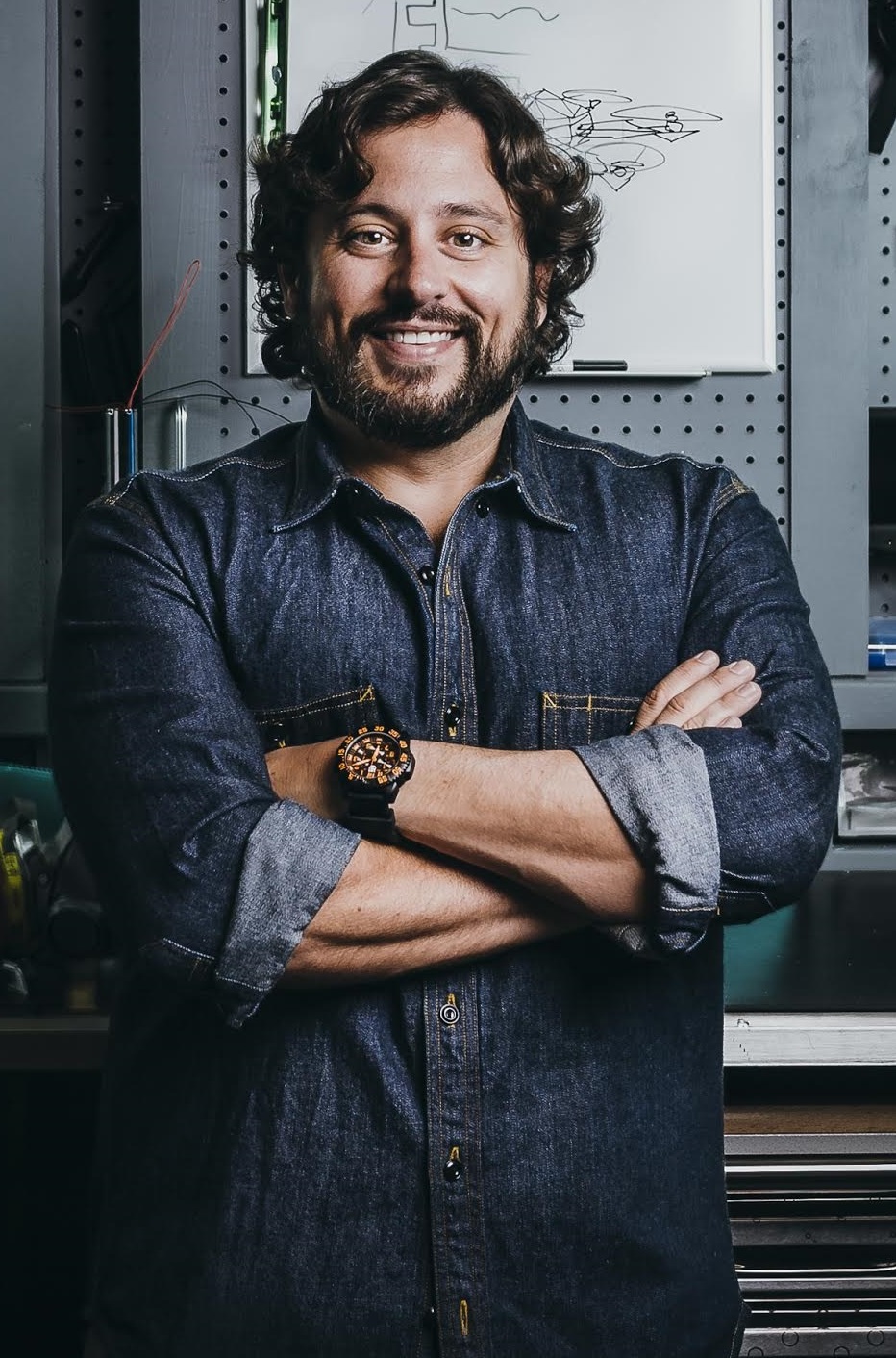
Ben Lamm
Frontier Insights
Frontier Thesis: Colossal leverages de-extinction as the ultimate proving ground for high-throughput synthetic biology and evolutionary genomics AI, aiming to capture a $1.7T market across conservation, biosecurity, and human therapeutics.
Strategic Playbook: Execute audacious biological moonshots—proven by end-to-end edited “mammoth mice”—to subsidize and modularize dual-use infrastructure. Monetize horizontal capabilities through spinouts (Astromech, Breaking), government bio-vaults, and high-margin vertical applications (pest eradication, IVF, drug discovery).
Risks & Warnings: Severe bottlenecking around artificial wombs and cloning efficiency; lingering regulatory hurdles; and high execution risk scaling unvalidated gene drives into complex real-world ecosystems.
Key Views & Dialogues
Race to Save Humanity: Inside $12B Colossal Biosciences & $3.8B Astromech
- 🗓️ Date:
2026-08-20| 🎙️ Show:Sourcery
Colossal’s woolly mice validated mammoth-editing in 30 days, with 100% healthy births and predicted phenotypes. With $635M raised, its screwworm solution could eradicate the problem in six to seven months versus $1.5B in taxpayer spending over eight years, pending permits. Astromec uses evolutionary-genomics AI for drug discovery; another extinct species may arrive within 12 months, but the target remains undisclosed.
View Dialogue Notes & Key Takeaways
Colossal’s woolly mice were a pipeline proof, not a publicity stunt — 100% healthy mice born with exactly the predicted phenotypes, carrying “the most multiplex edits delivered at one time ever,” engineered in 30 days. Lamm’s frustration is that “the 30-day part got lost” amid the cuteness discourse; the point was validating mammoth-target edits in a 21–22-day-gestation animal instead of a 22-month endangered elephant.
Colossal has raised $635M total, with the last round supposed to be $200M and oversubscribed to $400M — and every round has been more than 2x oversubscribed. Lamm’s read: “we’ve completely mispriced every single round… we’re a cheap date and we should raise our rates on capital,” and he calls Colossal “one of the most undervalued companies in the world” given the ability to “preserve, engineer and direct life on a planetary scale.”
The business model is not selling animals — Molly frames the broader opportunity as “civilization tech,” while Lamm describes government-scale use cases: gene drives against invasive species (a “half a trillion dollar problem globally”), artificial wombs, and human-health applications. The screwworm case is the tradeable math: taxpayers are spending ~$1.5B over 8 years to slow the problem, while Colossal’s already-built solution “could eradicate the entire problem in every model that we’ve done in six to seven months” — pending government permits it does not yet have.
Spinout Astromec (raised recently, “may or may not be raising money now soonish”) uses focused evolutionary-genomics AI for drug discovery — “we don’t have to go build a $500 billion data center.” The mechanism: elephants get cancer at 2–3% vs. humans’ 24–25% via p53 overexpression, and Colossal holds the world’s largest elephant and multi-species herpesvirus datasets, informing prediction models applicable to cancer evolution and bird flu.
The episode’s extinction setup is a forecast of up to 50% biodiversity loss in the next 25 years, and Lamm says conservation “just doesn’t move at the speed at which we’re eradicating species.” His hedge against critics: de-extinction is “net-new money, net-new technology,” not a replacement — all technologies are open-sourced free for conservation use — and “wouldn’t you rather have a de-extinction toolkit and not need it than need a de-extinction toolkit and not have it?”
Lamm’s hottest take: AI will converge into “a digital twin of nature” — real-time prediction models like those for missile defense and tsunamis, showing the ecosystem consequences of every data center or diverted river. He calls it “incredibly enlightening and terrifyingly scary,” and sees it enabling productionized species to offset adverse effects of human decisions.
Editing capability is compounding faster than promised, and the next milestone is teased but unnamed. Investors said 5–7 edits within five years would be great; Lamm says Colossal is now doing 100 edits, while elsewhere saying “hundreds,” and is pushing a new construct and delivery mechanism for thousands of edits at once. In the next 12 months: “Colossal potentially having the next extinct species birthed” — which one, “I’m not saying.”
🔗 Original source & video: Race to Save Humanity: Inside $12B Colossal Biosciences & $3.8B Astromech
AI + Synthetic Biology: The Most Transformative Technology in Human History | Ben Lamm (Colossal)
- 🗓️ Date:
2026-04-07| 🎙️ Show:Moonshots
Colossal uses de-extinction as a proving ground for an AI-enabled synthetic-biology platform, growing to 260 scientists and a reported $10 billion valuation in four years. Spinouts such as Breaking and a UAE-backed animal biovault show how platform discoveries could become commercial and sovereign infrastructure businesses. Artificial wombs remain the scaling unlock but all three projects “don’t work yet,” leaving edit efficiency, cloning economics, regulation, and gene-drive containment as material milestones.
View Dialogue Notes & Key Takeaways
Lamm frames de-extinction as a demanding proving ground for an AI-enabled synthetic-biology platform, not a novelty end market. He says, “Without AI, we would not be able to do anything that we’re doing.” Diamandis cited a rise from zero to a $10 billion valuation in four years, called Colossal massively undervalued, and said the company now employs 260 scientists—200 in the U.S. and 60 in Australia—plus AI programmers.
The platform is designed to produce focused businesses whenever a conservation technology proves commercially broader. Breaking, the first spinout, uses an editable microbial consortium that “actually breaks the chemical bonds” of plastic instead of creating smaller microplastics. Diamandis described a dozen-company pipeline; Lamm’s model gives discoveries dedicated teams and capital while sharing improvements across the ecosystem.
Governments could become foundational customers for biodiversity infrastructure and species preservation. Lamm said the UAE agreed to put hundreds of millions of dollars into the world’s first animal biovault initiative, including reference genomes, digital backups, globally shared data and a public living lab—a nine-figure initiative for each side. He also relayed an EY estimate linking extinction-related consumer demand, education and ancillary effects to a potential $1.7 trillion opportunity.
Artificial wombs are the potential scaling unlock, but Lamm’s explicit disclosure is that all three projects “don’t work yet.” The northern white rhino illustrates the target economics: two related females, 18 related embryos and roughly $25 million spent annually keeping two animals alive. Colossal has meanwhile acquired cloning companies; Lamm said ViaGen’s cloning efficiency was about 78%, versus roughly 2% ordinarily.
The addressable market extends into disease-resistant animals and plants, vaccines and ecosystem adaptation. Lamm cited chytrid-resistant amphibians as one actionable case and estimated the broader market at hundreds of billions of dollars today. He roughly characterized 99% of people fluent in synthetic biology and genome engineering as focused on human healthcare, while noting that Australia legally treats reconstructed Tasmanian tigers as GMOs.
Gene-drive biocontrol targets an invasive-species problem Lamm sized at $5.4 trillion globally, while saying the real figure is likely larger. Modified screwworms producing all-male later generations could displace poisoning, trapping and killing while allowing animals to live normally. Lamm once doubted the field after mosquito controversies, but changed his view because Colossal’s approach includes containment and rollback.
Technical compounding, rather than revived-animal spectacle, is the moat investors are being asked to underwrite. Colossal progressed from a few edits at 40% efficiency to hundreds of dispersed edits at 90%, with Lamm expecting thousands in coming years. He claimed DNA delivery was already 5× the largest benchmark he had seen and could reach 20× by year-end. Artificial-womb research has yielded hydrogel, microfluidics and embryo-grading technology that might transfer to IVF.
🔗 Original source & video: AI + Synthetic Biology: The Most Transformative Technology in Human History | Ben Lamm (Colossal)