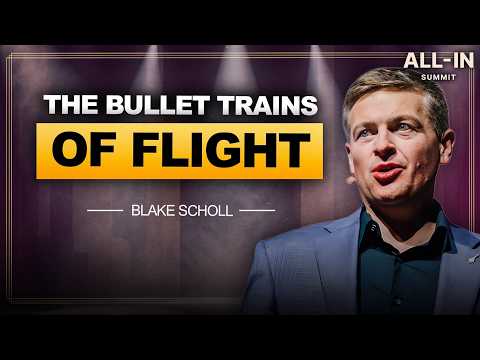
Blake Scholl
Key Views & Dialogues
Blake Scholl: Why Plane Speed Stalled, Supersonic Commercial Flight, & Revolutionizing the Engine
- 🗓️ Date:
2026-09-22| 🎙️ Show:All-In
Boom’s 42 MW, water-free, behind-the-meter data-center system repurposes its Mach 1.7 engine core, with the first engine due next month, while vertical integration targets multiple gigawatts annually and more than 10 GW added to the grid over five years. Overture targets a $3,500 round-trip break-even fare and a four-year goal, but the actual service date remains uncertain as regulatory momentum accelerates.
View Dialogue Notes & Key Takeaways
The presentation introduces Boom as set to fly at Mach 1.7 with 130 orders from major airlines. XB-1 became the first privately developed jet to break the sound barrier in 2025, built by “just 50 really dedicated men and women,” and demonstrated “boomless cruise”: atmospheric refraction redirects the sonic boom upward so it never reaches the ground. Scholl said the U.S. supersonic-flight ban began in 1973 and ended by executive order on June 6 of last year; the Supersonic Legalization Act passed the House unanimously.
The most tradeable reveal: Boom’s supersonic engine core, with the fan removed and a generator attached, becomes a 42 MW behind-the-meter data-center power-generation setup that “doesn’t need any water” because it is designed to run hot at Mach 1.7. Scholl calls it “an incredible money-printing business,” claiming “tens of gigawatts of demand in my inbox”; the first engine is due to run next month, after which Boom plans to auction it all off.
The Rolls-Royce breakup—“one of the dumbest things I ever did was try to outsource our engine development”—that led people to declare Boom dead is now, in a “bizarre twist of history,” what Scholl says makes the startup financially valuable. Boom is vertically integrating from raw materials through turbine blades and assembly, with a factory whose first parts were made last week, scaling to multiple gigawatts per year and targeting 10-plus GW added to the grid over five years.
Overture economics: a three-hour round trip across the Atlantic at Mach 1.7, with a break-even fare of about $3,500 round trip—“any dollar above that, United’s making some good money.” Scholl’s goal is four years; Calacanis floated 2030 as a rough possibility. Scholl hedges that the actual date is uncertain and says it is more important to be fast than predictable.
Boomless cruise works to about Mach 1.3, or roughly 50% faster than current flight, over land; over water, Boom can fly at full speed—twice as fast—with no one on the ground to hear the boom. Scholl says that could mean leaving New York at 9:00 a.m. and landing in San Francisco around 9:30 a.m.; the boom makes a “big U-turn in the sky and never touches the ground.”
Regulatory velocity as a thesis input: Boom broke the sound barrier Monday, Elon reposted the tweet, Scholl received a West Wing invitation by Tuesday, and a Boom model reached the Oval Office by Thursday. The executive order took 115 days, which Scholl said felt slow but likely would have taken longer under another administration; he emphasizes that supersonic flight is not partisan, citing unanimous votes so far.
🔗 Original source & video: Blake Scholl: Why Plane Speed Stalled, Supersonic Commercial Flight, & Revolutionizing the Engine