Cliff Weitzman
Frontier Insights
Frontier Thesis: Token expenditure will surpass engineering payroll within three years, turning compute efficiency, inference cost, and programmatic creative generation into a consumer AI company’s primary moat.
Strategic Decisions: Speechify vertically integrates hardware and distribution—purchasing H100s to undercut cloud rental economics, running 1,000 daily automated ad variants, and launching Simba 3.2 at a disruptive $10/M-character price point to counter ElevenLabs while rebuilding its B2B footprint.
Risks & Warnings: Heavy on-prem GPU commitments risk rapid technical obsolescence if Nvidia residual buybacks underperform, while sheer pricing undercut cannot replace enterprise distribution moats against entrenched incumbents.
Key Views & Dialogues
20VC: How to Build Your Own Data Center & Why Every Startup Should Do It | How ElevenLabs Leapfrogged Us: What I Learned | The AI Talent War: How Your Hiring Process Needs to Change with Cliff Weitzman, Speechify
- 🗓️ Date:
2026-09-05| 🎙️ Show:20VC
Speechify’s owned-GPU strategy compares $35,000–50,000 annual H100 rental with roughly $30,000 to buy, potentially lowering compute costs. NVIDIA’s deal with Blackstone, BlackRock, Apollo and Goldman Sachs could create a liquid secondary market and price floor through buybacks up to 25% of GPU value. Weitzman calls missing B2B his biggest strategic mistake; Simba 3.2 costs $10 per million characters versus ElevenLabs’ $100, but execution against an “unstoppable” rival remains unresolved.
View Dialogue Notes & Key Takeaways
Cliff Weitzman’s core capex math: renting an H100 from a hyperscaler runs $35,000–50,000 a year versus about $30,000 to buy it outright — roughly 1.5× the purchase price. The hardware is warrantied for three years and, he imagines, may keep working for 10; owned, memory-co-located clusters also give Speechify cheaper training and inference. Speechify spends tens of millions on NVIDIA GPUs and pays six-figure premiums to skip delivery queues, potentially getting a year of Rubin access before hyperscaler customers.
Weitzman says an NVIDIA deal with Blackstone, BlackRock, Apollo and Goldman Sachs — underwriting up to 25% of a GPU’s value as collateral — creates a liquid secondary market and a price floor, “exactly what Elon did in the beginning of SolarCity.” On circularity fears, he distinguishes the Oracle–OpenAI arrangements, which he calls ridiculous, from NVIDIA’s real, useful assets: “how many teraflops per second can this device do?” is effectively the unit of value.
Weitzman’s confession is the episode’s centerpiece: not going B2B was “the biggest strategic mistake I made in the history of Speechify,” and ElevenLabs leapfrogging him was “100% on me.” He wrongly assumed a text-to-speech API would commoditize, missing that an AI lab’s first product is a wedge for everything after it; Speechify’s Simba 3.2 API now costs $10 per million characters versus ElevenLabs’ $100 and OpenAI’s benchmarked $196.
Harry Stebbings argues going B2B now could be a fresh mistake — competing with an “unstoppable” ElevenLabs, which he says has Western-government buy-in, and Bret Taylor’s Sierra is “the Postmates effect.” Weitzman refuses to sit out: “The best way to lose is not to be in the race.” His precedents are Anthropic following OpenAI, Facebook following Friendster and MySpace, and OpenAI fumbling voice AI.
On the AI talent war, Weitzman inverts Stebbings’ premise: hiring is brutal at growth stage, where packages can reach $15 million a year and Stebbings sees $50 million-plus, but “the easiest time ever” for true seed companies because raw aptitude can be taught rapidly. Speechify now hires math Olympiads, Kaggle winners and physicists who may never have coded: “hiring for slope more than intercept.”
Speechify’s dev culture gives zero credit until code ships to production — “you make me a beautiful bottle of milk and you leave it down the road, the milk will spoil.” Claude Code is the top harness, engineers run 5–18 agents each and aim for “10 really good decisions per day.” There are no token leaderboards; wasteful token use can lead to people being let go, while a $12,500, two-week long-horizon run that produces a better model is money well spent.
On public-market calls, Weitzman picks Meta over xAI, saying “Elon’s distracted.” He then compares Meta with Elon’s SpaceX and Tesla: Meta is around a 32 P/E while Tesla is valued in the multiple hundreds and SpaceX is “insane”; Meta has more data than anyone but is constrained by GDPR and other laws, and Zuck has roughly 20 extra years. Stebbings counters that removing Zuck could lift Meta’s stock by ending the “CapEx, CapEx, CapEx” focus, whereas removing Elon destroys much more value.
His five-year contrarian call: human-computer interaction becomes primarily voice — and his deepest excitement is AI biology. For a family member with an orphan disease, he has analyzed 15 weeks of blood, genome, proteomic and RNA data against six years of self-reported data on a GPU cluster; he plans to sequence other patients to find a common thread. He says GPUs also helped identify his father’s prostate-cancer lesion, closing the loop on a founder story that began with dyslexia and Harry Potter audiobooks listened to 22 times.
🔗 Original source & video: 20VC: How to Build Your Own Data Center & Why Every Startup Should Do It | How ElevenLabs Leapfrogged Us: What I Learned | The AI Talent War: How Your Hiring Process Needs to Change with Cliff Weitzman, Speechify
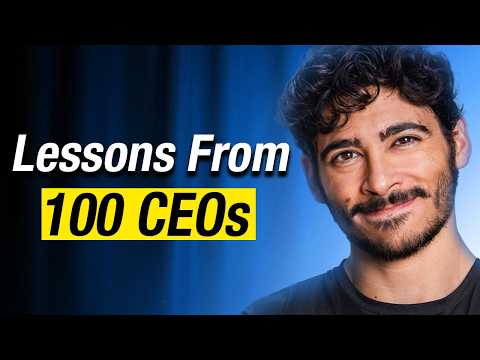
Cliff Weitzman: What I Learned from 100 of the World’s Top CEOs & Why Tokens Will Outspend Salaries
- 🗓️ Date:
2026-05-09| 🎙️ Show:20VC
Speechify expects token spending to exceed engineering salaries next year, with great companies reaching that point in 3 years. It tests 1,000 AI-generated ads daily plus 8,000 human creatives monthly on proprietary tooling and is among 200 companies provisioned for OpenAI ads. Single-digit inference costs versus Eleven Labs’ $70–100 support profitability, but undisclosed valuation and the OpenAI-Anthropic contest remain key watchpoints.
View Dialogue Notes & Key Takeaways
The headline call: token spend will exceed payroll. Speechify expects to spend more on tokens than on salaries next year — in engineering alone — and Cliff says great companies “will get there in 3 years.” Adoption is coerced, not suggested: “If you don’t spend 1,000 credits a day, I’m disappointed in you,” non-users must explain themselves in a public Slack thread, and holdouts get 24 hours to send a Loom of something they built with AI.
The ad machine is the moat: Speechify tests ~1,000 AI-generated ads a day (target 1,300) on top of ~8,000 human-made creatives a month, on a platform it built itself after N8N kept timing out — “if you use the tool that everybody else uses, typically you’re not going to win.” It is also one of just 200 companies provisioned to run ads on OpenAI, which Cliff calls “massive, massive” because “OpenAI knows everything about your history… inside of your psyche” — high CPMs don’t matter with conversion plus attribution, and the tracking SDK just launched.
Long Meta, “one of the most underrated stocks”: when engineering and design commoditize, what’s left is QA and customer acquisition — “I look at all the people who are vibe coding new products right now. Where do you think they’re going to get their users?” Cliff wouldn’t be long Snap (“lunch is completely eaten by Meta”), Figma a hold despite Harry being down 40% (“Dylan Field is a savage”; 40x→6x revenue is the market correcting, not the company failing).
Context is the edge in public markets too: unable to buy H100s in 2022 and stunned by Jensen’s earnings-call demo, Cliff bought Nvidia stock while brother Tyler bought a 3x levered option — “now like 36x up.” Cliff put a third of his money into Tesla in 2015 off a photovoltaics capstone. The Munger/Buffett punch-card rule: “when you find the opportunity, lever as hard as you can into it in a responsible way.”
Speechify is a stealth compounder by design: claimed 94% of the B2C voice-agents market, 1.1M five-star reviews, 50M+ users, 4.5 years profitable, and inference driven to single-digit dollars per million characters vs Eleven Labs’ $70–100. It discloses neither raise nor valuation publicly; Cliff says the team knows the raise figure: “If you find lightning in a bottle, you don’t want to tell other people about it.”
The diagnostic for consumer AI revenue ramps is inference cost: watch for “inference costs burning those companies alive.” Cursor is the benign case — money “went straight through Cursor and to Anthropic,” revenue without real losses — and churn spares only need-based products: “if you are blind… you will never churn from glasses. A meme maker, sure.”
The 850 coin flip lands contrarian: Cliff picks OpenAI over Anthropic at 850 — Sam Altman “comes off slimy” but is a record fundraiser whose enterprise deals look “like black magic and looks like fraud” — even while conceding “Anthropic is running circles around them right now, especially in the coding arena” and “I would marry Claude Code.” On Grok: “never bet against Elon.”
Three weeks living with MrBeast: Jimmy stopped a 100-person shoot to repaint a door pink — “he has the algorithm in his head.” The transferable lesson: the best-converting content needs no language (“our best performing ads include books not PDFs”), and Harry’s own frustration got a mirror — he’d be “17x more successful” if he’d backed every 7/10 founder he met, since he can’t tell a 7 from a 10; Cliff’s hiring version: “If you can really trust someone, you can afford to pay them significantly more.”
🔗 Original source & video: Cliff Weitzman: What I Learned from 100 of the World’s Top CEOs & Why Tokens Will Outspend Salaries