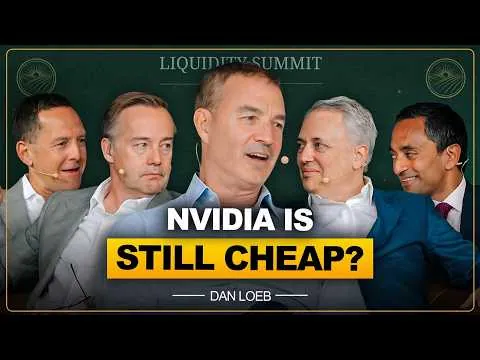
Dan Loeb
Key Views & Dialogues
Dan Loeb: The Lost Art of Short Selling, and Why Stock Picking is Back
Dan Loeb says short selling has returned, but valuation alone can be overwhelmed by Reddit-driven or thematic rallies; his homebuilder short instead links rates, mortgage spreads, disguised land commitments, inventory disruption, and cost inflation. Third Point now emphasizes durable businesses and adaptable management, while AI cannot replace human judgment, leaving Nvidia’s possible earnings breakout over the next two or three years a key catalyst to monitor.
View summary (6)
Loeb says “the lost art of short-selling has come back,” but valuation alone is a dangerous trigger. Expensive stocks can be swept into Reddit-driven or thematic rallies; his homebuilder short instead combines rates and mortgage spreads, disguised land commitments, inflated post-COVID pricing and inventory disruptions, and cost inflation.
Third Point evolved from buying “cheap securities with catalysts” toward judging business quality, technological disruption, and management adaptability. Because supposed moats around IBM, AOL, and Yahoo proved time-bounded, Loeb asks which companies can endure seven, 10, or 20 years—and treats management assessment as subjective pattern recognition.
His original event-driven edge came from incentives hidden inside complex transactions. In spin-offs, bankruptcies, demutualizations, and privatizations, management could sandbag projections while options were being reset and securities were in excess supply; investors then benefited as transparency, coverage, revenue, margins, and ROE exceeded those depressed expectations.
Loeb believes AI can improve investing systems without replacing the human network that sources opportunities and judges people. Third Point now spans equity long-short, structured and high-yield credit, CLOs, private credit, workouts, venture investing, and insurance, yet agents still cannot “look you in the eye” and make every interpersonal assessment.
Selling winners remains brutally difficult even for investors who identified them early. Sacks says he and his partners sold Palantir in the $20s and Enphase below $1—the latter position, he says, might have produced $4 billion—while Loeb argues that old market-cap ceilings distort thinking about Nvidia, which he expects could break out on earnings over the next two or three years.
Loeb connects inequality to failed education systems and criminal-justice reform to individualized accountability. He distinguishes false convictions, rehabilitation, and disproportionate sentences; Ross Ulbricht’s two life sentences plus 40 years led him to pursue the presidential-pardon route while acknowledging Ulbricht’s illegal conduct.
Legendary Investor Dan Loeb on AI, Credit, & Third Point’s $25B Strategy
Dan Loeb has reduced macro to oil and AI, making technology fluency essential as Jensen’s stack reshapes power, chips, models, and applications. Third Point sees leading AI companies as the most attractive sector, while its fulcrum-security framework targets mispriced credit such as Twitter debt and xAI obligations. AI is also destabilizing traditional quality investing and forcing structural sellers, leaving governance, due diligence, and the durability of pricing power as key risks to monitor.
View summary (8)
- Loeb has collapsed his macro dashboard to two variables: oil (war and geopolitics) and AI — everything else the government reports is “trumped right now” by those. His conclusion after 30 years of style evolution: “There was a time when you could say I’m just going to punt on tech… I think you have to be a tech person today.” His prism for the whole complex: Jensen’s stack (power → chips → LLMs → apps) plus the three most consequential companies — “Nvidia, Anthropic, and Elon World.”
- Loeb does not see a valuation bubble in the leading AI companies, and it’s where the bulk of Third Point’s capital sits. With the SOX up 40%, Loeb reviewed his entire semis/semi-cap/hyperscaler book expecting to take profits and instead concluded it’s “the most attractive sector right now” — Nvidia is a “catch-up trade” at 15x 2027 and 12x 2028 for the most dominant company at its size. Unlike the dot-com bubble, “which we were short,” these companies invest off their balance sheets while generating enormous cash; on Anthropic and “the next generation” — “we’re barely scratching the surface.”
- AI disruption made quality investing fragile last year — “a lot of these apparently high-quality companies very rapidly became less” so, probably the worst stretch for the cohort into the start of this year. Loeb’s own confessed mistake wasn’t the AI-disruption shorts that worked, but the ones where he “thought we knew better” and AI would not hit parts of information services; he still expects a shakeout with “phoenixes that rise from the ashes.”
- The human edge survives in structural anomalies, not information. Quants, CTAs, and pods run risk metrics that force selling on the way down — rational for their model, irrational for long-term owners — which is why Micron can print a quarter up 80%, ahead of expectations, and the stock still falls. On the remaining human role, Loeb says, “I honestly have no idea” what capital allocation will look like in six months or a year, though he thinks a fully AI-managed capital system is highly unlikely. AI also won’t sit on creditors’ committees or do private equity — “you always need people to do deals.”
- Fulcrum-security investing across a ~$25B multi-asset platform is the core framework. Third Point bought the Twitter debt resale at 96–97 cents (~12% yield) when most credit investors were scared — its largest credit position at the time — and did the xAI debt ($2B revenues, $20B enterprise value, no cash flow) because knowledge of the businesses made the credit underwritable. The firm’s other differentiator: it “can always default into credit” in stress, as in COVID when it piled into IG credit, not stocks.
- Governance is bad when directors’ loyalty to a weak CEO overrides fiduciary duty. Loeb sees writing and PR as the most effective social-pressure lever in activism; at likely Sotheby’s, Third Point bought 9.9%, gave the incumbent CEO a year, then brought in Tad Smith from MSG, who cleaned up operations before the company was sold.
- FTX was the hardest lesson: “We could verify it all on the blockchain… it just turned out it wasn’t what we thought it was.” Due diligence now includes checking bank balances. The uncomfortable coda: absent the fraud, the venture investments SBF made would have made him “like the best venture investor of this era.”
- Geographically: bullish Korea, Taiwan, Japan as hunting grounds; Japan’s governance reform, which Loeb helped seed via a paper urging ROIC be added to the Three Arrows, is progressing — cross-shareholdings breaking up, below-book valuations penalized. Europe is “just tough right now” on regulation; the Middle East is “probably the most vibrant interesting part of the world” — Bahrain, the Emirates, Saudi, Morocco, and likely Azerbaijan as “better allies to the US than NATO.”