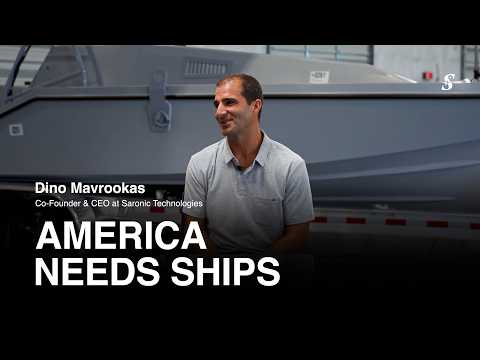
Dino Mavrookas
Key Views & Dialogues
Dino Mavrookas: America Needs to Build Ships Again
- 🗓️ Date:
2026-09-08| 🎙️ Show:Sourcery
China built over 1,000 commercial ships last year versus five large ocean-going vessels in the US, while China holds 57% of global shipbuilding capacity. Port Alpha’s $3 billion project targets autonomous container ships, tankers, and roll-on/roll-off vessels: simpler designs could enable scale and lower costs, but only 1% of the roughly $1 trillion FY26 Department of War budget went to autonomy.
View Dialogue Notes & Key Takeaways
Dino Mavrookas frames US naval decline in one ratio: “China outbuilds the US 230 to one,” with the biggest discrepancy in commercial shipbuilding — China built over 1,000 commercial ships last year while the US built five large ocean-going commercial vessels, a figure he thinks was for 2024. The US fleet sits around 290 ships; Congress set a 355-ship statutory minimum in 2018, and in 2024 the Navy said it needed 381. The 30-year plan to get there would cost $1.2 trillion “if we can even execute as a country in the first place.”
Despite a $1.5 trillion presidential budget request, maritime executive order, and SHIPS Act, only 1% of the roughly $1 trillion FY26 Department of War budget goes to autonomy — “that just gives you a sense of how far we actually have to go.” Mavrookas contrasts aircraft carriers that take 10+ years and whose cost jumped from the $13 billion he was quoting to the $19 billion the president cited last week, versus his view that Saronic’s autonomous ships could save taxpayers “hundreds of billions.”
The Castellion partnership is his exhibit A for the new defense-tech operating model: Mavrookas and Castellion CEO Brian got on the phone, invested their own capital, and were “eight steps ahead by the time the government even came in.” The planned result is a containerized hypersonic missile test launch off the back of Marauder, an autonomous ship, “before the Navy completes its first test of a hypersonic missile off of a manned vessel.”
On new primes, Mavrookas won’t dodge: five to 10 “really big, impactful companies” will scale over the next five to 10 years, reversing the consolidation that took roughly 55–60 primes down to five. He’s explicit this complements rather than replaces legacy: “we need the primes that exist today,” just alongside companies building what they can’t.
Commercial shipbuilding is the strategic foundation, not a side business: China holds 57% of global shipbuilding capacity and, he says, subsidizes construction, raw materials, labor, and financing. South Korea and Japan, the next two largest shipbuilders, get a lot of their commercial modules and labor from China. If conflict comes in the Taiwan Strait, “China can outproduce the rest of the world in terms of ships” — and without tankers and roll-on/roll-off vessels, “we actually don’t have the ships to resupply our force.”
Molly describes the just-announced $3 billion Port Alpha project as the scale bet: 10,000 jobs over 10 years and a $160 billion economic impact around Brownsville, Texas, while targeting autonomy for container ships, tankers, and roll-on/roll-off vessels. Mavrookas’s stated mechanism: autonomy means people are no longer required aboard, which “lets you simplify the design,” produce at scale, drive down costs, and open previously unserviceable markets.
His “hottest take” is his whole thesis, delivered with full conviction: “not just the defense market, but the entire maritime industry is centered around autonomy.” Molly cites Saronic’s $9 billion valuation and $2.6 billion raised; Mavrookas says the team has grown to 1,800 people in four years and is building for that autonomy-centered maritime future.
🔗 Original source & video: Dino Mavrookas: America Needs to Build Ships Again