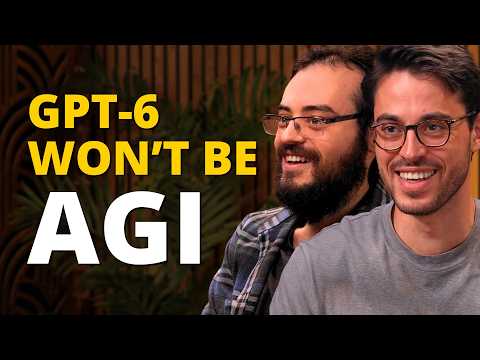
Ege Erdil
Frontier Insights
Frontier Thesis: AGI is a decades-long horizon—potentially 30 years out—flatly contradicting near-term hype; tracking empirical progress velocity is paramount. Concurrently, hyper-targeted automation (e.g., Mechanize’s virtual work environments) targets a realistic near-term displacement of 20% of routine labor within five years.
Strategic Decisions: Reject speculative AGI timelines in favor of pragmatic, measurable deployment. Focus on workflow automation rather than premature general intelligence, while avoiding commoditized tech gimmicks (exemplified by relabeled MVNO/hardware ventures).
Risks & Warnings: Rapid mid-level automation will outpace policy and wealth-redistribution frameworks, precipitating acute labor shocks before safety nets can adapt.
Key Views & Dialogues
Trump Is Selling a Phone + The Start-Up Trying to Automate Every Job + Allison Williams Talks ‘M3GAN 2.0’
- 🗓️ Date:
2025-06-20| 🎙️ Show:Hard Fork
Trump Mobile packages wholesale network capacity into a $47.45 monthly service, but the T1 Phone 8002’s $499 “made in the USA” claim faces a supply-chain test against the $1,999 Liberty Phone benchmark. Mechanize is building scored virtual workplaces to train agents for software engineering and other professions, with 20% job automation within five years potentially valuable while transition policy remains unresolved.
View Dialogue Notes & Key Takeaways
Trump Mobile packages wholesale network capacity into a $47.45 monthly service tied to Trump branding, while the T1 Phone 8002 gold version seeks a $100 preorder toward a purported $499 price. Casey Newton’s MVNO shorthand is “cheaper for worse service”: customers may be deprioritized at busy times, but the operator avoids building towers. The phone’s Android 15 and “made in the USA” claims look harder to reconcile with economics—the only domestic benchmark cited, the Liberty Phone, starts at $1,999.
The sharper risk is that a presidential side business creates fresh channels through which regulated companies could purchase influence. Trump appoints the FCC chair, while Amazon or Meta could hypothetically pay to preinstall apps on the Trump phone—what Casey calls “a new avenue essentially for bribery.” A recent disclosure reportedly showed Trump made $57 million from his family’s crypto firm last year and put his crypto holdings near $1.7 billion at the conservative low end.
Kevin Roose sees Trump’s ventures as a replicable playbook for converting attention, reputation, and political loyalty directly into cash. Mint Mobile sold for more than $1 billion, celebrity MVNOs are proliferating, and meme coins created another monetization route. Casey’s darker formulation is that Trump has learned to “monetize tribalism”; Kevin described loyal supporters paying more for products that may be less valuable, while Casey warned that repeated shocks can become ordinary.
Mechanize is building scored virtual workplaces—“very boring video games”—in which AI agents repeatedly practice software engineering and eventually other professions. Backed by investors including Patrick Collison and Jeff Dean, the startup supplies reinforcement-learning environments containing tools such as GitHub, Slack, email, and spreadsheets; AI companies then use them to train their own models. Its declared destination is the automation of all labor.
Mechanize does not need full automation on venture timelines: Ege Erdil says automating 20% of current jobs within five years would already be “insanely valuable.” The founders expect near-term AI to automate tasks rather than whole professions, potentially raising software-engineer productivity and wages while humans retain coordination, planning, testing, and cross-team work. Full replacement might take decades.
The founders’ ethical case is that economy-wide labor substitution might raise growth by 10 times or more and create enough production to overwhelm the costs of displacement. Ege’s formulation is that “the secret to mass consumption is mass production,” with sovereign-wealth-style distributions or expanded public benefits supplying income after wages disappear. Kevin’s pushback is the load-bearing one: technology may help in the long run, but “people don’t live in the long run.”
Mechanize offers no concrete transition policy and argues that detailed planning before the disruption becomes legible is “overrated.” Kevin counters that societies stockpile for foreseeable pandemics even without knowing their timing; Matthew concedes that the broad answer probably resembles the past century’s Social Security, Medicare, Medicaid, unemployment insurance, and greater redistribution. He also admits that his utilitarian calculus can sound cold to workers already frightened by automation.
M3GAN 2.0 turns the same debate into questions of parenting, creative ownership, and whether humans should relate to AI rather than merely extract from it. Allison Williams stopped letting her three-and-a-half-year-old question voice-mode ChatGPT after he named “the person who talks from your phone” Chapatiti; her rule became “less is more.” As an actor, she wants a synthetic likeness compensated like her physical performance and believes the “tiny moments where I’m bad at my job” may be precisely what keeps art—and employment—human.
🔗 Original source & video: Trump Is Selling a Phone + The Start-Up Trying to Automate Every Job + Allison Williams Talks ‘M3GAN 2.0’
AGI is still 30 years away — Ege Erdil & Tamay Besiroglu
- 🗓️ Date:
2025-04-17| 🎙️ Show:Dwarkesh Podcast
Tamay Besiroglu places full remote-work automation around 2045, while the guests argue that capability gains require roughly three orders of magnitude of compute each and only three or four may remain before infrastructure reaches a major economic share. Their broader forecast is roughly 30% explosive growth, but deployment, regulation, complementary supply chains, and unresolved agency and alignment gaps—not intelligence alone—will determine the timing and distribution.
View Dialogue Notes & Key Takeaways
Headline call: full automation of remote work lands around 2045, not 2027. Tamay Besiroglu gives 2045; Ege Erdil says he is more bullish, while Dwarkesh suggests shaving Ege’s prediction by five years or 20%. The logic: AI has unlocked roughly one major capability (gameplay, language, reasoning) per ~3 orders of magnitude of training compute, we’ve burned through 9-10 OOMs since AlexNet, and energy/fab constraints leave “maybe three or four orders of magnitude of scaling left” before AI infrastructure becomes a non-trivial share of world output.
The intelligence explosion is a category error — “like calling the Industrial Revolution a horsepower explosion.” Their thesis: transformative growth comes from broad, simultaneous upgrading of supply chains, capital, data, and deployment, not from geniuses in a data center; “it isn’t the case that the world today is totally bottlenecked by not having enough good reasoning.”
Software-only singularity is unlikely because compute and cognitive effort are complements: software progress has historically tracked hardware (~30%/yr, matching Moore’s law), the big innovations (transformer, flash attention, chinchilla) were all about harnessing compute, and GPU-rich labs — not academia — produce the algorithms. Dwarkesh’s counter-evidence (Kokotajlo’s survey showing 1/30th compute only costs 2/3 of progress) gets the reply that the imbalanced-scaling experiment “was never run.”
Falsifiers they’d accept: an AI that downloads a post-training-cutoff Steam game and beats it cold; OpenAI hitting $500B revenue (a mere $100B gets “maybe a 40 percent chance” and is not a huge update — “people pay trillions of dollars for oil”). Near-term marker: agents book flights by end of this year, which proves little since “nobody gets a job where they’re paid to book flights.”
They still forecast ~30% explosive growth, quantitatively: an H100 does ~1e15 flop/s (roughly a human brain), costs ~$30K, and running “the software of the human brain” at $50-100K wages pays itself back in about a year — an economy doubling time near one year. Growth differentials will be “determined by regulatory jurisdiction boundaries more than anything else”; Dwarkesh floats a 10-20% chance that global coordination throttles it, which Ege says is not unreasonable.
Takeover risk is overrated, lock-in doubly so: a dominant AI economy taking over humans is like asking “why doesn’t the US just invade Guatemala?” — war is inefficient when you already earn most of the income. Dwarkesh’s East India Company counter (“they just took over, right?”) challenges this, but the deeper claim is that value lock-in “looks very unlike anything that has happened in the past”: slavery ended from economic incentives, not abolitionist virtue.
Mechanize’s case for accelerating: each year of delay might cost tens of trillions in consumption and perhaps 100-200M lives, valued at up to ~$10M per statistical life — and pausing may not buy safety, because “imagine you were trying to make progress on alignment in 2016 with the compute budgets of 2016. You would have gotten nowhere, basically.”
The underrated unlock is the AI firm, not the AI genius: copyable workers give firms the missing third leg of evolution — high-fidelity replication — plus alignable preferences and a “hyper inference scale mega-Jensen” reviewing every pull request. Central planning arguments get stronger, though not decisive: Apple could run the economy of ancient Uruk, “but Apple as it exists today cannot manage the world economy as it exists today.”
🔗 Original source & video: AGI is still 30 years away — Ege Erdil & Tamay Besiroglu