Elon Musk
Core Stance & Frontier Insights
Musk forecasts AI exceeding the sum of human intelligence in roughly five years and humanoid robots creating a “quasi-infinite economy” by 2036, when money may not matter. Electricity outside China and chips inside it are his stated bottlenecks; China’s power surplus and progress toward lithography put leadership in play, while rival-model testing and 10-20% killer-robot odds define the watchlist. Frontier Thesis: AI has entered a “hard takeoff,” set to surpass aggregate human intelligence within five years. Combined with scaled Optimus humanoid robotics, it will decouple labor from human constraints, unlocking an economy of quasi-infinite abundance by 2036.
Strategic Decisions: Circumvent severe terrestrial power bottlenecks by scaling TeraFab manufacturing, Starship reusability, and shifting compute off-planet within 36 months to capture limitless orbital solar energy.
Risks & Warnings: Severe 2–5 year socio-economic turbulence during the transition, a persistent 10–20% catastrophic existential AI risk, and China leveraging domestic power dominance and lithography breakthroughs to outpace Western infrastructure.
Curated Podcasts & Talks
The full-length interview with Elon Musk
- 🗓️ Date:
2026-07-29| 🎙️ Show:The Economist
Musk forecasts AI exceeding the sum of human intelligence in roughly five years and humanoid robots creating a “quasi-infinite economy” by 2036, when money may not matter. Electricity outside China and chips inside it are his stated bottlenecks; China’s power surplus and progress toward lithography put leadership in play, while rival-model testing and 10-20% killer-robot odds define the watchlist.
View Dialogue Notes & Transcript Memo
Interview Summary & Key Takeaways: Musk forecasts AI exceeding the sum of human intelligence in roughly five years and humanoid robots creating a “quasi-infinite economy” by 2036, when money may not matter. Electricity outside China and chips inside it are his stated bottlenecks; China’s power surplus and progress toward lithography put leadership in play, while rival-model testing and 10-20% killer-robot odds define the watchlist.
- 🔗 Original source & video: The full-length interview with Elon Musk
- 📝 Transcript Status: Core insights and takeaways summarized. Full runtime is approx 45-90 mins.
View Dialogue Notes & Key Takeaways
Musk’s core timeline call: AI may exceed the sum of human intelligence in roughly 5 years, and by 2036 humanoid robots as the “end effectors” of digital intelligence create “a sort of quasi-infinite economy.” Pressed on how shareholders get paid, he dissolves the question — “I’ll make another prediction. Money won’t matter in 2036” — because if robots and AI produce more than “any human could possibly consume, what do you need money for?”
His stated risk hasn’t moved — the 10-20% killer-robot odds he gave on Ted Cruz’s podcast still stand — but his posture has flipped to fatalism: “I can’t see any way to really stop this incredible momentum… even if there was a stop button, we probably shouldn’t press it.” The host’s test — would he board a rocket with a 10-20% chance of exploding? — gets: “Yes, but let’s say you can’t do anything about it.”
A concrete governance proposal he’d start “immediately, really”: leading labs, including the Chinese ones, hold a call every week or two, and competitors get “as little as a week” of API access to test frontier models pre-release — MPAA-style self-rating, with government stepping in only when a builder won’t fix a flagged danger. The precedent: “it wasn’t as though someone in the government figured out Mythos had scary cybersecurity risks. It was Amazon. Amazon called the White House.” Timeline pressure: “six months is a long time.”
The China call: the AI constraint is electricity outside China, chips inside it. China already has more electricity than the US, Europe and India combined, heads to ~4x US production by his guess, and is “closer than most people realize to solving the lithography problem” — so “there’s a good chance that they are the leaders at some point.” Banning US firms from Kimmy K3 “won’t stop China from being the leader”; orbital data centers fix the power constraint, after which “the constraint will once again be chips outside of China.”
Labor: AI is already better than 90% of professional software engineers, heading to 99% and then “Stockfish level” — no way to compete — “and that applies to everything. Everything, everything.” Work becomes optional like gardening (the store’s tomato is plumper, but dinner from a friend’s garden is “a nice touch”); the answer is “universal high income,” Treasury-issued checks, and the contrarian macro call: “deflation will be the issue, not inflation” if goods output outruns money creation.
He defends ~80% post-IPO voting control as a long-horizon device — Mars spending was “literally listed” in the S1, yet quarterly pressure persists (“you missed your earnings this quarter cuz you spent too much on Mars” — “Yes”) — praises retail investors over quarterly-incentivized portfolio managers, and answers key-man risk with the Apple test: fine for years, but no more “Steve Jobs-level breakthrough product.”
The back half turns combative: Musk stands by “civil war in Britain is inevitable… if current trends continue” (his own timeline: ~20 years out, versus 10 for the singularity), while the host counters with crime data and his last UK visit being “a few years ago.” His counterpunch: “I think you’re the problem, the media… they hate you far more than they hate me.” On Dodge: “I got a little too involved in politics, got carried away, frankly” — but he insists zero people died from the aid cuts, since the Gates Foundation’s $50bn and MacKenzie Bezos’s tens of billions were available and “if they didn’t [act], I would say they’re equally responsible.”
🔗 Original source & video: The full-length interview with Elon Musk
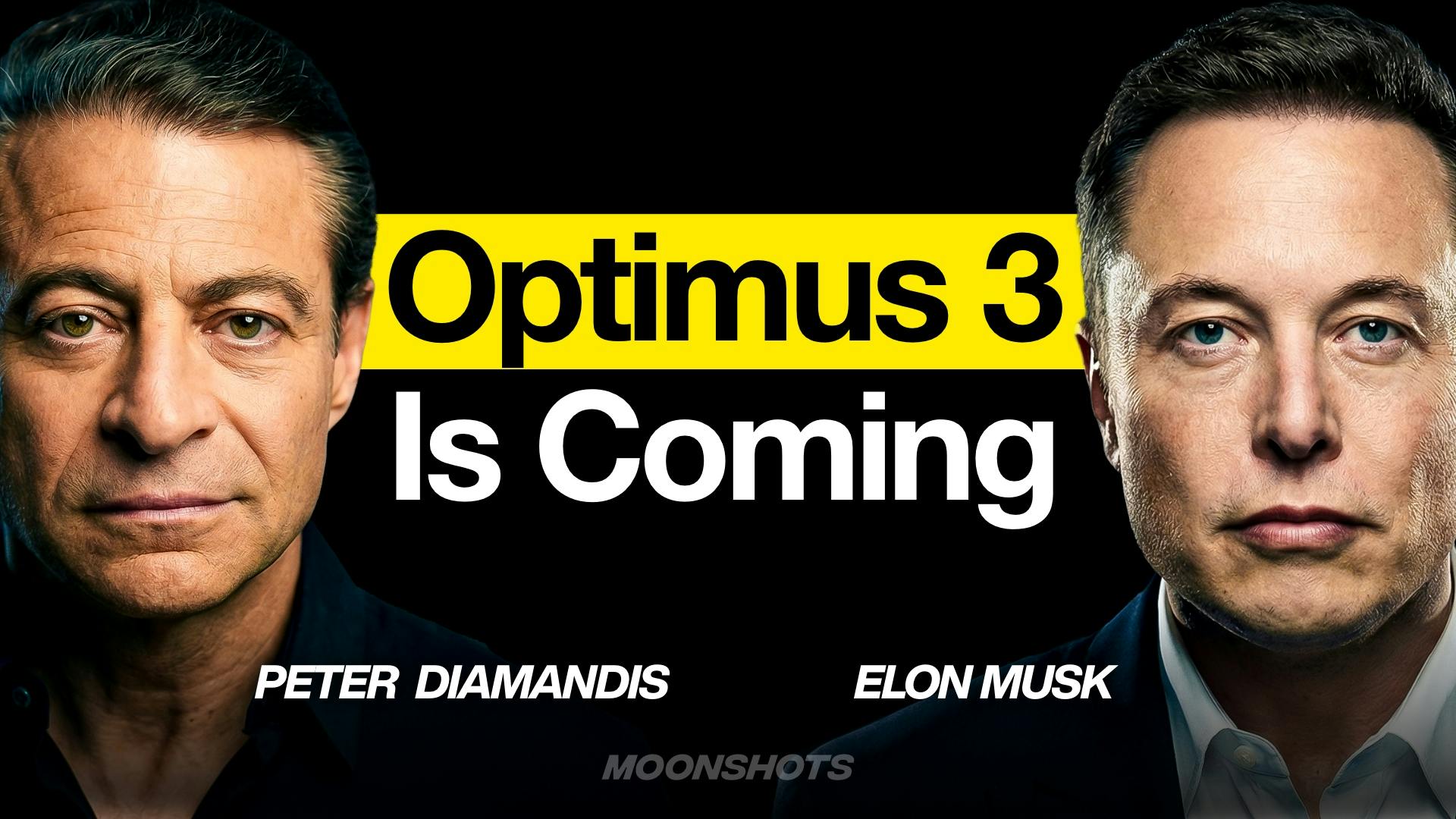
Elon Musk: Optimus 3 Is Coming, Recursive Self-Improvement Is Already Here, and the Singularity | #239
- 🗓️ Date:
2026-03-17| 🎙️ Show:Moonshots
Musk says recursive improvement is already in the hard takeoff, with full automation possible by the end of this year or next year, while Grok 4.20 remains behind on coding. Optimus 3 production is expected this summer, scaling around next summer as Tesla targets a roughly 10 million-square-foot factory and higher output per employee. The upside is a potential 10X economy within roughly 10 years, but Musk still assigns only approximately 80% or higher probability to the great outcome.
View Dialogue Notes & Transcript Memo
Interview Summary & Key Takeaways: Musk says recursive improvement is already in the hard takeoff, with full automation possible by the end of this year or next year, while Grok 4.20 remains behind on coding. Optimus 3 production is expected this summer, scaling around next summer as Tesla targets a roughly 10 million-square-foot factory and higher output per employee. The upside is a potential 10X economy within roughly 10 years, but Musk still assigns only approximately 80% or higher probability to the great outcome.
- 🔗 Original source & video: Elon Musk: Optimus 3 Is Coming, Recursive Self-Improvement Is Already Here, and the Singularity | #239
- 📝 Transcript Status: Core insights and takeaways summarized. Full runtime is approx 45-90 mins.
View Dialogue Notes & Key Takeaways
Key Takeaways: Musk says recursive improvement is already in the hard takeoff, with full automation possible by the end of this year or next year, while Grok 4.20 remains behind on coding. Optimus 3 production is expected this summer, scaling around next summer as Tesla targets a roughly 10 million-square-foot factory and higher output per employee. The upside is a potential 10X economy within roughly 10 years, but Musk still assigns only approximately 80% or higher probability to the great outcome.
- 🔗 Original source & video: Elon Musk: Optimus 3 Is Coming, Recursive Self-Improvement Is Already Here, and the Singularity | #239
Elon Musk – “In 36 months, the cheapest place to put AI will be space”
- 🗓️ Date:
2026-02-05| 🎙️ Show:Dwarkesh Podcast
Musk predicts space will be the cheapest place to put AI within 30-36 months, as terrestrial electricity stays flat while orbit delivers roughly 5x solar power without batteries. Gas turbines are sold out through 2030, making power the near-term bottleneck before chips; TeraFab, SpaceX’s hyperscaler ambition, and xAI’s MacroHard remain contingent on execution and China’s industrial lead.
View Dialogue Notes & Transcript Memo
Interview Summary & Key Takeaways: Musk predicts space will be the cheapest place to put AI within 30-36 months, as terrestrial electricity stays flat while orbit delivers roughly 5x solar power without batteries. Gas turbines are sold out through 2030, making power the near-term bottleneck before chips; TeraFab, SpaceX’s hyperscaler ambition, and xAI’s MacroHard remain contingent on execution and China’s industrial lead.
- 🔗 Original source & video: Elon Musk – “In 36 months, the cheapest place to put AI will be space”
- 📝 Transcript Status: Core insights and takeaways summarized. Full runtime is approx 45-90 mins.
View Dialogue Notes & Key Takeaways
Key Takeaways: Musk predicts space will be the cheapest place to put AI within 30-36 months, as terrestrial electricity stays flat while orbit delivers roughly 5x solar power without batteries. Gas turbines are sold out through 2030, making power the near-term bottleneck before chips; TeraFab, SpaceX’s hyperscaler ambition, and xAI’s MacroHard remain contingent on execution and China’s industrial lead.
- 🔗 Original source & video: Elon Musk – “In 36 months, the cheapest place to put AI will be space”
Elon Musk on AGI Timeline, US vs China, Job Markets, Clean Energy & Humanoid Robots | 220
- 🗓️ Date:
2026-01-06| 🎙️ Show:Moonshots
Musk forecasts AGI in 2026 and intelligence exceeding all humans combined by 2030, with capability improving roughly 10× per year, while electricity—not chips—constrains near-term deployment. xAI’s 1 GW buildout, China’s projected threefold US electricity output in 2026, and Colossus 2’s 1.5 GW target frame an immediate infrastructure race before possible labor and price deflation.
View Dialogue Notes & Transcript Memo
Interview Summary & Key Takeaways: Musk forecasts AGI in 2026 and intelligence exceeding all humans combined by 2030, with capability improving roughly 10× per year, while electricity—not chips—constrains near-term deployment. xAI’s 1 GW buildout, China’s projected threefold US electricity output in 2026, and Colossus 2’s 1.5 GW target frame an immediate infrastructure race before possible labor and price deflation.
- 🔗 Original source & video: Elon Musk on AGI Timeline, US vs China, Job Markets, Clean Energy & Humanoid Robots | 220
- 📝 Transcript Status: Core insights and takeaways summarized. Full runtime is approx 45-90 mins.
View Dialogue Notes & Key Takeaways
Key Takeaways: Musk forecasts AGI in 2026 and intelligence exceeding all humans combined by 2030, with capability improving roughly 10× per year, while electricity—not chips—constrains near-term deployment. xAI’s 1 GW buildout, China’s projected threefold US electricity output in 2026, and Colossus 2’s 1.5 GW target frame an immediate infrastructure race before possible labor and price deflation.
- 🔗 Original source & video: Elon Musk on AGI Timeline, US vs China, Job Markets, Clean Energy & Humanoid Robots | 220
Elon Musk: A Different Conversation w/ Nikhil Kamath | People by WTF Ep. 16
- 🗓️ Date:
2025-11-30| 🎙️ Show:People by WTF
Musk forecasts that AI and robotics could make work optional within 10 or 15 years, and deflation could arrive in roughly three years as output outpaces money-supply growth. He sees value concentrating in AI, robotics, spaceflight and scarce live events, with scaled Optimus production hopefully next year as a catalyst, while the timelines remain explicitly hedged.
View Dialogue Notes & Transcript Memo
Interview Summary & Key Takeaways: Musk forecasts that AI and robotics could make work optional within 10 or 15 years, and deflation could arrive in roughly three years as output outpaces money-supply growth. He sees value concentrating in AI, robotics, spaceflight and scarce live events, with scaled Optimus production hopefully next year as a catalyst, while the timelines remain explicitly hedged.
- 🔗 Original source & video: Elon Musk: A Different Conversation w/ Nikhil Kamath | People by WTF Ep. 16
- 📝 Transcript Status: Core insights and takeaways summarized. Full runtime is approx 45-90 mins.
View Dialogue Notes & Key Takeaways
Key Takeaways: Musk forecasts that AI and robotics could make work optional within 10 or 15 years, and deflation could arrive in roughly three years as output outpaces money-supply growth. He sees value concentrating in AI, robotics, spaceflight and scarce live events, with scaled Optimus production hopefully next year as a catalyst, while the timelines remain explicitly hedged.
- 🔗 Original source & video: Elon Musk: A Different Conversation w/ Nikhil Kamath | People by WTF Ep. 16
Elon Musk: OpenAI Betrayal, His Future at Tesla, and the Next Big Thing — Grokipedia
- 🗓️ Date:
2025-10-31| 🎙️ Show:All-In
Grok is moving X toward semantic ranking and search across text, images, and video, initially processing the top 10 million of roughly 100 million daily posts. Grokipedia’s broader, maximally truth-seeking corpus remains unproven amid factual errors, while Tesla’s Cybercab, Optimus, and inference ambitions depend on safety gates and Musk retaining roughly 25% voting influence.
View Dialogue Notes & Transcript Memo
Interview Summary & Key Takeaways: Grok is moving X toward semantic ranking and search across text, images, and video, initially processing the top 10 million of roughly 100 million daily posts. Grokipedia’s broader, maximally truth-seeking corpus remains unproven amid factual errors, while Tesla’s Cybercab, Optimus, and inference ambitions depend on safety gates and Musk retaining roughly 25% voting influence.
- 🔗 Original source & video: Elon Musk: OpenAI Betrayal, His Future at Tesla, and the Next Big Thing — Grokipedia
- 📝 Transcript Status: Core insights and takeaways summarized. Full runtime is approx 45-90 mins.
View Dialogue Notes & Key Takeaways
Key Takeaways: Grok is moving X toward semantic ranking and search across text, images, and video, initially processing the top 10 million of roughly 100 million daily posts. Grokipedia’s broader, maximally truth-seeking corpus remains unproven amid factual errors, while Tesla’s Cybercab, Optimus, and inference ambitions depend on safety gates and Musk retaining roughly 25% voting influence.
- 🔗 Original source & video: Elon Musk: OpenAI Betrayal, His Future at Tesla, and the Next Big Thing — Grokipedia
Joe Rogan Experience #2404 - Elon Musk
- 🗓️ Date:
2025-10-31| 🎙️ Show:The Joe Rogan Experience
Starship’s promised full reusability next year could cut space-access costs 100x or more, while SpaceX already carries roughly 90% of Earth’s orbital mass. Musk sees AI and robotics as the only route beyond America’s debt burden, toward universal high income, but expects severe labor disruption before that outcome. Tesla’s Roadster prototype is expected hopefully before year-end, while XChat may launch as a standalone app in a few months and phones could become AI inference edge nodes within five or six years.
View Dialogue Notes & Transcript Memo
Interview Summary & Key Takeaways: Starship’s promised full reusability next year could cut space-access costs 100x or more, while SpaceX already carries roughly 90% of Earth’s orbital mass. Musk sees AI and robotics as the only route beyond America’s debt burden, toward universal high income, but expects severe labor disruption before that outcome. Tesla’s Roadster prototype is expected hopefully before year-end, while XChat may launch as a standalone app in a few months and phones could become AI inference edge nodes within five or six years.
- 🔗 Original source & video: Joe Rogan Experience #2404 - Elon Musk
- 📝 Transcript Status: Core insights and takeaways summarized. Full runtime is approx 45-90 mins.
View Dialogue Notes & Key Takeaways
Key Takeaways: Starship’s promised full reusability next year could cut space-access costs 100x or more, while SpaceX already carries roughly 90% of Earth’s orbital mass. Musk sees AI and robotics as the only route beyond America’s debt burden, toward universal high income, but expects severe labor disruption before that outcome. Tesla’s Roadster prototype is expected hopefully before year-end, while XChat may launch as a standalone app in a few months and phones could become AI inference edge nodes within five or six years.
- 🔗 Original source & video: Joe Rogan Experience #2404 - Elon Musk
Elon Musk on DOGE, Optimus, Starlink Smartphones, Evolving with AI, Why the West is Imploding
- 🗓️ Date:
2025-09-10| 🎙️ Show:All-In
Optimus Version 3 targets human-level dexterity, reality-navigating AI and million-unit manufacturing, with estimated production costs of $20,000-$25,000 and no existing humanoid supply chain. Tesla’s AI5, Starlink’s roughly two-year handset transition and Starship’s fully reusable heat shield create distinct execution catalysts, while demand, integration and technical reliability remain unresolved.
View Dialogue Notes & Transcript Memo
Interview Summary & Key Takeaways: Optimus Version 3 targets human-level dexterity, reality-navigating AI and million-unit manufacturing, with estimated production costs of $20,000-$25,000 and no existing humanoid supply chain. Tesla’s AI5, Starlink’s roughly two-year handset transition and Starship’s fully reusable heat shield create distinct execution catalysts, while demand, integration and technical reliability remain unresolved.
- 🔗 Original source & video: Elon Musk on DOGE, Optimus, Starlink Smartphones, Evolving with AI, Why the West is Imploding
- 📝 Transcript Status: Core insights and takeaways summarized. Full runtime is approx 45-90 mins.
View Dialogue Notes & Key Takeaways
Key Takeaways: Optimus Version 3 targets human-level dexterity, reality-navigating AI and million-unit manufacturing, with estimated production costs of $20,000-$25,000 and no existing humanoid supply chain. Tesla’s AI5, Starlink’s roughly two-year handset transition and Starship’s fully reusable heat shield create distinct execution catalysts, while demand, integration and technical reliability remain unresolved.
- 🔗 Original source & video: Elon Musk on DOGE, Optimus, Starlink Smartphones, Evolving with AI, Why the West is Imploding
Joe Rogan Experience #2281 - Elon Musk
- 🗓️ Date:
2025-02-28| 🎙️ Show:The Joe Rogan Experience
Musk reframes DOGE as a threat to bureaucracy, citing a federal government losing $2 trillion a year and failing its own audits, while Treasury’s PAM system moves roughly $5T annually through payments lacking categorization codes or descriptions. Mandatory documentation now being implemented could, by his guess, save $100 billion a year, while Starship’s unresolved orbital heat-shield problem remains the bottleneck to reusability targeted this year and rapid full-stack reuse next year.
View Dialogue Notes & Transcript Memo
Interview Summary & Key Takeaways: Musk reframes DOGE as a threat to bureaucracy, citing a federal government losing $2 trillion a year and failing its own audits, while Treasury’s PAM system moves roughly $5T annually through payments lacking categorization codes or descriptions. Mandatory documentation now being implemented could, by his guess, save $100 billion a year, while Starship’s unresolved orbital heat-shield problem remains the bottleneck to reusability targeted this year and rapid full-stack reuse next year.
- 🔗 Original source & video: Joe Rogan Experience #2281 - Elon Musk
- 📝 Transcript Status: Core insights and takeaways summarized. Full runtime is approx 45-90 mins.
View Dialogue Notes & Key Takeaways
Key Takeaways: Musk reframes DOGE as a threat to bureaucracy, citing a federal government losing $2 trillion a year and failing its own audits, while Treasury’s PAM system moves roughly $5T annually through payments lacking categorization codes or descriptions. Mandatory documentation now being implemented could, by his guess, save $100 billion a year, while Starship’s unresolved orbital heat-shield problem remains the bottleneck to reusability targeted this year and rapid full-stack reuse next year.
- 🔗 Original source & video: Joe Rogan Experience #2281 - Elon Musk