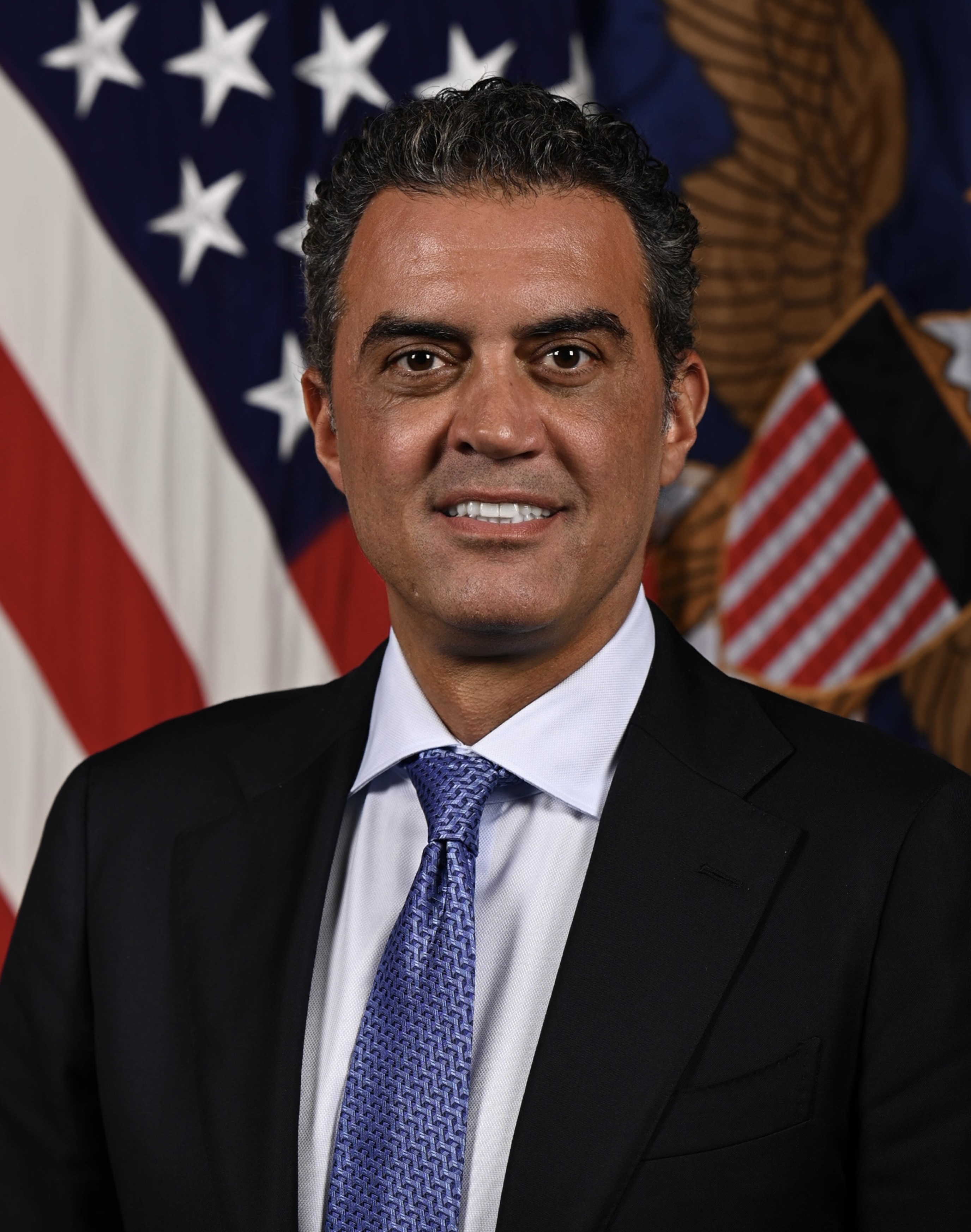
Emil Michael
Frontier Insights
Core Frontier Thesis
Real-world operational loops now dictate technological supremacy. In enterprise software, cheap inference and sub-second latency convert models into autonomous action layers; in defense, warfare shifts to rapid-iteration, low-cost drone swarms and agile domestic manufacturing.
Strategic Decisions
Capitalize on controlled agent execution across critical workflows to build compounding feedback loops. Concurrently, mandate multi-model redundancy and sovereign infrastructure within defense procurement to break vendor lock-in.
Risks & Warnings
Dual-front vulnerabilities loom: civilian agents face catastrophic impersonation and data fraud, while military AI faces severe operational sabotage if model control planes remain tethered to activist AI labs.
Key Views & Dialogues
War with Iran + Pentagon vs Anthropic with Under Secretary of War Emil Michael
- 🗓️ Date:
2026-03-06| 🎙️ Show:All-In
Iran is framed as a “weeks, not months” disarmament campaign, while disrupting Iranian and Venezuelan oil flows could create leverage over China in a broader April grand bargain. Defense procurement is shifting toward fixed-price, mass-attritable systems—LUCAS drones cost roughly $50,000-$80,000—while the Anthropic rupture underscores model-control risk and the need for multi-model redundancy, domestic inputs and manufacturing capacity.
View Dialogue Notes & Key Takeaways
The episode’s strategic thesis is that Iran is a short disarmament campaign, while leverage over China is the larger geopolitical prize. Emil Michael described a “weeks, not months” operation aimed at Iran’s nuclear, missile, drone and proxy-supply capacity, with “no scenario” resembling Afghanistan or Iraq. Friedberg and Chamath argued that removing Iranian and Venezuelan oil from China’s reach could strengthen an April grand bargain; Chamath characterized China leverage as a second-order benefit rather than the stated mission.
Michael credits recent operational success to experienced commanders, overwhelming force, refreshed war plans and looser rules of engagement—not one secret weapon. He said roughly 100 personnel entered Venezuela’s most fortified compound, extracted the president and his wife and left with no KIAs, while plans such as Midnight Hammer had been prepared years earlier. The doctrine is closer to Colin Powell’s: “go all in, have a clear objective, come out.”
Drones, autonomy and directed energy are turning defense procurement toward cheap, expendable mass. Michael priced long-range LUCAS one-way attack drones at roughly $50,000-$80,000, versus multibillion-dollar legacy platforms, and cited Ukraine estimates that drones cause 70% of casualties. The end state is “drone swarms controlled by AI,” but autonomy will be deployed scenario by scenario: missing a hostile drone with a laser is categorically different from operating in a dense civilian area.
The Pentagon-Anthropic rupture makes AI-vendor sovereignty a board-level risk for governments and companies. Michael said Anthropic’s contracts restricted strike planning, satellite movement and other mission uses, while the company retained the model’s control plane in AWS GovCloud; after an executive asked whether Anthropic software had supported the Maduro raid, Pentagon leaders feared refusals, shutdowns or model interference during combat. His required standard is simple: “all lawful use.”
The investment implication is multi-model architecture, because model quality may converge while policy, reliability and price do not. Google and Grok accepted the Pentagon’s lawful-use standard, while OpenAI moved to provide redundancy and Sam Altman tried to mediate. Calacanis said his software company’s AI operating costs had more than tripled since November 2025, yet still saw Anthropic potentially reaching a $1.5 trillion valuation from a roughly $350 billion mark if the dispute does not derail adoption.
Hormuz risk is transmitting through insurance before physical oil losses fully arrive. With oil at $84, supertanker traffic reportedly down 94%, 3.3 million barrels of daily production at risk and war-risk premiums jumping from 0.25% to 1.25%, Friedberg explained that leveraged shipowners cannot sail once coverage disappears. He called federal political-risk insurance a “brilliant move” that could keep trade moving and seed a US maritime-insurance industry.
The investable defense bottleneck is shifting from venture funding to contracts, domestic inputs and manufacturing capacity. Defense-tech venture capital is already about 3x last year’s level, Michael said; the Pentagon now needs startups to win large contracts quickly while a $200 billion lending authority supports solid-rocket motors, batteries, fiberglass and critical minerals at roughly Treasuries plus 100 basis points. His procurement goal is to replace cost-plus requirement sprawl with fixed-price, performance-driven buying of “mass-attritable, low-cost” systems.
🔗 Original source & video: War with Iran + Pentagon vs Anthropic with Under Secretary of War Emil Michael
No Priors Ep. 10 | With Copilot’s Chief Architect and founder of Minion.AI Alex Graveley
- 🗓️ Date:
2026-01-15| 🎙️ Show:No Priors
GitHub Copilot improved in-the-wild test performance from fewer than 10% to more than 60%, while inference cost fell from $30 to $10 per user monthly. Ghost-text block completion and lower latency drove acceptance and retention, as Alex Graveley’s next catalyst is controlled agents taking real-world actions.
View Dialogue Notes & Key Takeaways
GitHub Copilot advanced from passing fewer than 10% of in-the-wild tests to more than 60%, showing how Alex Graveley’s team improved a weak model through evaluation, prompting, code data, historical versions, diffs, and scale. Alex emphasized that the early results were not a reason to conclude the approach was impossible: “the crazy thing is that these things work at all,” and they can improve as they scale.
Copilot’s key product breakthroughs were ghost-text block completion and extreme latency reduction, rather than a conventional question-and-answer interface. Programmers could judge a completed block quickly and press Tab; Alex recalled a “crazy” statistic that every additional 10 milliseconds meant roughly 1% fewer accepted completions. Poor results in India traced to requests traveling through Europe to OpenAI’s Texas data center.
The economics improved faster than expected: estimated inference cost fell from $30 per user per month to $10 and then lower, while weekly-cohort retention remained above 50% months after launch. Alex pushed for low pricing and market capture. Elad framed 40% of a user’s code as not much at that price, while Alex said some “whales” have Copilot write 80% of their code.
The next platform shift Alex described is from AI that answers questions to agents that take controlled actions. Minion targets scheduling, travel, taxes, and identifying neglected contacts—“Copilot applied to everyday activities”—with Alex saying he thinks “file my taxes” can become feasible within the next few years.
Real-world action can provide an observable feedback loop. Code is unusually valuable because it can be run; similarly, web actions reveal success, failure, and annoyance. Alex also sees people’s clicks on the web as a gigantic, currently “unowned” dataset.
Alex sees near-term AI risk primarily in fraud and malicious use, not machines autonomously killing humanity. He forecasts “many years of extreme discomfort” involving impersonation and stolen savings, and argues for anti-abuse systems and legislation rather than expecting OpenAI to solve everything. He cited spam blockers, account filtering, and fingerprinting; Elad noted that agents can absorb some messaging costs, while Emil pointed to traceable bank accounts and compared the threat to a better-resourced or more distributed North Korea.
Alex described AI-native product intuition as bimodal: very senior builders and very young or naive people often see the potential, while the experiential middle may reject it. The reusable traits are experimentation, metric selection, intuition, and tenacity after failed attempts. He is interested in what emergent properties may appear if “these things” become 10 times bigger, comparing the exploration to building the Large Hadron Collider.
🔗 Original source & video: No Priors Ep. 10 | With Copilot’s Chief Architect and founder of Minion.AI Alex Graveley