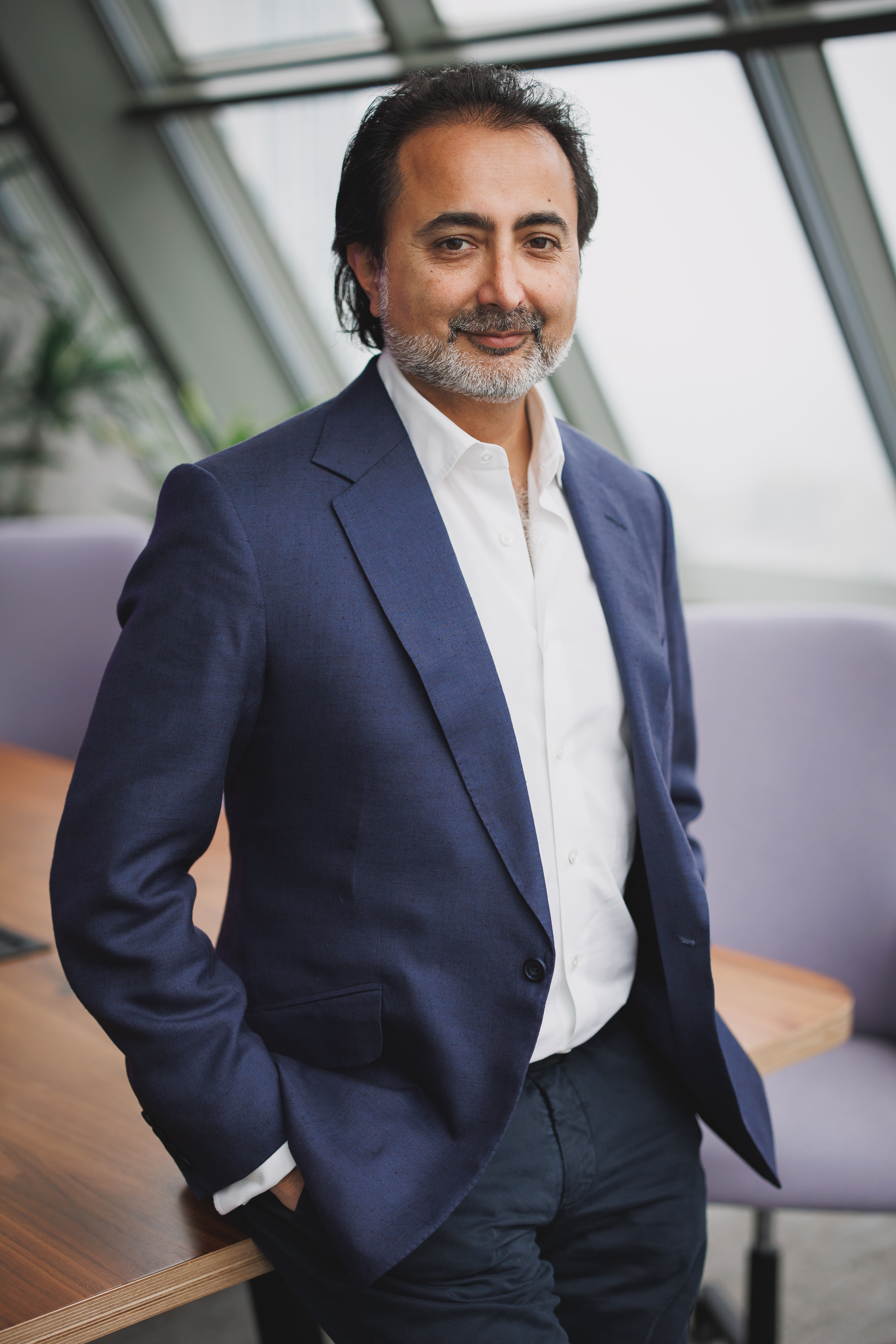
Hemant Taneja
Frontier Insights
Hemant Taneja (General Catalyst) Frontier Thesis & Strategy:
Frontier Thesis: AI is not mere software automation; it is an industrial upheaval driving domestic reshoring, workforce restructuring, and hyper-compressed product cycles where scale aggressively concentrates into outliers like Anthropic and Nvidia.
Strategic Playbook: GC caps fund sizes to protect 4–5x returns while deploying multi-tier capital products. As legacy software multiples collapse (15x to 3x), value shifts from debt-laden incumbents to AI-native workflows, robotics, physical manufacturing, and deep enterprise transformation.
Risks & Constraints: Plummeting model durability, debt maturities, hardware unit economics, fragmented state-level regulation, and massive displacement of entry-level labor.
Key Views & Dialogues
General Catalyst’s First-Ever Quarterly Review | CEO Hemant Taneja
- 🗓️ Date:
2026-04-20| 🎙️ Show:Sourcery
Anthropic is adding $10 billion of revenue a month and NVIDIA added $1 trillion of market cap in 100 days, highlighting AI-era scale concentration. GC’s counter-bet spans seed, Creation, and Customer Value Fund strategies, while 15x-to-3x revenue-multiple compression could leave even doubled-EBITDA software equity unrecovered. Leverage coming due in the next five years makes AI transformation opportunities and durability uncertainty key variables to monitor.
View Dialogue Notes & Key Takeaways
Taneja’s core thesis is that AI-era scale will gravitationally concentrate into a handful of trillion-dollar companies, and General Catalyst exists to counter that pull. Citing Anthropic adding $10 billion of revenue a month and NVIDIA adding $1 trillion of market cap in 100 days, he argues that concentration can bring instability because society will reject it. GC’s job is empowering founders to build “parallel companies that essentially create a counter-concentration architecture” — the through-line uniting its seed fund, creation strategy, and Customer Value Fund.
His software-buyout thesis is that traditional terminal-value math is breaking down. If multiples compress from 15x revenue to 3x, a PE-owned company can double EBITDA and still never recover its equity; with heavy leverage “coming due in these PE-backed companies in the next five years… many of those companies, the equity value will certainly not exist. Some of them may not even recover their debt.” In a world “where code is self-writing,” paying 30x free cash flow assumes 30 years of durability that is increasingly difficult to underwrite.
The distress is already an opportunity: “you’re already seeing venture capital gobbling up PE businesses.” GC’s Creation team, including Mark and Madhu, is “buying them for not a lot, and we’ll arb them into AI transformation” — the same logic behind its AI roll-up thesis: “everywhere we offshored for labor productivity, we’re now onshoring back with AI.” He read Vista’s $250 million software buyout debt fund as “small” toe-dipping that could become a larger strategy.
On bubble management, GC’s discipline is proactive marking: it wrote its portfolio down 40% during COVID “for no other reason than saying, ‘This is not real.’” After the ChatGPT moment, it went back company by company to determine “the actual reality” it believed in and course-correct portfolio NAV. Taneja insists “it doesn’t matter if there’s a bubble or not. Bubbles are actually great for us” — inflated paper gains “screw with your mind as investors” and affect LP capital planning. GC also sold part of its GP economics to Petershill in 2018 to fund scaling, then bought that relationship back a couple of years ago.
Three years after ChatGPT, he says the AI value map has clarified into an investable stack: AI clouds (Together AI), frontier models (Anthropic “came from behind but has strong leadership”), sovereignty plays (Mistral in Europe), and applied roll-ups. The tell on velocity: GC’s 15-month-old Percepta engineering team told him “literally almost everything” changed in how software is built — “think about the rest of the world that needs to get their arms around this technology.”
Global resilience, not American dynamism, is GC’s geographic bet: “global TAM, last I checked, was bigger than the American TAM,” and geopolitics means “defense primes are gonna emerge everywhere.” GC invested in Anduril’s seed round, Helsing’s seed round, and Rafa in India. Taneja and Neeraj committed $5 billion over five years to India’s resilience opportunity — not a separate fund — while GC also bought Summa hospital in Akron, Ohio, to build an “AI-native hospital” as a model for “health assurance.”
On Anthropic’s Pentagon standoff and Mythos, he refuses the binary: “I cannot say the perspectives on either side were wrong.” He credits Dario for giving the model to companies first to “eliminate security debt” before release, and challenges critics: “I thought we were accelerationists in this group.” The investment implication, hedged but stark: “the uncertainty of what’s durable or not is just stunning right now.”
The rumored GC IPO gets a flat, categorical denial: “We’re not going public. I’ve said it many times.” Nikesh Arora just joined as a lead director to mentor the firm, and Taneja pushes back on Silicon Valley’s glorification of the “asshole symptom” among founders: “kindness and ambition are not at odds with each other.”
🔗 Original source & video: General Catalyst’s First-Ever Quarterly Review | CEO Hemant Taneja
Why AI will dwarf every tech revolution before it: robots, manufacturing, AR glasses from CES 2026
- 🗓️ Date:
2026-01-08| 🎙️ Show:All-In
AI is compressing product cycles and organizational change, with Anthropic moving from roughly $880 million after one 10x year toward another announced 10x-or-more year and McKinsey pairing 25% client-facing growth with a 25% non-client-facing reduction. Enterprise value depends on data infrastructure, redesigned human-agent workflows, and distribution through incumbent assets, while robotics faces slower hardware diffusion; falling entry-level demand, manufacturing constraints, and the race toward verticalized applications are the catalysts to watch.
View Dialogue Notes & Key Takeaways
AI is compressing product cycles and value creation enough to dwarf the PC, internet, cloud, and mobile eras. Bob Sternfels calls the pace “literally warp speed,” while Hemant Taneja describes “peak ambiguity”: technology capabilities and geopolitical conditions are changing simultaneously, making organizational speed more important than fixed plans.
Anthropic is the episode’s clearest specimen of this compression. Taneja says the business was doing roughly $880 million when General Catalyst invested, after 10x growth, and later announced another 10x-or-more year. He framed the $60 billion valuation against an approximately $8 billion-$10 billion run-rate business as “the cheapest deal that got done last year” on financial metrics. Venture investors must now consider whether trillion-dollar companies are plausible.
Enterprise adoption and IT spending can drive model-company growth, but nontechnology companies are still struggling to realize value at scale. Calacanis dramatizes the CFO-CIO conflict: one sees spending without ROI, while the other warns that delay invites disruption. Sternfels sees a path to make them allies; Taneja points to data infrastructure, adapted models, and redesigned human-agent workflows rather than isolated pilots.
General Catalyst is buying some declining incumbents as transformation and distribution infrastructure for AI startups. Taneja describes the firm as “venture capital for America,” meeting founders at different stages with flexible capital, policy capabilities, and market access. Its Ohio health-system acquisition provides a site to deploy AI and demonstrate a healthcare playbook; declining call-center assets can similarly provide access to customers. Sternfels calls this a new asset class: transformation rather than conventional private-equity optimization.
AI is splitting headcount growth, output, and organizational layers rather than shrinking every role uniformly. At McKinsey, Sternfels says client-facing staff will grow 25% next year while the non-client-facing half of the firm shrinks 25% and increases output 10%. With 40,000 humans and 25,000 personalized agents—and expected parity by year-end—the firm is simultaneously adding and shrinking.
The entry-level labor market is losing its old training bargain, making initiative and human judgment more valuable. Calacanis says graduates sending 100-200 résumés may receive no offers because training someone can take longer than building an agent; he recommends direct outreach and useful spec work demonstrating “chutzpah,” drive, and skill. The panel places human value in leadership and goal-setting, judgment and parameter-setting, creativity, curiosity, and resilience.
Physical AI will be constrained as much by manufacturing economics as by model intelligence. Sternfels expects a major autonomous-vehicle transformation over the next 12-24 months and cites 50,000 unfilled U.S. manufacturing jobs at one contract manufacturer, while Taneja warns robotics will diffuse more slowly than LLMs because there is no equivalent hardware API. Calacanis nevertheless predicts Tesla’s Optimus 3 will eclipse its cars, reach billion-unit scale, and become “the most transformative technology product ever made.”
Today’s awkward interfaces may be transition products toward continuous health intelligence and less intrusive computing. Google Glass had an early AR direction but insufficient utility; Taneja sees wearables, blood testing, and tiny-volume diagnostics as possible precursors to customized medicine. Calacanis compares LLM hallucinations to a Discman’s skipping. Sternfels’s broader behavioral bet is renewed in-person connection rather than trying to be fulfilled online while lonely offline.
🔗 Original source & video: Why AI will dwarf every tech revolution before it: robots, manufacturing, AR glasses from CES 2026
General Catalyst CEO, Hemant Taneja: Lessons Scaling GC to $40BN in AUM
- 🗓️ Date:
2025-09-22| 🎙️ Show:20VC
General Catalyst CEO Hemant Taneja is concentrating venture around few companies while adding a few hundred million to Anthropic at $60B and again at $180B, a 5x oversubscribed round. He cites roughly 20x ARR versus peers at 50-100x, while model durability remains highly unclear; GC caps venture funds to deliver four to 5x and routes scale into creation and customer-value vehicles.
View Dialogue Notes & Key Takeaways
The Anthropic call: GC put “a few hundred million” in at the $60B round less than a year ago — revenue then “under a billion,” publicly guided to grow ~9x — and did it again at $180B, a round 5x oversubscribed. Taneja’s math: at ~20x ARR versus peers raising at “50 to 100 times,” it was “the cheapest round that got done this year on a multiple basis,” and if next year’s revenue lands near $27B, the same multiple makes it “a half a trillion dollar company by the end of next year.”
Core doctrine, stated flat: “venture capital can’t scale and performance at the same time” — more money doesn’t create more Patrick Collisons. So GC caps venture funds at a size that can “deliver four to 5x,” routes scale into creation and customer-value vehicles, and defines winning as the biggest AUM from the fewest companies — Chanel, not Walmart.
Stripe is the template: seeded 2010, invested 14 times in 15 years, roughly $1B in for a sub-10% stake worth over $5B — “I think Stripe’s going to be a trillion dollar company… probably a 25-year hold.” The corollary sin is under-doubling: he told a GC partner sitting on a decacorn, “you’re going to make over a billion dollars on this investment and you’re an idiot — you gave up making the second billion.”
Jobs are the under-priced macro: “everywhere you offshored for labor benefit, you’re going to onshore for AI productivity” — GC says it bought a 3,000-person Philippine call center in a company called Crescendo on that thesis. It’s “a 5-year problem,” not 12-18 months; one consulting client asked for a plan to reach 100,000 employees “but only 10,000 of them are humans.” Governments comfort themselves society will slow it down; Harry adds, “I don’t think we have time.”
Growth bar reset: “Triple triple double double is definitely dead. I tell our investors don’t bring that to me… you got to go like 1 to 15 to 20 to 100” — Mercor went 1→500M in 17 months. The unresolved variable is durability: “we never had so much scale without just taking durability for granted,” and some of the fastest growers “will also not be around.”
OpenAI post-mortem: he passed on the structure and regrets it daily — but the dilution math illustrates the toll: per Harry’s cited chart, the $200M invested at the $1B valuation returned only ~25x, versus “hundreds of x” for GC’s best first checks. Microsoft “maybe took more risk,” made the highest multiple on ~$20B — and Harry said Microsoft now uses Anthropic for the majority of its suite.
His biggest change of mind is indexing over picking: “when you know the trend’s going to win, but you don’t know which one’s going to win, you’re better off backing all of them” — he did Stripe but skipped Square, tried to pick the winner in AI, and says “in hindsight we should have just gone and indexed,” as he cited likely Yuri Milner and likely Lightspeed doing.
Price discipline is usually a conviction tell: “Price only hurts once”; “investors use price as a reason to pass because they couldn’t gain conviction elsewhere — it just makes them sound pragmatic.” Returns come from concentration: of 200+ investments over 25 years, ~60-70% of returns sit in about 10 companies.
🔗 Original source & video: General Catalyst CEO, Hemant Taneja: Lessons Scaling GC to $40BN in AUM