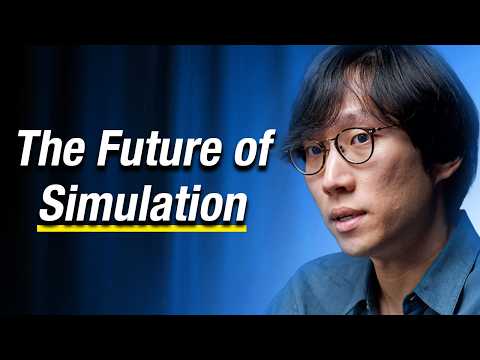
Joon Sung Park
Frontier Insights
Core Thesis: Simile treats human simulation as AI’s next frontier, asserting scaling laws hold: causal, behavioral data unlocks predictable fidelity (85% replication vs. 20–30% in frontier LLMs), compressing months of enterprise research into minutes.
Strategic Bets: Aggressive post-training and capital deployment ($300M in 6 months) to build defensive causal datasets that simulate the macroeconomy via digital twins.
Risks & Unit Economics: Massive compute overhang—inference costs rival foundation model training. The model only survives if $10M–$20M simulation runs generate >$100M in enterprise decision value within an unproven TAM.
Key Views & Dialogues
Simulating Humanity: from Generative Agents to 8 Billion Digital Twins — Joon Sung Park, Simile AI
- 🗓️ Date:
2026-08-21| 🎙️ Show:Latent Space
Simile reports an early glimpse of a simulation scaling law, with more human data and compute producing predictable performance gains. A validated 1,000-person study reached 85% behavior-and-attitude replication versus frontier models’ 20–30% on niche populations, while preregistered-experiment post-training delivered significant gains; current deployments aim to shape decisions, though TAM and future foundation-model-scale costs remain unresolved.
View Dialogue Notes & Key Takeaways
Joon Sung Park’s headline claim is that simulation has its own scaling law: “The more data about humans and more compute you ingest, you start to get predictable gains in model performance” when simulating and predicting people. Simile post-trains its own models and is seeing “an early glimpse” of this curve.
The core moat argument: Park contrasts generative models’ emphasis on “super-rational, objective machines” with Simile’s need for models “as dumb as I am”—models that make the same mistakes humans make. Web-trained models contain fundamentally self-exposed attitudinal data, with some behavioral data sprinkled in, rather than the “dark knowledge of humanity”—what people actually do. On niche populations, Park says frontier-model behavior prediction falls to 20–30% (50–60% on the general population), versus Simile’s validated benchmark of replicating people’s attitudes and behaviors with 85% accuracy, “about as accurately as people could replicate their own.”
The validation asset is the “Generative Agent Simulations of 1,000 People” paper: 1,000 representatively sampled Americans, two hours of data collection, digital twins tested two weeks later against surveys, Big Five, behavioral-economics games, the General Social Survey and published RCTs. A follow-up showed post-training on tens of thousands of preregistered experiments from the Open Science Foundation platform delivers significant further gains—causal, randomized-controlled-trial data is the scarcest and most valuable input because “the world is our ground truth, but it happens once.”
The product pitch is simulation as a tool for shaping outcomes, not predicting them: “It doesn’t really help you to hear that your sales are going to tank in two quarters… What they want to know is, well, what do we need to do now to avoid that future?” His Foundation/psychohistory discussion—the counterintuitive first move of exiling the scientists to Terminus—illustrates why step-by-step causal simulation beats point forecasts, e.g., an EV marketing plan that lifts EV sales but makes overall auto sales go down.
On TAM, Park explicitly rejects the $100B market-research framing: “Simulation is not a tool for market research. Simulation is a tool for human decision-making.” Current deployment includes concept testing, focus groups, simulated earnings calls for public companies, and a Gallup strategic partnership; Simile collects data from tens of thousands of people weekly and has panel partnerships reaching tens of millions globally. Collected panelists are reusable across studies because traits like risk tolerance “don’t really change over time.”
Maturity marker for investors: Park says the simulation industry feels like where GPT-3.5 and GPT-4 were for the AGI saga—powerful enough to do real damage in current verticals, with aggressive scaling still ahead. His hunch is that simulations will eventually “cost as much as training a foundation model,” and of a society-scale climate-change run he says, “I would raise the money right now just to run that.” In a host exchange, swyx says an Africa UBI study returned “no” and floats a roughly $14M cost over five years; Park does not confirm the figure and questions whether implementation was the issue.
Park describes Simile as both a research lab and a product company: about 60 people, an SF headquarters at Mission Rock plus a new New York office, co-founded with Michael Bernstein, Percy Liang (who coined “foundation model”) and Lainie Ellen, with roughly 15–20% of headcount drawn from Park’s lab. His closing market frame: “You look at any advanced civilization in science fiction, and there are two twin-pillar technologies. One’s AGI in some form, and the other is simulation.”
🔗 Original source & video: Simulating Humanity: from Generative Agents to 8 Billion Digital Twins — Joon Sung Park, Simile AI
The AI Company Simulating the Entire Economy | Simile Co-founder & CEO, Joon Sung Park
- 🗓️ Date:
2026-08-01| 🎙️ Show:20VC
Simile’s defensible AI data strategy combines behavioral, transaction, and randomized-control-trial data to model how people shape outcomes, not merely predict them. That 85% validation and rapid enterprise pull support Park’s vision of synthetic panels surpassing human panels within 3 years and eventually commanding $100 million simulations, with compute economics and misuse still unresolved.
View Dialogue Notes & Key Takeaways
Park’s investable thesis, stated twice and worth pricing in: “for AI companies of this generation, you need to have an interesting data strategy that’s going to be defensible.” Simile’s data strategy goes beyond web data — which records what people say — to behavior, transaction, and above all randomized-control-trial data, because “no one really cares about prediction… What people actually care about is they want to shape the future,” and that requires causal counterfactuals. Asked where he’d invest, he applies the same test: data nobody else can access or collect — naming robotics and the inference/chip layer.
Some enterprise deals closed within 3 months. Park planned to spend until end-2026 warming up the market; instead some of the largest enterprise customers closed “at a lightning speed for enterprise” because the pain of slow, expensive experimentation was “way more acute than I could have imagined.” The killer demo: rerunning a consulting firm’s study on the first call — “we predicted the outcome of studies that took 3 to 6 months, but just within 2 minutes.”
Validation number to anchor on: 85%. After the Smallville demo drew inbound from Fortune 500 boards, the team spent a year proving models predict people’s behaviors and attitudes “85% as accurately as people replicate their own” (published end-2024) — the work Park credits with starting the synthetic-panels field, which he says will outgrow the current human-panel market within 3 years since only ~5% of those ideas ever get answered.
The pricing endgame is extreme: “in about 2-3 years, we’re running a single simulation session that’s going to take 10, 20 million dollars to run… but it’s going to be so valuable that people will pay $100 million for it” — simulation as the next frontier of token-maxed inference, sold to the largest enterprises and governments. Today’s production model already runs at ~1/100th its original cost.
On Kalshi/Polymarket and markets generally: Simile’s differentiation is “not just what’s going to happen, but how it’s going to happen and why” — showing the steps so customers can prevent or encourage the outcome. Quants have already joined the firm, “maybe Simile will actually own a small hedge fund down the line,” and with some form of AGI and a perfect simulator, Park thinks assumptions we hold about the world will change — “certainly, one of these could actually be the stock market.” The deeper assumption he says may no longer hold is that everyone’s perspective is impossible to obtain — replaced by “a representational layer of our society.”
$300M raised in ~6 months: a $100M round ~5 months ago, then a $200M insider preempt — Shardul at Index has “never seen this kind of traction,” and Greenoaks had independently mapped the market and closed in days without a process. Park said there was certainly a consideration of whether they needed the money; the raise logic was “the money does take compute” — you can’t control research outcomes, only inputs.
Team-building doctrine worth stealing: hire people who were “the common denominator of success” at every stage of their life, and who hold “two superpowers that’s not supposed to coexist” — his co-founder Laney is “short-term paranoid, long-term religious,” a balance requiring “somebody who is broken in some ways.” Harry’s addendum: founders who wish they’d worried less have it backwards — the paranoia is what made it work out.
🔗 Original source & video: The AI Company Simulating the Entire Economy | Simile Co-founder & CEO, Joon Sung Park