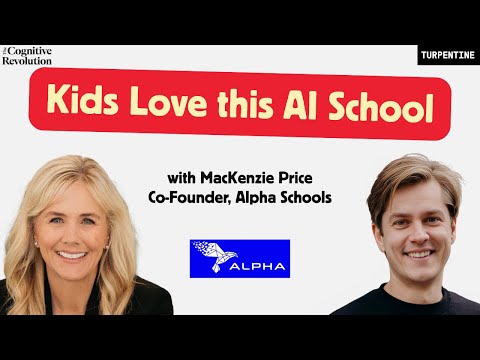
MacKenzie Price
Frontier Insights
Core Thesis:
Alpha decouples instruction from socialization: orchestrated AI agents compress mastery learning into two hours daily, repurposing human educators purely as motivational guides and cultural architects.
Strategic Decisions:
They capture top-tier private microschools ($40k–$65k) as beachheads to fund development, deliberately planning downstream expansion via charter models and sub-$1k hardware once inference costs fall.
Risks & Warnings:
Viability hinges entirely on collapsing token unit economics (~$10k/student). Crucially, claims of 99th-percentile outcomes mask severe selection bias; scaling to 10,000 schools faces public system inertia, unproven randomized validation, and parental skepticism toward machine-led pedagogy.
Key Views & Dialogues
This $40M AI Company Is Using AI Tutors to Teach 2 Hours/Day | #233
- 🗓️ Date:
2026-02-25| 🎙️ Show:Moonshots
Alpha claims mastery-based AI tutoring can deliver academics in two hours while its reported SAT average reaches 1,410 across high school and 1,535 for seniors. Its model combines personalized lessons, behavioral monitoring, and high-paid guides, but roughly $10,000 per student in AI-token costs, limited public approvals, and the need for pharmaceutical-grade evidence constrain scale.
View Dialogue Notes & Key Takeaways
Alpha School says mastery-based AI tutoring compresses academics into two hours while lifting students toward the top of national performance. Its reported SAT average is 1,410 across the entire high school, 1,535 for seniors, with freshmen targeting at least 1,410 and some already above 1,500. Joe Liemandt’s broad claim is that any student can reach the 99th percentile without spending all day at a desk or doing homework at night.
The technology thesis is not “give children ChatGPT,” but combine learning science, personalized lesson generation, and continuous behavioral measurement. TimeBack targets 80–85% answer accuracy, adapts to each student’s knowledge and interests, and uses vision models to detect guessing, skipping explanations, or leaving the learning environment. Alpha says it has invested more than $10 million in the platform, but is still spending roughly $10,000 per student on AI tokens—a major cost-down requirement.
Alpha’s operating model unbundles the five jobs traditionally forced onto one underpaid teacher. Software handles subject expertise and instructional sequencing; six-figure “guides” concentrate on motivation, emotional support, parents, and culture, with 80,000 applicants reported for roles. “Teens need high standards and high support” is the hiring and training premise, while kindergarten remains deliberately human-heavy at roughly five or six students per teacher.
Student engagement is treated as the system’s indispensable input, not a soft outcome. More than 90% reportedly say they love school, 40–60% would choose it over vacation, and two-thirds of Alpha High students once asked to remain open through summer. Joe Liemandt’s warning to schools shopping only for EdTech: unless they rebuild around the proposition that “kids must love school more than vacation, this isn’t going to work.”
The saved time becomes Alpha’s differentiated product: afternoons devoted to leadership, teamwork, entrepreneurship, financial literacy, relationships, storytelling, and grit. Fifth graders have operated food trucks and Airbnbs, while high-schoolers spend four years on evolving passion projects such as producing an all-teen Broadway musical. The model sells agency as much as academics: students should become “creators and contributors, not consumers.”
The go-to-market starts with owned private microschools, then extends the TimeBack engine across different formats and price points. New locations generally open near 25 students; Alpha retains control rather than franchising and added 13 schools in the year discussed. The group has launched Texas Sports Academy and a gifted-and-talented school, and described wilderness, Montessori, and other models for further rollout, including in 2026. Texas Sports Academy uses state vouchers to reach about $300 per month in parent payments.
The largest unresolved risks are proof, parent adoption, public-system resistance, unit economics, and consistent quality at scale. In-person charter applications in 10 states received no approvals, while Arizona authorized one virtual option; governments want substantially more evidence. Liemandt proposes a million-student, “pharmaceutical-grade” randomized trial. His ambition is 10,000 schools over 20 years and eventually one billion learners, but his blunt conclusion is that “the blocker to education reform is what’s in parents’ heads.”
🔗 Original source & video: This $40M AI Company Is Using AI Tutors to Teach 2 Hours/Day | #233
A.I. School Is in Session: Two Takes on the Future of Education
- 🗓️ Date:
2025-09-05| 🎙️ Show:Hard Fork
Alpha School’s model compresses core academics into two hours through personalized AI lesson plans, then shifts human time toward motivation, entrepreneurship, leadership, and social development. Reported 99th-percentile results and claims of moving students from the 10th to the 90th percentile remain subject to selection bias, while AI simultaneously threatens university assessment and widens inequality through unequal access.
View Dialogue Notes & Key Takeaways
Alpha School’s central wager is that AI can compress core academics to two hours while humans move up the stack into motivation and social development. Students complete personalized math, reading, language, and science work in 25-minute Pomodoro blocks, then spend afternoons on entrepreneurship, financial literacy, leadership, teamwork, and communication. MacKenzie Price’s pitch is that children can be “crushing their academics” by lunch without homework or a traditional lecturer.
The model’s reported outcomes are striking, but its evidence still carries a selection-bias discount. Price says Alpha classes rank in the 99th percentile across grades and subjects, except fifth-grade math at the 93rd, and claims students can move from the 10th to the 90th percentile within two years. She concedes selection bias at a private network commonly costing roughly $40,000 annually, while pointing to a $10,000 option and schools rolling out free as ways to broaden the data.
Alpha’s technology thesis is more specific than “give every child a chatbot.” Generative AI builds K–8 Common Core and high-school Advanced Placement lesson plans around each student’s gaps; a vision model measures accuracy, pace, explanation-reading, and guessing; and future lessons could overlay a student’s “knowledge graph” with an “interest graph.” The operational breakthrough is turning assessments from inert grades into instructions for what the learner should study next.
Motivation, not content delivery, is the bottleneck Alpha is trying to own. Price assigns only 10% of a strong learning experience to correct pace and level and 90% to motivation, making guides responsible for personal connection rather than explaining how to “carry the one.” Alpha Bucks let students earn, spend, save, invest, and donate; her defense of the extrinsic reward system is that only “5% of the population” is naturally motivated to learn for its own sake.
D. Graham Burnett argues that AI is already breaking the university’s assessment machinery, even if faculty remain defensive. Systems now emulate human analysis and expression well enough to make outputs indistinguishable from human work, undermining papers and the professoriate’s “police function.” His opportunity case is that universities can abandon students’ “karaoke dance” of producing inferior academic articles and return to shaping people “equal to the conditions of freedom.”
Burnett nevertheless considers institutional decline more likely than a humanities revival. As parents, students, and administrators optimize for tuition ROI and employment, he expects vital humanistic work to migrate into “thousands of new schools” financed outside the traditional university and perhaps offering neither accreditation nor diplomas. Princeton, Harvard, Yale, and Stanford may remain recognizable, but many other institutions must “get dynamic or die.”
Students who want to learn are already assembling adaptive-learning systems more responsive than many courses. One MIT student uses Gemini to identify prerequisite concepts, Perplexity to teach and quiz each exam topic until mastery, and a Gemini-written Google Apps Script to turn Notability backups into summaries and 10-question review quizzes. Casey Newton’s dividing line is motivation: for a student who genuinely wants mastery, AI may be “one of the best things that has ever happened to them.”
The same ubiquity creates a three-sided risk around cheating, inequality, and skill formation. A student admits using summaries to skip books, while Kevin Roose calls AI detectors an “absolute travesty” because false positives can punish original work; paid subscriptions also give wealthier students better answers and more queries. If computer-science degrees become four years of autocomplete, the deeper threat is not merely weak learning but reaching a point where AI no longer needs graduates to initiate the work.
🔗 Original source & video: A.I. School Is in Session: Two Takes on the Future of Education
2-Sigma in 2 Hours: How Alpha Schools are Using AI to Revolutionize Education
- 🗓️ Date:
2025-06-25| 🎙️ Show:The Cognitive Revolution
Alpha School says its AI-mediated mastery model delivered 2.3 times projected NWEA MAP growth in 2024–25, with core subjects taking roughly 20–30 hours annually versus about 200 traditionally. Dash orchestrates curated apps, measurement, pacing, and intervention rather than offering an open chatbot, while guides shift toward motivation and mentorship; the premium model’s expansion depends on lower costs, charters, and a developing price ladder.
View Dialogue Notes & Key Takeaways
Alpha School says its AI-mediated mastery model delivered 2.3 times the NWEA MAP growth projected for its students in the 2024–25 school year. Core subjects take roughly 20–30 hours each per year versus about 200 traditionally, while classes generally score near the 99th percentile. MacKenzie Price’s blunt comparison: “The time-based classroom is a joke.”
The product is deliberately not a child-facing chatbot, because Price expects most students to use an open chat box to cheat. Alpha’s Dash platform instead routes each student into the exact lesson needed across curated third-party and proprietary adaptive apps, then analyzes speed, accuracy, knowledge gaps, and behavior. The implementation combines orchestration, longitudinal learning data, app selection, and intervention logic rather than relying on a single foundation model.
AI produced a measurable step change only after Alpha redesigned the operating model around it. Adaptive apps existed when Price founded the school in 2014, but students could “topic shop,” avoid difficulty, or neglect entire subjects; after AI-based measurement and lesson planning arrived in 2022, learning rates rose from about 1.5 times expected growth to more than 2 times. Alpha simultaneously eliminated teacher-led academic instruction: “When we got out of that hybrid environment, we had learning rates just go…like crazy.”
The model converts teacher labor from content delivery into motivation, mentorship, and emotional support rather than eliminating adults. Guides are accountable for three outcomes: every student loves school, learns twice as fast in two hours, and develops life skills. Alpha hires beyond education credentials, pays guides from $100,000, and treats a struggling student as an operating failure to diagnose—not a lazy child to blame.
Alpha is not using AI to weaken standards or dissolve subjects into free-form projects. Students still complete K–8 Common Core and high-school AP curricula, including drills, handwriting, and multiplication fluency; Price argues that stored knowledge makes critical thinking and analogy possible. She believes every child can reach at least the 90th percentile through appropriate pacing and motivation, and thinks “two-hour learning” might eventually become one-hour learning.
The current economics remain premium, but Alpha is explicitly building a price and distribution ladder. Flagship tuition runs roughly $40,000–$65,000; specialized schools cost about $25,000, $15,000 schools are being introduced, and Price says Brownsville’s socioeconomically mixed campus consistently outperforms other campuses. An Arizona virtual charter has been approved, a Texas physical charter is under application, and Price expects falling AI costs could eventually support a $1,000-per-year tablet-based academic product.
The two-hour academic block creates a second product surface: afternoons devoted to life skills and AI-enabled creation. Students work on entrepreneurship, financial literacy, leadership, sports, robotics, public speaking, and resilience; even kindergarteners use AI to make books, art, movies, games, and coded machines. Price’s labor-market thesis is that students must become “creators and contributors, not just consumers,” using AI as a superpower on the “gray frontier” beyond established knowledge.
🔗 Original source & video: 2-Sigma in 2 Hours: How Alpha Schools are Using AI to Revolutionize Education