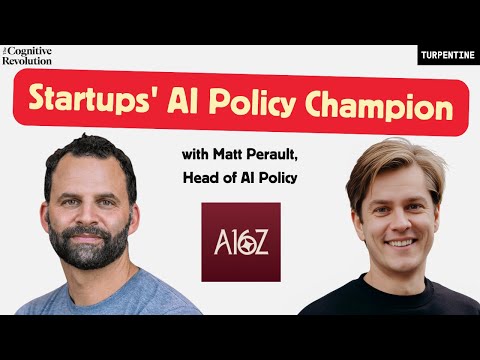
Matt Perault
Frontier Insights
Thesis: a16z anchors its long-term fund economics on open AI innovation and broad market adoption, championing a “Little Tech” agenda that rejects heavy upfront development controls in favor of downstream accountability.
Strategy: Regulate malicious use—not model creation—via existing laws. Advocate for revenue-based regulatory thresholds over compute or training caps to prevent entrenching trillion-dollar incumbents, while leveraging federal preemption, open-source access, and targeted national action plans to protect agile startups.
Risks: Premature compute-based licensing risks cementing an oligopoly. Conversely, downstream enforcement leaves ecosystems vulnerable to irreversible catastrophic risks or laboratory accidents occurring before legal remedies can act.
Key Views & Dialogues
The Little Tech Agenda for AI
- 🗓️ Date:
2025-09-08| 🎙️ Show:The a16z Show
a16z’s Little Tech thesis is that AI rules built for trillion-dollar incumbents could compound their existing capital, compute, and talent advantages. The operative comparison is “five people and you’re in a garage” versus “thousand-person compliance teams”; licensing, audits, impact assessments, and disclosure regimes could entrench a small number of frontier developers. For investors, policy design…
View Dialogue Notes & Key Takeaways
a16z’s Little Tech thesis is that AI rules built for trillion-dollar incumbents could compound their existing capital, compute, and talent advantages. The operative comparison is “five people and you’re in a garage” versus “thousand-person compliance teams”; licensing, audits, impact assessments, and disclosure regimes could entrench a small number of frontier developers. For investors, policy design may determine whether startups remain credible challengers or the market consolidates by construction.
Matt Perault and Collin McCune reject zero regulation in favor of “regulate use, do not regulate development.” Existing consumer-protection, civil-rights, and criminal laws already reach many harmful AI uses, while development controls burden every builder before a violation occurs. Perault ties that position to venture’s 10-year fund horizon: unsafe, scammy products and public distrust cannot produce the durable ecosystem investors need.
The pair argues that the 2023 safety panic nearly normalized an unprecedented permission-to-build regime for software. CEO testimony, existential-risk advocacy, and a social-media-policy “do-over” produced proposals for frontier licenses, nuclear-style oversight, FLOPs-based disclosures, and open-source bans. Perault’s warning is concrete: U.S. nuclear policy yielded only “2 or 3 new nuclear power plants in a 50-year period”; applying that model to AI would suppress breakthroughs and, in his categorical view, mean “you lose to China.”
Colorado is their clearest case that compliance process can substitute for actual protection. Its framework asks resource-constrained startups to classify high-risk uses and conduct assessments or audits that might identify bias but will not “end racism in our society.” Perault prefers direct liability: codify that using AI to violate anti-discrimination law is illegal, then let the attorney general enforce against the observable harm.
They concede that existing law may not be the endpoint if AI creates genuinely incremental risk. Asked whether terrorism, cybercrime, or other capabilities could become “10,000x” more powerful, Perault calls that conceivable and endorses policy responsive to marginal risk. His resistance is to speculative ex-ante surveillance—predicting who might offend and intervening before conduct occurs—which may be both invasive and ineffective.
The National AI Action Plan marks a thesis-level shift from “safety with a splash of innovation” toward winning while keeping people safe. The speakers highlight support for open source, right-sized startup regulation, worker retraining, labor-market monitoring, and clearer federal-state roles. On China, McCune sees a hard tradeoff: restrictions must keep powerful technology from the PLA and CCP, but locking down U.S. open-source models invites Chinese products to become the world’s default platform.
The failed federal moratorium exposed political execution risk, not consensus for a 50-state AI patchwork. McCune says its perceived 10-year ban on all state AI law was a misreading, but “perception is reality”; a partisan reconciliation vehicle and one or two Republican senators were enough to defeat it. The next push is narrower federal preemption for model regulation, backed by a more organized coalition and Leading the Future PAC—even as Perault expects big and little tech may diverge again on the details.
🔗 Original source & video: The Little Tech Agenda for AI
a16z on Protecting Little Tech: The Techno-Optimist AI Policy Agenda with Matt Perault
- 🗓️ Date:
2025-06-09| 🎙️ Show:The Cognitive Revolution
a16z favors policing harmful AI uses while keeping research broadly open, arguing that compute or training-cost thresholds could reinforce concentration among only three to 10 companies. The unresolved risk is whether ex-post enforcement can address irreversible harms, while temporary rules, liability regimes, and the Trump administration’s national AI action plan in June or July shape market access.
View Dialogue Notes & Key Takeaways
a16z’s policy call is to regulate harmful AI use while leaving research and development broadly open. Matt Perault insists this is not a deregulatory dodge: governments may need more investigators, technical expertise, enforcement resources, and targeted updates to existing law. The dividing line is that policymakers should punish discrimination, criminal conduct, and other harms without trying to “criminalize the math.”
The firm’s economics favor durable adoption, not a short-lived AI boom that collapses under accumulated harms. Perault contrasts a16z’s 10-year fund life with a four-year public-company vesting cycle: if enthusiasm explodes tomorrow but “the market cratered a year later,” the portfolio still loses. Little tech therefore needs both room to build and an ecosystem whose products people trust.
Threshold regulation could convert AI’s natural power laws into a state-reinforced oligopoly. Nathan Labenz notes that assessments of today’s frontier produce lists of only three to 10 companies, but Perault says rules designed for five, 10, or 15 developers could cement precisely that concentration. He prefers revenue thresholds where affordability is the objective; compute or $100 million training-cost thresholds measure development activity, not capacity to absorb compliance.
The unresolved disagreement is whether some AI harms would be irreversible before use-based enforcement could begin. Labenz raises lab leaks and the possibility that sufficiently capable AI development could get out of control without deployment; Perault uses a COVID hypothetical—if it came from a lab and 10-plus million people died globally—as a case where a later fine would be inadequate. Labenz later worries about closed-door AI-assisted ML research, while Perault answers that dangerous research may also produce defenses and breakthrough benefits and doubts publishing a safety plan has a strong “direct correlation” with actual product safety.
Transparency is the sharpest practical clash between frontier-risk monitoring and little-tech burden. Labenz cites the Claude 4 launch remark, “We want Claude to take over all the ML research so we can all go to the beach,” and worries the gap between laboratory and public capabilities will widen. Perault argues many proposed disclosures are speculative, unhelpful to consumers, and likely vulnerable under the First Amendment; a16z instead proposes concise “AI model facts,” including knowledge-cutoff dates.
California’s SB 813 is promising only if startups can realistically obtain its liability protection. Perault likes that the bill confronts tort liability through an opt-in, privately administered regime, but rejects the idea that any nominally voluntary system is automatically fair. His analogy: if immunity required paying $20 billion, incumbents would buy protection while startups retained the risk—“That’s not really voluntary.”
Temporary or adaptive rules still impose real competitive costs during a critical market-formation period. Erik Torenberg proposes three-to-five-year sunsets; Perault replies that even temporary stringency resembles making racers carry “a 20-pound backpack for the first mile.” He points to reported EU doubts about implementing the EU AI Act, Colorado’s governor supporting a federal moratorium affecting his state’s own law, and the Trump administration’s expected national AI action plan in June or July.
🔗 Original source & video: a16z on Protecting Little Tech: The Techno-Optimist AI Policy Agenda with Matt Perault