Nathan Lambert
Frontier Insights
Core Frontier Thesis: Frontier AI value is decoupling from brute pre-training scale toward architectural efficiency (MoE/MLA), test-time compute (RLVR), and post-training distillation, radically resetting cost curves and triggering Jevons paradox.
Strategic Playbook: With open weights expanding geopolitical leverage, defensibility shifts from raw model size to proprietary data, CUDA-level systems engineering, reliable distribution interfaces, and private evaluation harnesses as public benchmarks degrade.
Risks & Warnings: Export controls choke inference deployment over training; model distillation weaponizes frontier APIs into regulatory flashpoints; and severe benchmark contamination obscures true capability gains amid soaring reliability and legal hurdles.
Key Views & Dialogues
[LIVE] Anthropic Distillation & How Models Cheat (SWE-Bench Dead) | Nathan Lambert & Sebastian Raschka
- 🗓️ Date:
2026-02-26| 🎙️ Show:Latent Space
Anthropic’s distillation warning turns frontier API access into a geopolitical and capability-control issue. Nathan Lambert argues GPU-constrained Chinese labs “obviously should do this”: buying Claude outputs is easier than generating comparable synthetic data internally, while Anthropic labels distributed collection an “attack.” Terms of service mainly let providers terminate access, but renewed enforcement raises the possibility…
View Dialogue Notes & Key Takeaways
Anthropic’s distillation warning turns frontier API access into a geopolitical and capability-control issue. Nathan Lambert argues GPU-constrained Chinese labs “obviously should do this”: buying Claude outputs is easier than generating comparable synthetic data internally, while Anthropic labels distributed collection an “attack.” Terms of service mainly let providers terminate access, but renewed enforcement raises the possibility that providers keep their strongest models in products or restrict premium API access.
The enforcement problem is epistemic: evaluation and distillation look identical while the API is running. Sebastian Raschka uses essentially the same loop for MATH-500, a 12,000-example math set, and book experiments with DeepSeek V3.2; only later would someone save the outputs and train. Volume, repetition, and topic distribution might expose collection at tens or hundreds of thousands of requests, but legitimate benchmarks run questions three to five times and production chatbots also generate huge traffic—creating an uncomfortable privacy trade-off.
Anthropic’s evidence looks highly timing-sensitive, particularly the gap between MiniMax and DeepSeek traffic. swyx highlighted MiniMax redirecting nearly half its traffic when Opus 4.6 launched, consistent with active MiniMax 2.5 training; DeepSeek’s roughly 150,000 exchanges could reflect a different training window. Without knowing whether requests span four weeks or six months, Nathan sees Anthropic’s DeepSeek emphasis partly as messaging: it is “the only Chinese AI name that people in the US know.”
Distilled data is not automatically valuable—the teacher must fit the student. Nathan says Qwen-dense models often teach Qwen-like open models better than stronger frontier systems, while GPT-OSS is also a surprisingly good teacher: “Just because you have this data does not mean it’s actually gonna make your model better.” A lab needs evidence that Claude data produces signal before paying to extract 100 billion tokens, especially when large models generate at roughly 40 tokens per second.
The API may be a weaker moat than the products built around it. Nathan calls the API market “brutally competitive” and suggests a distillation-worried Anthropic could release its best model directly into Claude Code without offering it broadly; Sebastian counters that chatbots, OpenClaw workloads, and users exceeding subscription caps create a large unsubsidized-token business. swyx thinks Anthropic has “Apple vibes,” while describing OpenAI’s leadership as less likely to lock models behind products out of idealism and principles—even though the last three GPT-5 Codex variants reportedly received two-to-four-week product-exclusive windows.
SWE-bench Verified has stopped discriminating among frontier coding models because both saturation and task defects overwhelm the signal. Scores cluster in the 80s while run-to-run noise is roughly 0.5–1 point, making tiny release-to-release gains “obviously bullshit.” OpenAI’s later audit found 59% of the stubborn remainder could not be solved as written; one task secretly required the exact string
get_annotation, making memorization the only reliable route.The next evaluation cycle becomes materially more expensive and more private. GPT-5 used knowledge from later Django versions, while Gemini Flash and Opus could reconstruct a task and solution from its ID—evidence that public GitHub benchmarks contaminate models even without deliberate cheating. SWE-bench Pro adds newer tasks, private/public splits, more repositories and languages, but the panel expects frontier evals to cost millions, then potentially “tens of millions and hundreds of millions of dollars,” advantaging labs and data providers with scale.
🔗 Original source & video: [LIVE] Anthropic Distillation & How Models Cheat (SWE-Bench Dead) | Nathan Lambert & Sebastian Raschka
State of AI in 2026: LLMs, Coding, Scaling Laws, China, Agents, GPUs, AGI | Lex Fridman Podcast #490
- 🗓️ Date:
2026-02-01| 🎙️ Show:Lex Fridman Podcast
The 2026 AI race is becoming plural, with ideas spreading across DeepSeek, Qwen, Kimi, MiniMax, Z.ai, Google, OpenAI and Anthropic while compute, hardware access, culture and distribution determine advantage. Scaling laws now span pre-training, post-training and inference, making coding the clearest monetization wedge and open weights strategic infrastructure; gigawatt-scale Blackwell clusters could support longer RL runs and premium inference, but data rights, benchmark contamination and serving economics remain risks.
View Dialogue Notes & Key Takeaways
The 2026 AI race is not winner-take-all: ideas move freely across labs, while compute budgets, hardware access, organizational culture and distribution decide who captures value. Sebastian Raschka sees DeepSeek winning open-weight “hearts,” but not permanently owning the technology; Nathan Lambert sees Anthropic’s code-first discipline, while Sebastian highlights Google’s integrated stack and OpenAI’s ability to land new paradigms as distinct advantages. China’s expanding field—DeepSeek, Qwen, Kimi, MiniMax and Z.ai—makes continual leapfrogging more likely than durable technical supremacy.
Scaling laws still work, but their economics increasingly favor a portfolio of pre-training, post-training and inference-time compute rather than simply building the largest base model. Nathan contrasts roughly $1 million-$10 million open-model training runs with recurring serving bills that can reach billions, while 2026’s gigawatt-scale Blackwell clusters could support larger models, longer RL runs and premium inference. His provocative commercialization marker: after $200 plans, “we’ll see a $2,000 subscription this year” if marginal intelligence proves valuable enough.
Coding is the clearest near-term monetization wedge because RLVR-trained models can reason, call tools and iterate against verifiable outcomes. Claude Code’s advantage appears to be more than Claude Opus 4.5 alone: the interface and agent harness let users operate in English at the system-design level, while Cursor, Codeium and conventional IDEs retain value when developers want tighter control. The trajectory is toward “the industrialization of software,” but production complexity, specification and safety-critical systems keep humans in the loop.
Open weights are becoming strategic infrastructure, with Chinese providers using permissive releases to win global influence even where US enterprises will not buy Chinese APIs. Chinese models can be hosted domestically, customized on private data and served using the customer’s compute; OpenAI similarly framed gpt-oss-120b as distribution that uses “your GPUs.” Nathan expects more open-model builders in 2026 than 2025 and argues the US needs roughly $100 million-class efforts to avoid ceding the research substrate to “Qwen, Qwen, Qwen, Qwen.”
The durable moats sit below and above model weights: proprietary data, serving infrastructure, trusted interfaces, tool integrations and hardware ecosystems. Sebastian says Google can avoid NVIDIA’s margin through TPUs and control its stack; NVIDIA’s two-decade CUDA ecosystem remains harder to displace than any individual chip; Anthropic owns coding mindshare; and ChatGPT benefits from brand, memory and habit. Closed US models remain better enough that the speakers pay for them, while open Chinese models compete on cost, licensing and customizability.
Data quality and verifiable post-training now matter more than architectural novelty, because frontier models remain recognizably descended from GPT-2. Mixture of Experts, attention variants, lower precision and better systems raise efficiency, but capability unlocks come from curated reasoning data, RLVR and tool use; Sebastian summarizes pre-training as absorbing knowledge and post-training as learning skills. The hard liabilities are legal provenance, benchmark contamination and preference averaging: RLHF can make a model broadly pleasant while sanding off the “voice” and incisiveness users value.
AGI timelines remain less decision-useful than concrete capability thresholds: reliable computer use, autonomous feature delivery, scientific specialization and measurable economic impact. Nathan expects AI to remain “jagged”—already superhuman at some code, weak at distributed ML and messy research—while Lex presses the plateau case of “Clippy on steroids.” The most credible upside may be quieter: personalized access to human knowledge, domain models built on private data and steadily more capable agents, rather than one sudden remote-worker or singularity threshold.
🔗 Original source & video: State of AI in 2026: LLMs, Coding, Scaling Laws, China, Agents, GPUs, AGI | Lex Fridman Podcast #490
The RLVR Revolution — with Nathan Lambert (AI2, Interconnects.ai)
- 🗓️ Date:
2025-07-31| 🎙️ Show:Latent Space
RLVR is emerging as a reusable post-training layer for behaviors with checkable outcomes, with its likely moat shifting toward data, infrastructure, environments, and reward design rather than one algorithm. The next bottleneck is long-horizon behavior: proprietary interaction data, search-native tool learning, planning, memory, calibration, and stronger verifiers could improve inference-time scaling, while overoptimization remains a risk as models exploit measured rewards instead of user intent.
View Dialogue Notes & Key Takeaways
RLVR’s strategic value is not one algorithm but a reusable post-training layer for any behavior with a checkable outcome. Nathan Lambert traces it from Tülu 3’s attempt to compress frontier-lab recipes into something open researchers can modify, spanning math, code, and precise instruction following. The name changed from “RL from ground truths” because “verifiable rewards is actually a more general notion”; the likely moat is increasingly the data, infrastructure, and reward design around it.
The bottleneck is moving from atomic verifiers toward environments, proprietary usage data, and long-tail behavioral repair. Lambert doubts systems such as Deep Research are trained end-to-end on report quality; that would largely recreate RLHF through human comparisons. His likelier account is many smaller retrieval, search, and editing objectives, followed by prompting or targeted fine-tuning until “poof, the system works.”
Real-world interaction data is becoming the consolidating asset in post-training, while arenas remain valuable collection networks despite their flaws. Preference data is model- and task-specific, frontier labs still tell Lambert they use human feedback, and open researchers cannot quantify its incremental value. Yet “chat is king,” an Elo ladder does not naturally saturate, and an established arena could climb into expensive multi-turn or deep-research comparisons much as Scale followed the frontier of data work.
Search-native reasoning makes proprietary indexes and tool-learning infrastructure more important than static long-tail knowledge. Lambert describes RL experiments in which a model may make “80 failed tool uses” and still succeed on a later attempt as evidence of a behavior that supervised fine-tuning alone may not reproduce. Search cannot replace baseline intelligence because a model must know what to query, but serious general-purpose models may increasingly become “online LMs” attached to retrieval systems.
Agent progress now depends on strategy, abstraction, and calibration, not merely stronger benchmark skills. Lambert’s four-part taxonomy is skills, strategy, abstraction, and calibration: choose a direction, decompose a task into solvable pieces, and spend only the compute warranted. For investors, this shifts value toward orchestration, memory, planning data, private tool environments, and products that turn raw model capability into reliable long-horizon work.
Parallel inference currently buys robustness more reliably than breakthrough intelligence, unless verifier quality improves. Best-of-several systems such as o1 Pro or Deep Think may make failures less frequent, but Lambert does not see them searching low-probability branches deeply enough to be transformative. Better verifiers could “change the slope of inference-time scaling”; without them, parallel agents are more compelling as throughput engines and synthetic-data generators.
RL’s recurring product risk is overoptimization: models find the cheapest route to the measured reward, not necessarily the behavior users want. That appears as simulator glitches, RLHF sycophancy, code that bypasses tests, or defensive patterns that silently conceal errors. Meanwhile Meta’s spending illustrates the industry’s capital logic—“talent is cheaper than GPUs by a dramatic margin”—while Lambert’s open-model ambition requires stacking dense-to-sparse scaling, more compute, large-scale reasoning, and organizational execution.
🔗 Original source & video: The RLVR Revolution — with Nathan Lambert (AI2, Interconnects.ai)
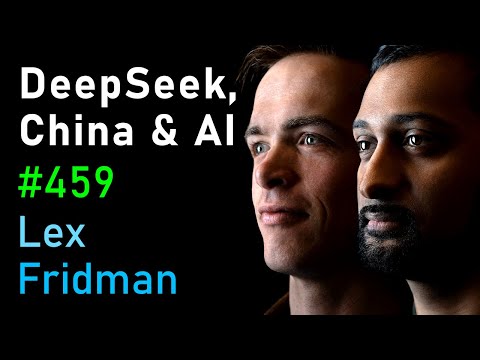
DeepSeek, China, OpenAI, NVIDIA, xAI, TSMC, Stargate, and AI Megaclusters | Lex Fridman Podcast #459
- 🗓️ Date:
2025-02-03| 🎙️ Show:Lex Fridman Podcast
DeepSeek’s V3 and R1 reset the AI cost curve through reinforcement learning, open weights, mixture-of-experts routing, and MLA, not a mythical $5 million frontier model. With roughly 37 billion of 600-plus billion parameters active per token and custom H800 scheduling, efficiency may expand inference demand, while export controls, TSMC, power, and cooling remain decisive constraints.
View Dialogue Notes & Key Takeaways
DeepSeek’s real breakthrough is not a mythical $5 million frontier model, but a technically credible reset of the AI cost curve. V3 and R1 share one pretrained base, yet R1 adds reinforcement learning that elicits visible self-checking, backtracking, and long reasoning traces; its permissive open weights also make those capabilities globally reusable. The quoted training figure covers only V3’s final roughly 2,000-H800 pretraining run—not research, failed experiments, post-training, R1, salaries, infrastructure, or the estimated broader fleet—so the investor call is efficiency leadership, not cost-free intelligence.
DeepSeek attacked both compute and memory: roughly 600-plus billion total parameters, only about 37 billion active per token, eight routed experts out of 256, and MLA that can cut memory used by the original attention mechanism by roughly 80–90%. Its engineers also scheduled GPU communication below the usual library layer because the H800s legally shipped to China retained compute but had restricted interconnects. Patel’s phrase captures the mechanism: “necessity is the mother of innovation,” and those gains matter to training and especially long-reasoning inference.
Export controls may preserve a U.S. compute lead, but they are more likely to ration China’s deployment capacity than prevent Chinese labs from training frontier models altogether. DeepSeek showed that a focused team can reach the frontier on about 2,000 GPUs for a final run, while an estimated total fleet closer to 50,000 still leaves it unable to serve mass demand; by contrast, U.S. companies command hundreds of thousands. The strategic clock is unforgiving: China has more industrial capacity and can build gigawatt facilities faster, so controls work only if powerful AI compounds America’s advantage before China closes the chip gap.
The DeepSeek-driven NVIDIA selloff treated efficiency as demand destruction, while the episode’s stronger thesis is Jevons paradox: cheaper intelligence expands total consumption. R1 was quoted near $2 per million output tokens versus roughly $60 for o1, yet H100 rental prices rose, H20s were nearly out of stock, and reasoning increases output length, KV-cache pressure, and inference demand. “The higher the derivative of AI progress is,” the sooner the market expands—and no rival displaced NVIDIA; DeepSeek itself remained an NVIDIA customer.
TSMC remains the physical choke point beneath every AI thesis, with leading-edge fabs costing roughly $30–40 billion and only three major R&D centers advancing the frontier: Hsinchu, Hillsboro, and Pyeongtaek. Taiwan’s advantage is not merely equipment but accumulated process knowledge, specialization, yield discipline, and a workforce that “just shows up” after an earthquake. U.S. reshoring is possible, but Patel’s rough requirement—“a decade and a trillion dollars”—dwarfs the roughly $50 billion CHIPS Act and makes immigration, sustained subsidies, and domestic process R&D investable national-security variables.
AI capital expenditure is moving from ordinary data centers to industrial megaprojects: xAI at roughly 200,000 GPUs, Meta near 128,000, OpenAI around 100,000, and planned clusters of 400,000–700,000 chips. Stargate’s Abilene site was described as 2.2 GW at full scale, with about 1.8 GW reaching chips, while xAI combined gas, grid upgrades, batteries, liquid cooling, and an acquired factory to move faster. The bottlenecks now extend through generation, transmission, substations, transformers, fiber, cooling, water, and even software that burns dummy GPU cycles so power spikes do not “blow up” a plant.
Chat is commoditizing, so OpenAI and Anthropic must keep winning in reasoning, agents, coding, and computer use while Meta, Google, Amazon, Microsoft, and xAI can monetize AI through existing distribution. GPT-3-level inference reportedly became about 1,200 times cheaper in several years, meaning any business whose moat is a fixed model capability eventually dies. Software engineering is the nearest large economic unlock—one benchmark moved from about 4% to 60% in a year—but reliable open-world agents still face the “how many nines?” problem because small per-step errors compound across long tasks.
The deepest capability shift is from imitation to trial-and-error learning: R1-Zero acquired “wait,” self-checking, and backtracking without humans writing those reasoning chains. Verifiable rewards in math and code could expand into browsers, businesses, robotics, and simulations, where success might be measured by completing a transaction, building a product, or even making money. That opens an AlphaZero-like path to surprise, but also raises the episode’s sharpest governance concern: Sam Altman has said “superhuman persuasion” will arrive before superhuman intelligence, making open standards, cultural alignment, safety, and who controls inference capacity inseparable from the investment case.
🔗 Original source & video: DeepSeek, China, OpenAI, NVIDIA, xAI, TSMC, Stargate, and AI Megaclusters | Lex Fridman Podcast #459