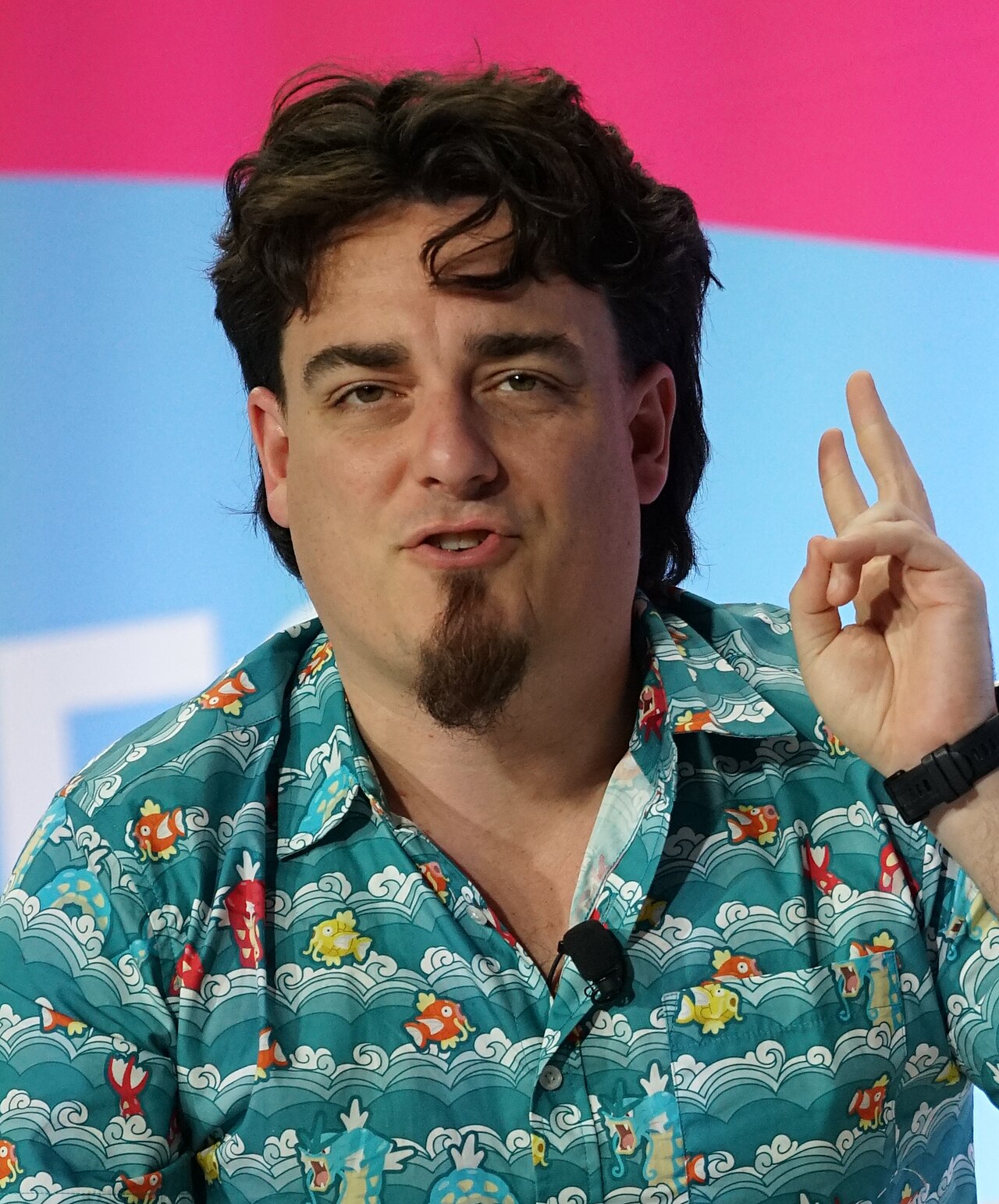
Palmer Luckey
Frontier Insights
Core Thesis: Modern deterrence does not require AGI—scaling human-level systems that compress operational cycles from months to minutes upends war economics. Via Lattice, omnipresent sensing converts directly into predictive lethality.
Strategic Moat: Rejecting cost-plus inertia, Anduril self-funds deployable hardware to capture margins through speed, low cost, and software reuse. Deployments like IVAS validate targeting high-urgency bottlenecks where legacy primes fail.
Critical Risks: China’s ~300x shipbuilding capacity and the 2027 timeline demand immediate physical manufacturing scale. Meanwhile, autonomous violence remains constrained by the imperative of civilian control and human accountability.
Key Views & Dialogues
Aliens, AI Weapons, China & Global Conflict: Palmer Luckey Sounds the Alarm | EP #169
- 🗓️ Date:
2025-05-09| 🎙️ Show:Moonshots
Luckey’s differentiated defense thesis relies on human-level AI, fast decision cycles and mass replication rather than superintelligence, with Lattice turning pervasive sensing into battlefield prediction. China’s roughly 300-times US shipbuilding advantage makes scalable production central: Anduril targets relevant capabilities before the end of 2027, a $900 million Columbus factory before 2030, and an eventual IPO to fund F-35-scale programs.
View Dialogue Notes & Key Takeaways
Luckey says the NHI record contains a tiny residue of sensor-and-eyewitness cases he cannot explain, but nothing he has seen conclusively establishes alien craft. He has seen neither recovered vehicles nor programs analyzing wreckage, and suspects the answer will be “something that is beyond our current understanding”—perhaps a natural phenomenon or even time travel, which he calls more plausible than visitors from a nearby galaxy.
Anduril does not require superintelligence for its thesis because speed, latency and replication are already military superpowers. A human-level system completing a month’s analysis in a minute, or a reliable 100-IQ driver duplicated 100,000 times “for free,” can transform operations. Luckey believes superintelligence will happen, but says, “I’m not betting my company on superintelligence.”
Lattice’s strategic ambition is to convert pervasive sensing into prediction, making software more valuable than marginal hardware performance. Luckey would rather double an aircraft’s decision quality than its speed or weapons load: connect enough sensors, model the battlefield and get 9,000 of 10,000 guesses right. The endpoint is a practical version of “Laplace’s demon” that acts on what an adversary will do, not merely what it is doing.
Rogue actors and China present different, non-substitutable risks: one can be suicidal, while the other can rationally pursue territorial and industrial control. Luckey fears small groups using AI to create tailored bioweapons because they may believe “they win by losing”; separately, he takes China’s stated willingness to use force against Taiwan seriously and warns that capturing a democracy and semiconductor capacity is a threat no lone actor can replicate.
America’s defense bottleneck is industrial organization as much as technology, with China’s shipbuilding capacity cited at roughly 300 times the US level. Anduril therefore rejects blanket vertical integration: wartime demand may jump 10x or 100x, so products must use interchangeable suppliers and existing automotive or aviation infrastructure. “We have to design for mass production using existing infrastructure.”
The 2030 battlefield will be an awkward blend of Reagan-era equipment and a thin edge of new autonomy, not a wholesale robotic replacement. Even at “breakneck speed,” Luckey expects Anduril-class systems to constitute perhaps 1%-2% of a major fight; its “China 2027” mandate requires relevant capabilities before the end of 2027, while a new $900 million Columbus factory is intended to put autonomous fighters into combat before 2030.
Pulsar L demonstrates the product opportunity in layered counter-drone defense, while Luckey’s ethical framework keeps responsibility with humans rather than banning autonomy. He says a live test brought down 25 autonomous attack drones using electronic warfare, but stresses that EW must sit beside directed energy and kinetic defenses. If AI can distinguish a tank from a school bus, he argues, banning that discrimination makes war less precise: “The key is to never abdicate human responsibility.”
Anduril intends to go public because Luckey says it cannot win an F-35-scale program without doing so, but he wants to select investors as deliberately as employees. His model is Tesla: attract holders willing to fund a multi-decade thesis and repel quarterly optimizers, even if that requires saying “some crazy shit” publicly. That mission discipline also explains rejecting faster-growing commercial work, while wildfire prevention and safer air-traffic systems are discussed as potential applications of the technology.
🔗 Original source & video: Aliens, AI Weapons, China & Global Conflict: Palmer Luckey Sounds the Alarm | EP #169
Palmer Luckey on the Next Wave of Military Tech Powered by AI | EP #158
- 🗓️ Date:
2025-03-27| 🎙️ Show:Moonshots
Anduril’s product-company model funds working defense systems before procurement, aligning incentives around speed, affordability, and reuse in a market where roughly 80% of major programs go to five companies and 30% receive one bid. The IVAS handoff and four-gate investment screen validate rapid, self-funded bets, while autonomous-violence accountability, procurement priorities, regulation, and the uncertain timing of humanoids and eVTOL adoption remain key risks.
View Dialogue Notes & Key Takeaways
Anduril’s defining wager is that a defense product company should finance working systems before asking the government to buy them. That reverses cost-plus incentives, where longer schedules and pricier components increase profit; Luckey says roughly 80% of major defense acquisition programs go to five companies, 30% receive one bid, and the resulting economics resemble home renovation. Product-company incentives instead make speed, affordability and reuse pay.
The IVAS handoff is the clearest validation yet of that model. The host framed Microsoft’s transfer as a $22 billion contract; Luckey said Anduril also bought Microsoft’s remaining mixed-reality business after spending heavily on the infantry system it believed should exist. Having lost the original competition as a sub-24-person company nearly eight years earlier, he says he can accomplish “in about six months what other companies would take eight years to do.”
Anduril applies a four-gate screen before committing capital: the Pentagon must care, Congress must care, Anduril must be able to execute, and existing suppliers must be failing. That steers it toward strategic bottlenecks such as rocket-booster capacity, domestic manufacturing and long-range fighters—not lower-priority counterterrorism projects. If all four conditions hold, Luckey says the result should appear “in the Anduril showroom within a year or two.”
Luckey expects humanoids to enter defense as low-performance operators of legacy equipment, not robotic special forces. A machine with the abilities of an “85-year-old man” can staff silos, manipulate controls and operate vehicles built for humans; wrapping superhuman robotics around “a person made of meat” makes military exoskeletons comparatively unattractive. In broader military automation, reducing a task from one million people to 100,000 or even 1,000 may help, but going to zero sacrifices meaningful human attention and accountability.
His hard boundary is that responsibility for violence must not be outsourced to autonomous systems. Fully autonomous warfare would leave humans unable to give meaningful attention to individual uses of force or answer for catastrophic outcomes. “If we’re going to kill people, we need to kill people—and it needs to weigh on us.” More broadly, he expects periods without war but not permanent peace: deterrence depends on known outcomes, while asymmetric advantages or extremist groups can reopen conflict. Despite selling weapons to Ukraine, he says decisions about conflicts and weapons quantities belong to accountable civilian leaders, not corporate executives.
Luckey’s Oculus decision shows how he values platform investment over marginal changes in personal wealth. He rejected a $1 billion offer at 13 months; at 18 months, the host described Zuckerberg’s later offer as $2.2 billion, while Luckey referred to a $2.3 billion sale. The decisive difference was Zuckerberg’s commitment to at least $1 billion annually in VR R&D for 10 years; Luckey says the promised $10 billion became $60 billion, even though the sale’s control risk culminated in his firing. When Facebook changed its name to Meta, he put “all of my liquid assets” into Meta stock.
Incumbents’ shareholders, regulators and existing revenue streams are more durable barriers than access to engineers. Legacy defense investors want “an ultra-low-risk extension of the United States government, akin to a bond,” while civilian eVTOL companies must survive delayed regulation and local opposition; Luckey therefore sees public safety as the near-term aerial-mobility market and hybrids as more practical than battery-heavy designs. His capital discipline is equally visible in prosthetics: the technology fascinates him, but competent specialists already exist, so Anduril would create only marginal gain.
🔗 Original source & video: Palmer Luckey on the Next Wave of Military Tech Powered by AI | EP #158