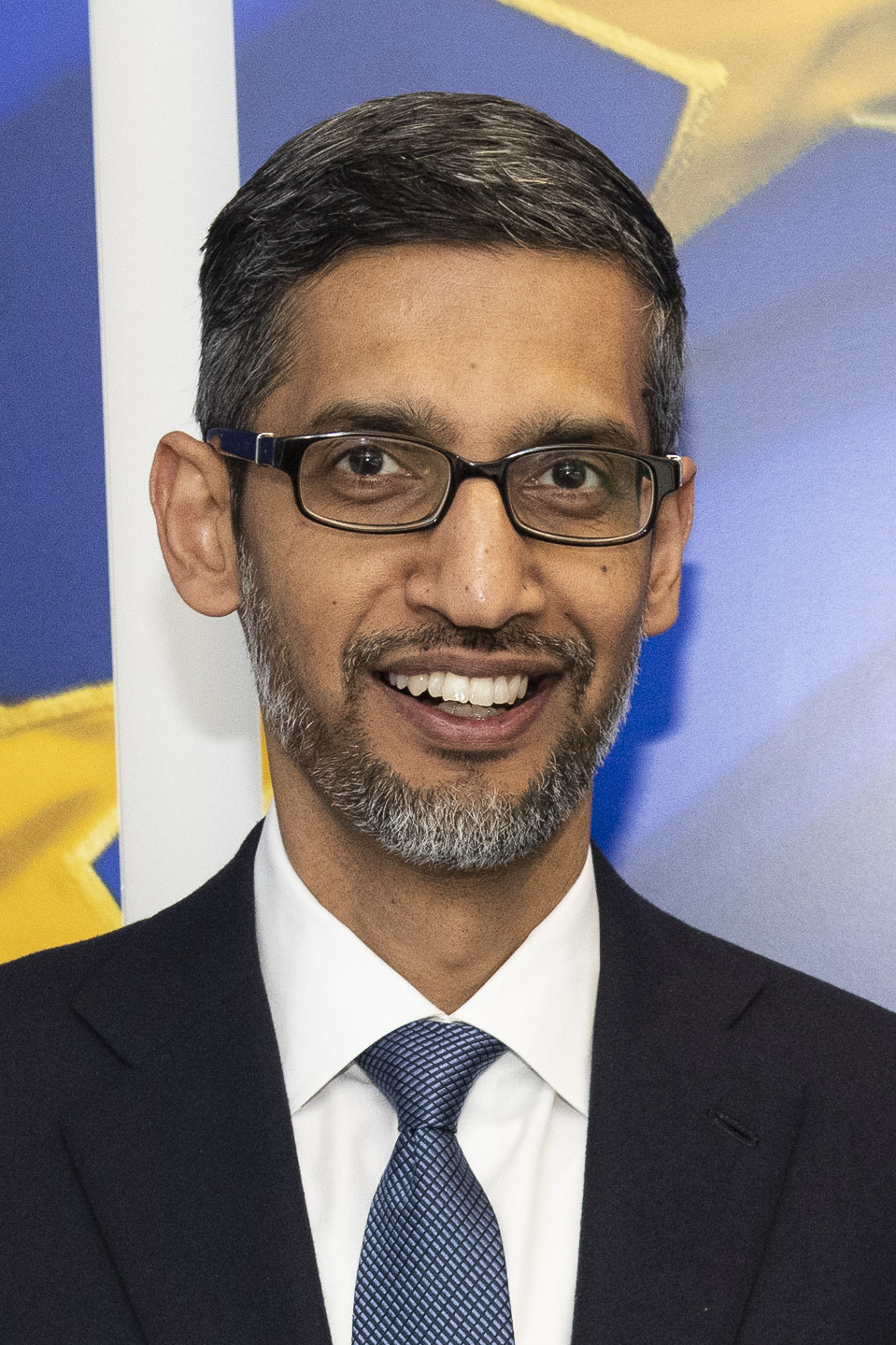
Sundar Pichai
Frontier Insights
Frontier Thesis
Pichai views Gemini not as a standalone chatbot, but as the ubiquitous, horizontal intelligence layer underpinning Google’s entire ecosystem—from 1.5B+ Search users to Android, Cloud, and Waymo.
Strategic Decisions
Alphabet is aggressively trading capital for moats: investing $75B in capex, TPUs, and data center capacity to drastically crush token costs and latency via efficient models like Flash, while actively reinventing its $200B core ad engine through monetizable AI Overviews.
Risks & Warnings
Execution bottlenecks loom: high inference latency, soaring power demands, persistent lag in agentic coding, and the perilous task of maintaining search monetization while racing toward AGI.
Key Views & Dialogues
Our Field Trip to Google I/O + A Sit-Down With Sundar Pichai + System Update
- 🗓️ Date:
2026-05-22| 🎙️ Show:Hard Fork
Google pitches Gemini 3.5 Flash at four times the speed and much lower cost of leading frontier models, alongside AI Mode’s biggest Search change in 25 years. Pichai conceded gaps in agentic coding and long-horizon work, citing Antigravity usage “doubling every week,” while trust, security, monetization, and uncertain AGI timing remain constraints.
View Dialogue Notes & Key Takeaways
Google’s I/O pitch rests on efficiency, distribution, and product breadth: Gemini 3.5 Flash is four times faster and much cheaper than leading frontier models, while AI Mode accompanies what Google calls Search’s biggest change in 25 years. Kevin saw a strategy built to serve billions; Casey countered, “Fast and cheap is what you talk about when it isn’t the best,” with much of the promised utility still “coming this summer” or limited to trusted testers.
Sundar Pichai candidly conceded that Google is a bit behind in agentic coding, tool use, instruction following, and long-horizon work on complicated codebases. He argued that internal Antigravity usage is “doubling every week,” producing the data needed to close the gap, and that in today’s model race “30 to 60 days look like five years.”
Google plans to evolve Search methodically rather than abruptly retire its classic interface, preserving sources and links while expanding AI Mode. Pichai expressed confidence that greater user value will support some combination of advertising and subscriptions: “Adam Smith’s rules don’t change in this new world.”
Public acceptance is a strategic constraint Google must address beyond model benchmarks: a cited New York Times/CNN poll found 16% of people calling AI mostly good versus 35% mostly bad. Pichai called the anxiety natural because “humans aren’t evolved to process that much change,” acknowledged disruption and economic concerns, but rejected overly deterministic doom scenarios.
Google is deliberately constraining consumer agents until they earn trust, because an unexpected action could make users back off and the systems can be hacked. Pichai compared the rollout to persuading someone to enter the back seat of a self-driving car: users need control and transparency before Spark can progress from meeting preparation and calendar organization to consequential tasks.
Pichai described current agent systems as a continuum toward recursive self-improvement, not RSI itself. Antigravity can build a simple operating system in over 12 hours rather than the “multiple thousands of hours” a person might need, but “we aren’t quite there yet”; if that threshold approaches, he wants consultation beyond individual labs and no “race conditions” around AGI.
Selling TPUs to rivals is a platform-economics decision, not a concession that starves Google’s own models. Pichai said first-party AI and Google Cloud have separately planned capacity and cash flows, while outside researchers improve future hardware; he still could not choose between a three-to-five-year and five-to-10-year AGI horizon, but progress over the last one to two years made him feel it was “on the closer side than not.”
Meta’s response to falling behind is an unusually large organizational bet: roughly 8,000 layoffs, or 10% of workers, alongside 7,000 employees reassigned to AI initiatives. The hosts expect morale and surveillance concerns to intensify, but Casey’s thesis was stark: helping Mark Zuckerberg win the AGI race is now “the entire point of the company,” with “not a secondary objective.”
🔗 Original source & video: Our Field Trip to Google I/O + A Sit-Down With Sundar Pichai + System Update
Sundar Pichai: CEO of Google and Alphabet | Lex Fridman Podcast #471
- 🗓️ Date:
2025-06-05| 🎙️ Show:Lex Fridman Podcast
Sundar Pichai’s central bet is that Gemini becomes a horizontal intelligence layer across Search, coding, Android, Waymo and robotics, with monthly token volume rising from 9.7 trillion to 480 trillion in 12 months. Search is being rebuilt around AI-mediated discovery while serving cost and latency constrain model deployment, and Alphabet’s 2026 Waymo scaling, AI Mode rollout and agentic web remain catalysts to monitor.
View Dialogue Notes & Key Takeaways
Pichai’s central bet is that Gemini can become one horizontal intelligence layer across Alphabet rather than a standalone chatbot product. The same multimodal world model can improve Search, Gmail, coding, Android/XR, Waymo and robotics, letting one deep investment advance several businesses. “For the first time you can do one investment in a very deep horizontal way” and drive multiple products on top.
The model curve has not flattened, but serving economics—not maximum intelligence alone—determines what reaches users. Gemini’s monthly token volume rose from 9.7 trillion to 480 trillion in 12 months, a 50x increase, while Pichai still sees headroom across pre-training, post-training, test-time compute, tools and agents. A Pro model can capture roughly “80, 90%” of Ultra capability with tolerable latency and cost; Fridman noted that Flash may be more impactful than Pro when latency is decisive.
Google is redesigning Search as an AI-mediated route into the web, with monetization following only after the organic experience works. AI Mode fans each query into multiple searches, assembles context and supports dialogue; Gemini’s translation can also widen access to the English-language web for non-English speakers. Linking to the human-created web remains “a core design principle.” Ads will eventually be rethought as relevant “commercial information,” alongside subscriptions, rather than simply inserted into the old 10-blue-link format.
Alphabet’s AI recovery was built on a small number of consequential organizational and infrastructure decisions made before public sentiment turned. Pichai points to the TPU investment begun 10 years earlier, combining Google Brain and DeepMind, forming a dedicated AI infrastructure team and physically colocating researchers. While outsiders argued he should step down, he treated leadership like scuba diving: beneath a choppy surface, “you go down one foot under” and find calm—without ignoring genuine external signals.
AI is already increasing engineering output, but Google’s measured gain is more conservative than code-generation headlines imply. Roughly 30% of code uses AI-generated suggestions, yet Google estimates the actual company-wide engineering-velocity gain at 10%; it still plans to hire more engineers. Fridman expects the larger unlock from dependable agents handling migrations, refactoring and whole-codebase work, while humans retain design, architecture, judgment and problem-solving.
Generative AI should expand creative supply dramatically, while scarce human presence may command a premium. Fridman imagines tens of millions—or perhaps a billion—people turning ideas into software, films and other artifacts; Pichai expects more filmmakers and an expansion of human creativity, insisting that “this is the worst it’ll ever be.” Yet informational content may automate faster than experiences rooted in human struggle: people may consume an AI history briefing while still wanting to watch a person contend with that history, much as a perfect machine athlete may not evoke Messi.
Alphabet sees physical AI as a portfolio extending from proven autonomy into robotics and ambient computing. Waymo had reached 10 million paid robotaxi rides, with further scaling planned in 2026; Pichai expects both Waymo’s general-purpose L4/L5 driver and Tesla to prosper in a vast market. Gemini Robotics, Project Astra, Android XR, translation glasses and Google Beam all test how the same intelligence can perceive and act in the physical world.
Pichai expects extraordinary disruption by 2030 even if AGI arrives slightly later, and argues that existential-risk mitigation could be partly self-correcting. He calls today’s uneven systems “artificial jagged intelligence” and says, “we will just fall short” of AGI by 2030, while still facing major positive and negative externalities by then. He offered no numerical p(doom), but argued that a sufficiently high perceived threat could align humanity against it—a “self-modulating aspect”—while explicitly saying this does not mean he thinks the underlying risk is “actually pretty high.” Fridman also argued that AI may reduce the dangers humanity faces without AI.
🔗 Original source & video: Sundar Pichai: CEO of Google and Alphabet | Lex Fridman Podcast #471
Sundar Pichai, CEO of Alphabet | The All-In Interview
- 🗓️ Date:
2025-05-16| 🎙️ Show:All-In
Alphabet is rebuilding its roughly $200 billion search-ad engine around AI Overviews and AI Mode, reaching more than 1.5 billion users across 150-plus countries while queries grow longer. AI Overview ads have reached the revenue baseline of traditional results, serving cost has fallen dramatically, and 2025 capex of $75 billion targets infrastructure and Cloud capacity. Latency, electricity, and execution remain the binding constraints as Alphabet extends its full-stack advantage and pursues quantum, robotics, and ambient-computing catalysts.
View Dialogue Notes & Key Takeaways
Pichai is defending a company whose stock has risen 4.5x to a roughly $2 trillion market cap under his tenure, while quarterly revenue grew from $20 billion to nearly $100 billion. His defense of Alphabet’s roughly $200 billion search-ad run rate is that generative AI expands demand rather than merely cannibalizing links. AI Overviews reach more than 1.5 billion users across 150-plus countries, produce sustained query growth where triggered, and will be joined by AI Mode, where queries are already two to three times longer than search queries two years ago. His operating rule: “The dilemma only exists if you treat it as a dilemma.”
The early economics weaken the sharpest bear case: AI Overview ads have reached the revenue baseline of traditional results, while serving cost has fallen dramatically over 18 months. Pichai says latency—not cost per query—is now the harder constraint because search users expect near-instant responses. His upside case is that “commercial information is also information,” so better AI should eventually improve ad relevance.
The standalone Gemini app trails on Friedberg’s cited scoreboard, but Pichai argues Alphabet’s AI distribution is broader than an app comparison. Friedberg cited figures from recent court testimony, including March data, of 350 million monthly Gemini users against 600 million for ChatGPT and 500 million for Meta AI; Pichai pointed to stronger engagement after Gemini 2.5 Pro and called it “still early days.” He emphasized usage across Search, YouTube, Cloud, Android-related Gemini experiences, and the Gemini app. Diversification matters too: YouTube and Cloud exited last year at a combined $110 billion.
Alphabet is spending $75 billion in 2025 to turn its full-stack infrastructure into both a cost advantage and a Cloud-capacity asset. Most capex goes to servers and data centers, while half of compute spending supports Google Cloud; seventh-generation TPUs and an Ironwood single pod above 40 exaflops underpin the claim that Google sits on the “Pareto frontier of performance and cost.” NVIDIA remains complementary: Gemini runs on GPUs as well as TPUs, and Pichai called NVIDIA’s software stack “world class.”
Pichai sees no fundamental model plateau yet, though harder gains should increasingly separate elite research teams. He described progress as “artificial jagged intelligence,” moving from pre-training to post-training, inference compute, and agentic workflows. DeepSeek forced an adjustment in priors about China’s proximity to the frontier, although Google’s internal comparison found Flash similarly efficient or arguably better.
Electricity and execution—not model theory—look like the binding constraints on AI-led growth. Friedberg cited US power capacity rising from roughly 1 to 2 terawatts by 2040, versus China moving from 3 to 8; Pichai acknowledged Google Cloud is already supply-constrained this year. Solar-plus-batteries, nuclear, geothermal, grids, permitting, transmission, and electrician shortages therefore become part of the Alphabet thesis.
Quantum, robotics, and ambient computing are moving from distant research options toward stated breakthrough windows. Pichai puts a useful quantum computation in roughly three to five years, a “magical moment” for robotics two to three years away, and compelling AR glasses a couple of product cycles out. Google previously tried the robotics application layer “too early”; Gemini’s vision-language-action models now change the premise.
The execution reset combines founder involvement, smaller teams, in-person intensity, and a portfolio unified by foundational technology rather than capital allocation. Sergey Brin is working with Gemini engineers on code, loss curves, architecture, and post-training, while Pichai has recreated Labs-style work with roughly 10-person teams and refocused employees on mission. He says Google is retaining critical AI talent and attracting top PhDs; Googlers have started more than 2,000 companies. Alphabet is “not a holding company” in the conventional sense—but Pichai still cited a heavily debated Netflix acquisition as one alternate path in the “multiverse.”
🔗 Original source & video: Sundar Pichai, CEO of Alphabet | The All-In Interview