Thomas Laffont
Frontier Insights
Frontier Thesis & Strategy: AI is driving an unprecedented capital concentration into a $4T private unicorn pool (led by OpenAI, Anthropic, and SpaceX), pointing toward a massive upcoming IPO wave. The impact is already quantified: AI disruption is eroding legacy search, while SaaS revenue growth slows from 17% to 9%. Value is shifting to sovereign compute and infrastructure challengers (CoreWeave, Oracle) as GPU allocation diverges from legacy cloud share.
Risks & Warnings: Sky-high capex, looming model price wars, passive capital crowding, and uncertain macro liquidity (debt sustainability, IPO timing) threaten to rapidly compress fragile valuations.
Key Views & Dialogues
Thomas Laffont: The $4T AI IPO Wave Is Coming… and We’ve Never Seen Anything Like It
- 🗓️ Date:
2026-06-04| 🎙️ Show:All-In
AI has made the unicorn economy healthier but sharply more concentrated: funding per unicorn is up 5x since 2021, and a private “Magnificent Eight” approaches $4 trillion ahead of a possible liquidity event. OpenAI and Anthropic could exceed AWS by year-end and potentially all of Microsoft by 2028, while SpaceX’s recurring constellation revenue supports a platform thesis; public-market scrutiny and a possible price war remain unresolved.
View Dialogue Notes & Key Takeaways
Laffont argues that AI has made the unicorn economy healthier but radically more concentrated. The economy is up 70% since September 2024, while funding per unicorn has increased 5x since 2021 because fewer companies are raising much larger rounds. The result is a K-shaped market where “the power law rules our lives” and the cost of missing a winner keeps rising.
A private-market “Magnificent Eight”—with seven names listed in the transcript—now represents almost $4 trillion and could drive an unprecedented liquidity wave. Laffont names SpaceX, Stripe, Anthropic, Databricks, Revolut, ByteDance and Anduril; he says nearly every constituent has beaten the Magnificent Seven. Adding the anticipated SpaceX, OpenAI and Anthropic listings could return more capital than roughly the prior decade combined.
OpenAI and Anthropic are scaling quickly enough to challenge the hyperscalers financing them. Laffont’s assumptions suggest the AI leaders could exceed AWS by year-end and potentially all of Microsoft by 2028, though he stresses these are forecasts. His rebuttal to bubble comparisons is blunt: “These are not fake companies”—they have substantial revenue, extraordinary growth and, reportedly, even a profitable month at Anthropic.
SpaceX should be valued as an improving platform, not simply as a launch operator. Laffont finds launch cadence most correlated with valuation, but valuation per launch also rises because each launch advances the business from unpredictable contracts to recurring constellation revenue, multiple customer-owned constellations and eventually new applications such as space data centers. Starlink alone may address a global telecom and service-provider profit pool of $200 billion to $400 billion.
The episode’s “10X paradox” is that the largest company bucket shows a higher historical incidence of a 10x. Laffont’s data puts the unicorn-to-decacorn rate near 8%, the decacorn-to-$100 billion rate at 8%-13%, and the share of $100 billion-plus companies that had achieved a 10x at 31%. He extrapolates that trillion-dollar companies might have greater than 30% odds of reaching $10 trillion. The hosts challenge the obvious trade—buy only after $100 billion or even $1 trillion—because crowded demand can detach valuations from familiar metrics.
The next public-market test may take time to emerge after passive demand washes through supply. The hosts suggest “six months plus one” as a possible point for clearer judgment. Laffont welcomes scrutiny from short sellers, politicians and public investors, while declining to infer a structural inefficiency from a tiny sample: Anthropic became a different company after Claude Code, a single event that “dented the trajectory” of almost the entire industry. Longer term, recycled IPO capital could fund infrastructure—or provoke an OpenAI-Anthropic price war, though Laffont says their infrastructure spending makes that outcome unclear.
🔗 Original source & video: Thomas Laffont: The $4T AI IPO Wave Is Coming… and We’ve Never Seen Anything Like It
Thomas Laffont, Coatue - Anthropic, Citrini Paper, AI Volatility & Next Mag 7
- 🗓️ Date:
2026-03-06| 🎙️ Show:Sourcery
Anthropic’s raise saw projections and business scale move materially within months, while board decks show AI-tool spending expected to at least triple next year. With the Mag 7 flat and Microsoft shedding almost $1 trillion, SpaceX, OpenAI, Anthropic, Revolut and Databricks could reshape the index, while SaaS faces reacceleration, multiple compression, and harder-to-control terminal value.
View Dialogue Notes & Key Takeaways
In a discussion of Anthropic’s announced $30B fundraise, Laffont says the projections and scale of the business grew materially during the roughly two-to-three-month process. He thinks the disclosed revenue was “something in excess of $13 or $14 billion or something like that,” materially lower when discussions began. He points to Claude Code adoption—its inventor Boris, a friend who worked at Coatue for 2.5 years developing software—and a repeating board-deck pattern: one slide said spend on the tool was “way too low” and expected to at least triple next year.
The Mag 7 has been “essentially flat over the past year or so,” with Microsoft shedding “almost $1 trillion,” and Laffont’s candidates for the next index are SpaceX, OpenAI, Anthropic, Revolut and Databricks. “If you want to outperform the index over a long period of time, you’re going to need exposure to these companies” — some of them will probably go public in the next twelve to twenty-four months.
On the Centrine paper: he rejects the fire-in-a-crowded-room analogy and says early discussion is healthy. “By definition, if everyone thinks we’re in a bubble, then we’re not in a bubble” — and he’d “much rather have daily volatility and daily questioning than no volatility or no questioning, followed by a massive crash three years later.”
His SaaS re-rating math is stark: Workday growing 13% organically at 28–30x GAAP earnings versus Avago growing “almost 40%” at a cheaper multiple. Either AI re-accelerates the top line or multiples settle at “some version of twenty-ish times GAAP earnings” — and a third, sentiment-driven bucket looms: “in three or four years, if Claude Code can rewrite their entire business,” terminal value is “harder for companies to control.”
On the “sixty-four-trillion-dollar question” of software jobs, not one company he’s involved with is saying “we want to cut our engineering staff in half.” They hope engineers become more productive and enable new features. He asks whether companies such as Rippling could shift from selling software to selling “the work of an HR professional,” while keeping open the possibility of fewer outsourced engineers in India. His anti-doomer example is the ATM: a 1970s NYT article predicted 70% teller-job cuts, but teller jobs exploded through the early 2000s as cheaper branches multiplied.
His “BFI” (big fucking idea) framework dismisses pitched TAMs: what matters is whether the TAM grows 2–3x over five-to-ten years and whether new TAMs get added, as Uber grew the taxi market “five or 10x” then added grocery and food. His biggest early Apple error was modeling the phone’s price declining 5% over five years — “the opposite happened.”
The under-discussed half of Coatue, highlighted in his lesson from brother Philippe, is risk management — forged after the fund launched in December 1999 and the market fell “80%” over about two and a half years. “Your formative years as an investment manager will stick with you like a face tattoo over the next decades” — and “the ability to endure and compound is what really defines generational investing firms.”
🔗 Original source & video: Thomas Laffont, Coatue - Anthropic, Citrini Paper, AI Volatility & Next Mag 7
IPOs and SPACs are Back, Mag 7 Showdown, Zuck on Tilt, Apple’s Fumble, GENIUS Act passes Senate
- 🗓️ Date:
2025-06-21| 🎙️ Show:All-In
Meta is treating AI as a threat to perhaps half of its $1.7 trillion value, pairing reported $100 million talent offers with a $14 billion-plus Scale AI stake. That insurance addresses labeling and agent knowledge, but Chamath says Meta still lacks tightly coupled compute and silicon, making infrastructure integration the key risk as the Mag 7 separates into distinct AI wagers.
View Dialogue Notes & Key Takeaways
Meta’s reported $100 million talent offers and $14 billion-plus Scale AI stake are rational insurance against an AI threat to perhaps half of its $1.7 trillion value. Thomas Laffont calculates that spending 4%-5% of the roughly $850 billion at risk makes sense if it marginally improves Meta’s odds. Chamath’s warning is that labeling and agent knowledge supply only two parts of “the compounding of secrets”; without tightly coupled compute and silicon, Meta remains “on their back heel.”
The Mag 7 has fractured into distinct AI wagers: Meta +18%, Microsoft +13%, Nvidia +8%, Amazon -3%, Google -8%, Tesla -20%, and Apple -21% in the cited period. Five-year picks clustered around Google and Tesla because both can integrate models, proprietary infrastructure, distribution, and physical products. Nvidia remains protected by GPUs, but Friedberg sees a “low probability but very high severity risk” from Chinese semiconductor innovation.
Apple drew the episode’s sharpest disagreement: its large installed device network could become an ambient AI moat, or its cash-cow culture could make reinvention impossible. Friedberg imagines one “ethereal and ubiquitous” assistant moving across AirPods, watches, phones, cars, and rooms; Jason wants a humanoid robot. Chamath sees a company optimizing cables, replacement devices, and buybacks—“a this-and-that strategy is not a strategy”—while Thomas argues Apple’s recurring-profit transition proves it has reinvented itself before.
IPOs and M&A are reopening because investors need exposure to scarce growth after SaaS decelerated from 17% median growth in 2021 to 9% today. CoreWeave reportedly quadrupled to an $81 billion market cap, Circle rose roughly sixfold to $48 billion, and Chime initially gained 40% before retreating 20%. The old growth basket is fading: only 5% of the cited SaaS cohort still grows above 25%, versus 25% in 2021.
AI’s economic upside comes from expanding service throughput while replacing bloated software and operating expense. OpenEvidence was said to reach one-third of US physicians, often used ten times daily, while Chamath described development gains of 50%-70% at successive workflow stages that compound into dramatically smaller teams. His trade: find businesses capable of replacing hundreds of millions in licenses with tens of millions in custom software.
The labor outcome remains unresolved even among the panel: Microsoft’s roughly 250,000-person workforce could grow, remain flat, or shrink depending on whether AI creates revenue faster than it removes work. Chamath says today’s coding agents produce too much “crap” on long, complicated tasks for layoffs to be credited to them; Friedberg thinks that limitation may disappear within three or four years. All agreed that owning a synthetic basket of AWS, Azure, and Google Cloud could capture the infrastructure demand whichever platform leads.
The Senate’s 68-vote GENIUS Act would bring stablecoin issuers onshore, require quarterly audits and one-to-one reserves, and give legacy offshore issuers three years to comply. It also preserves banks’ position by prohibiting issuers from passing reserve interest to token holders—a compromise Sacks hopes will eventually be revisited. His framing was a reversal from “regulation through prosecution” toward rules the crypto industry can actually price and follow.
🔗 Original source & video: IPOs and SPACs are Back, Mag 7 Showdown, Zuck on Tilt, Apple’s Fumble, GENIUS Act passes Senate
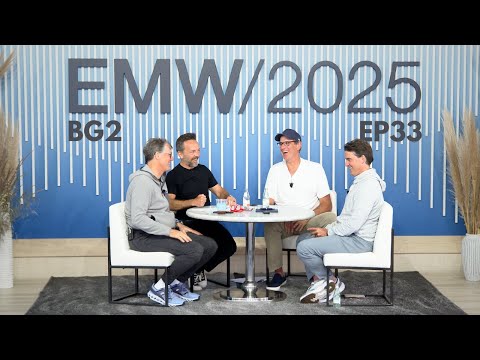
Coatue’s Laffont Brothers. AI, Public & VC Mkts, Macro, US Debt, Crypto, IPO’s, & more | BG2
- 🗓️ Date:
2025-06-20| 🎙️ Show:BG2
Coatue’s joined receipt data shows ChatGPT subscriptions coincided with Google page views falling 8% YoY, after pre-subscription growth of roughly 4% annually, despite no built-in virality. Cloud revenue shares diverge sharply from Nvidia GPU allocation—AWS has 44% of cloud revenue but roughly 20% of GPUs, versus Oracle’s 5% and 19%; whether this reflects AI lag, different silicon, or Nvidia concentration limits remains crucial.
View Dialogue Notes & Key Takeaways
Philippe Laffont is the most bullish he’s been in ten years of East Meets West, and his core argument is that the AI supercycle is never priced in precisely because everyone perpetually fears the peak: “every time I’m optimistic I’m worried this is it… and yet things tend to work out.” Tech has gone from 5% to 15% of global GDP and Coatue’s provocative slide asks when AI reaches 75% of total US market cap — with utilities and power-equipment makers arguably due for reclassification as TMT.
Coatue joined 100M daily credit-card receipts with email-receipt data to show ChatGPT is measurably eroding Google: users’ Google page views grew ~4%/yr pre-subscription, then fell 8% YoY (11% peak-to-trough) after they started paying OpenAI $20/month. “These major shifts start one little step at a time and that one little step becomes a gigantic move quickly” — and ChatGPT’s adoption curve beats Twitter/Instagram/TikTok despite having no inherent virality.
Slide 27 is Bill’s “favorite slide”: cloud revenue share (AWS 44%, MSFT 30%, GOOG 19%, ORCL 5%) vs Nvidia GPU allocation (AWS only 20%, Oracle 19%, CoreWeave 11%). Either AWS is behind in AI, is running a different silicon strategy, or Nvidia won’t tolerate a dominant customer — and if GPU share predicts future cloud share, Oracle’s reinvention and CoreWeave’s pure-play focus are the trade, with possibly “a dozen hyperscalers” coming.
On macro, Philippe’s formula: “tokens trump tariffs.” If AI drives 1990s-style productivity of 2.5–3.5%/yr, debt/GDP bends from a projected 140% back toward 80–100% — raising the question of who rationally buys 30-year bonds at 4.5% (a move to 6–7% loses you 60–70%). Precedent: in 1993 experts said debt/GDP would go 60→80; it went 60→40.
The brothers are forcing themselves to re-rate Bitcoin as an institutional asset: at $2T of ~$450–500T world net worth vs gold at $15–20T and Microsoft at $3.5T, “could it be five or six?” Stablecoin legislation passed the day of recording, and Brad predicts interest-bearing stablecoins lead to 1/5/10/30-year government stablecoins — government going direct-to-consumer “just like companies do.”
The private-market cycle is turning red-to-yellow/green: after a 2021 cohort that’s still down 50% five years post-IPO (ex-SPACs; ~75% on a relative basis), CoreWeave and Circle worked and rule-of-40 cohorts are being rewarded. Meta paying “100% of the price for 49% of the company” for Scale shows the urgency premium — Anthropic’s billions took 12 months, then 3, then 2.
It’s the “golden age of margin expansion”: Mag 7 revenue compounding 20%+ on ~2% opex growth, Microsoft possibly at peak employees forever, AppLovin doubling revenue with headcount down 35%+. Bill’s tell: “a willingness to reduce headcount is a different level” of AI conviction than lip service. Google has 187,000 employees; OpenAI 2,700.
Thomas’s founder 2x2: growing >25% and profitable → get IPO-ready; >25% burning → fortress balance sheet (OpenAI just raised $40B); <25% profitable → play offense, even back into losses; <25% and burning → “reinvent” — Bill’s warning that these companies are “protecting something that doesn’t exist” as their multiple slides from 5x to 1x.
🔗 Original source & video: Coatue’s Laffont Brothers. AI, Public & VC Mkts, Macro, US Debt, Crypto, IPO’s, & more | BG2
Trump’s First Week: Inauguration Recap, Executive Actions, TikTok, Stargate + Sacks is Back!
- 🗓️ Date:
2025-01-25| 🎙️ Show:All-In
Trump’s opening week reset national strategy around energy, technology and private capital, with DOGE confronting agencies’ spending incentives and Stargate proposing $500 billion for AI infrastructure. The decisive tests are whether compute earns an adequate return, whether electricity and nuclear deployment can scale, and whether TikTok’s proposed ownership structure avoids government picking winners.
View Dialogue Notes & Key Takeaways
Trump’s opening-week signal was a business-first reset that places technology, energy and private capital at the center of national strategy. Chamath read the inauguration’s business-heavy guest list—leaders from Meta, Google, Apple and others alongside international business figures—as “Team America,” while Thomas Laffont highlighted Scott Bessent’s sharper framing: “We’re not in a green-energy race with China; we’re in an energy race with China.” The political mandate may be broad, but Friedberg warned that congressional incentives still favor projects and jobs over deficit reduction.
DOGE’s engineering model is clear, but its political path is not: each agency gets a four-person team while legislators remain rewarded for bringing spending home. Friedberg’s best evidence was Mitch McConnell pressing the agriculture-secretary nominee about a delayed $60 million Kentucky research lab—the opposite of voting programs away. His bleak assessment: “There’s no stop in the train,” while DOGE’s last-minute move inside government changes its institutional setup.
TikTok’s US franchise plausibly supports a roughly $100 billion valuation, with a much higher ceiling if it monetizes like Meta. Laffont estimated about 100 million US DAUs versus roughly 200 million across Facebook and Instagram, yet comparable aggregate time spent; starting from Meta’s $1.5 trillion market cap produced a theoretical $375 billion US ceiling before regulatory, algorithm and execution discounts. The product’s original insight was equally important: every uploaded item gets shown to at least one person, so “your content will be shown” even without followers.
Trump’s demand that America receive 50% of TikTok prompted a wider proposal: taxpayers should share the upside whenever government grants scarce permits, land or subsidies. Chamath invoked Bernard Arnault’s one-franc acquisition of the Boussac assets containing Christian Dior and argued that a retained French stake could now be worth $175 billion; he would likewise have accepted 5%-10% government equity alongside a company he helped start’s $150 million battery-materials grant. Laffont’s pushback was fundamental: ownership risks government “picking winners,” while taxes and open auctions preserve a level playing field.
Stargate’s announced $500 billion over four years is financeable facility by facility, but the real underwriting question is whether the resulting compute earns an adequate return. Laffont’s OpenAI bull case rests on ChatGPT’s claimed 300 million weekly actives, more than one million enterprise users and 80%+ share versus Gemini and Grok—not on whether SoftBank wires $500 billion upfront. Chamath countered with a Chinese, MIT-licensed model built for millions, runnable on a laptop and, in his account, competitive with OpenAI’s o1—evidence that “spending more money doesn’t necessarily get you further along.”
Electricity, not GPUs, may be the binding constraint on American AI: the US pays roughly 1.5x-3x China’s power price and has about half its generation capacity. Thomas’s chart put the countries near 1,000 terawatt-hours each in 2000 but roughly 1,600 versus 9,000 today; Laffont argued that even export controls become irrelevant if China eventually has 10x the power and can deploy vastly more, slightly older chips. Their categorical conclusion was that America cannot catch up without nuclear, and Friedberg called regulatory delay a larger national-security threat than the border.
Trump’s first actions exposed the tension between political reconciliation and equal justice while giving David Sacks formal mandates in crypto, AI and science policy. Friedberg, from a law-enforcement family, said pardoning roughly 1,500 January 6 participants—including violent offenders—“betrayed the blue”; Jason called January 6 “a stain” but argued that unequal prosecutions and excessive sentences made a more granular review necessary, while Friedberg questioned the pardon power itself. Sacks’s new working groups seek US crypto leadership, an AI action plan aimed at global “dominance,” less ideological model bias and a PCAST committed to “truth-telling in science.”
🔗 Original source & video: Trump’s First Week: Inauguration Recap, Executive Actions, TikTok, Stargate + Sacks is Back!