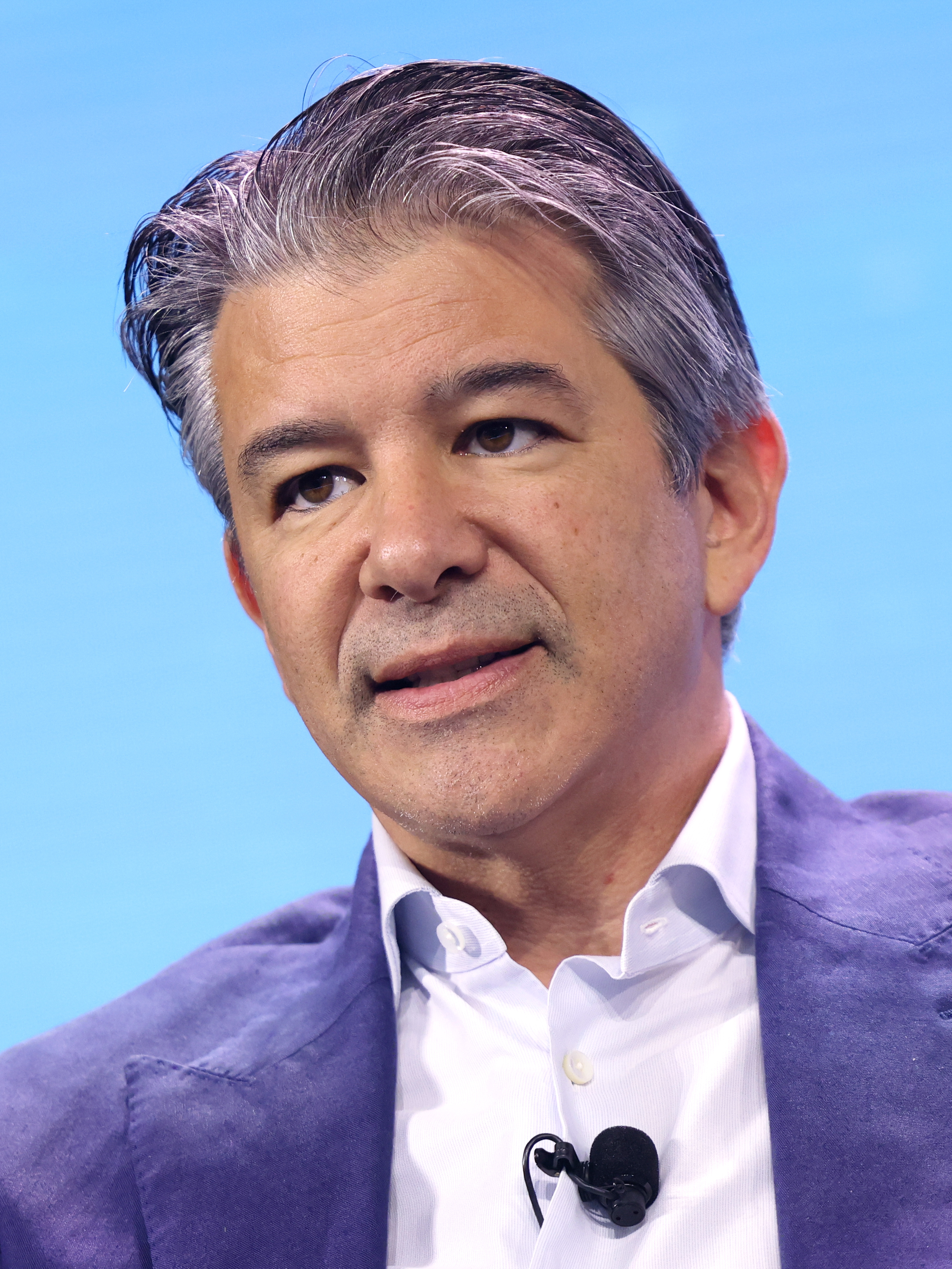
Travis Kalanick
Frontier Insights
Thesis: Value is violently shifting from raw silicon narratives to physical deployment. Atoms reconceptualizes the physical world as an “atomic computer,” leveraging full-stack industrial AI to cut food, mining, and logistics unit economics by over 50%.
Strategy: Bypass commoditizing foundation models and speculative Capex cycles. Instead, capture the application layer by integrating robotics, logistics, and proprietary operational data into defensible, full-stack infrastructure.
Risks: Token deflation and hyper-efficient models threaten compute pricing power. Long-term moats hinge not on narratives, but on ruthless capital discipline, heavy operational execution, and navigating aggressive regulatory friction.
Key Views & Dialogues
Excellence Is the Capacity To Take Pain | Travis Kalanick, Founder of Uber
- 🗓️ Date:
2026-08-16| 🎙️ Show:David Senra
Adams—also rendered “Atmo” or “Atoms” in the transcript—is pursuing specialized robotics and AI across food, mining, and robot “wheelbase,” targeting gains such as 20% more annual mine output. Its investable thesis is that operational efficiency can eventually outrun subsidy, but management capacity, regulatory intervention, and the company’s “slightly different” fundraising process remain key execution and financing variables to monitor.
View Dialogue Notes & Key Takeaways
The current venture is called Adams in the transcript, though later passages also render it as “Atmo” or “Atoms.” Kalanick describes specialized robotics and AI attacking one industry at a time—food, mining, and autonomous “wheelbase”—rather than humanoids. A humanoid suits general-purpose home chores, but “if you want to make a thousand pancakes an hour, you wouldn’t have a humanoid do it.” He presents 20% more annual mine output as the kind of gain automation could target; since everything is grown, mined, or manufactured, “land is the whole damn thing”—automating that lever could make it “the ultra lever.”
The core marketplace lesson from Uber’s wars: “at some point efficiency outstrips subsidy.” Efficiency compounds from signup flow through pickup times, completion rates, and driver positioning into network effects. At 10 billion rides a year, nobody funds $2-a-ride subsidies ($20B/year), so a more efficient network can eventually outstrip a rival’s subsidies—“this is why Lyft is smaller than Uber,” in his account.
Uber China went “so vertical it almost leaned to the left” — at one point, probably Uber’s top 10 cities by rides were Chinese — before Chinese state-linked money and government action turned the contest against Uber. Didi were “pure warriors, no poetry,” copying at art-form speed; Uber gave Baidu roughly 7%, rather than the roughly 50% people said a China partner required, to secure trusted local backing amid regulatory pressure.
Taxis are “a government-condoned cartel that outlaws competition” — and Kalanick says New York is turning Uber back toward that system. NYC medallion economics as he tells it: a driver paying $40k/year to rent a car for a 12-hour shift, with $80k/year flowing to a holder “whose grandpa got it for free.” After Kalanick left, he says limits on Uber drivers made the number of Ubers “either fixed or shrinking right now”—while acknowledging he may have that wrong—which he attributes to rising prices and falling reliability.
On Benchmark: an “unspoken activist investor” ran a once-a-week-crisis war room in 2017 while Uber was already preparing an IPO — and his fundraising rule stands: “I never get attached to a price. I get attached to a process.” Gurley, whom he calls a catastrophist, urged taking the first term sheet at roughly a $6B valuation in mid-2014; a competitive process closed two months later at a $17.5B pre-money valuation. His VC math: perhaps 10% clear the “do no harm” bar and 1% are actually helpful—the VC is “a chess enthusiast” checking in quarterly on a grandmaster’s game.
His fundraising mechanics are a usable template: at peak Uber, five simultaneous pitch rooms ran 12 hours a day for a week, covering $250M-plus, $100M, $50M, and $25M checks. The modern variant collects each bidder’s demand at illustrative prices, aggregates the curve, cuts and re-bids. In a supercycle, he says a two-hour “QED” presentation might need to become 45 minutes—otherwise “you’ll talk yourself out of the deal”—and focus more on the theory of the case. He is closing an Adams round now on a “slightly different” version.
The maxim “excellence is the capacity to take pain” comes with an unexpected caveat: you can get too numb. The world-class marathoner at mile 21 isn’t smiling, and “all of human progress is through that push toward excellence. That is a push through pain.” But a veteran can lose “the extra fierceness” of being bothered by something wrong. His stated end state: “imagine fierceness with calm on the inside. That’s what I got.”
The self-diagnosis worth filing: “I was running a $70 billion company the way somebody who thought he was going to starve next week would run it” — no “chalk on the shoe,” but too close to the line too often. Today, he says, many tasks that took him X time take X/3; the core of his Adams vision note took about 90 minutes. Of his younger self, he says, “I would kick his ass.” On fear of failure, he agrees it can get you places but not all the way, and says he was transitioning away from it. He started Uber at 33 with his couple million already invested in friends’ startups, including as the first investor in Expensify.
🔗 Original source & video: Excellence Is the Capacity To Take Pain | Travis Kalanick, Founder of Uber
Travis Kalanick on Building Atoms After Uber
- 🗓️ Date:
2026-08-14| 🎙️ Show:The a16z Show
Adams is positioning “industrial AI” as an atom-based computer, with robotic food production at roughly $6–8 per meal targeting delivered meals near grocery-store cost and mining automation pitched as 20% more gold per year. Transport becomes the platform’s wheelbase across multiple hundred-billion-dollar industries, but the thesis still hinges on proving autonomy faster than Waymo and overcoming resistance to change.
View Dialogue Notes & Key Takeaways
Kalanick’s core thesis: Adams is building “industrial AI”—treating atoms like bits, where digitized manufacturing is the CPU, real estate is storage, and transport/logistics is the network of an “atom-based computer.” He has been pursuing this quietly for eight years (“a lot of folks think I’m back, but… I’ve been working my ass off the whole time”), framing the prize as multiple $100-billion or trillion-dollar industries being automated—a new industrial age alongside digital AI’s enterprise impact.
The food computer is the most concrete unit economics disclosed: robotic production at roughly $6–8 per meal, with “autonomous burritos” for delivery, targeting a prepared-and-delivered meal that “approaches the cost of going to the grocery store.” If production and delivery of food both get automated—which Kalanick says he expects—“food will be completely revolutionized.”
Mining is the second computer, and his pitch to gold-mine CEOs is blunt: “Would you like 20% more gold per year?” They have not said no, but they say, “Prove it.” His endgame framing is stark: if every part of mining gets automated, “what is a mining company? It just owns real estate. It will be completely revolutionized—a multitrillion-dollar market.”
Transport is the “wheelbase for robots”—his claim is that autonomy is a platform full of “silver medals” (food delivery, parcel, trucking, off-road/mining) spanning many $100-billion-scale industries, with a “dark-horse angle” if Adams builds autonomy faster than Waymo. Humanoids, in his telling, are for low-scale tasks in human environments; industrial scale demands specialized machines that move.
The recurring risk framework is what he calls the “final boss”: resistance to change, illustrated with the Homestead strike, Frick surviving an assassination attempt, and Edison’s animal-electrocution FUD against AC—rhyming with 2014 Uber strikes across Europe and Uber/Lyft drivers now protesting at Waymo’s office. “You have to deliver an overwhelming amount of progress to make your change happen.”
On his own evolution: at Uber he ran “right up against the line”—now he’s “a few inches off that line.” He still stands by every Uber decision, but says “you don’t need to guess anymore” that he did the right thing. Ben Horowitz’s diagnosis: thinking you’re in survival mode with 20,000 employees is dangerous because “the guy eight levels down” can do something stupid—while the “meritocracy and toe-stepping” culture that got diluted after Travis left was “the core part.” Kalanick says Adams now calls this “the best idea wins.” He also describes a “Champion’s Heart”: get back up after being knocked down.
The a16z round is Horowitz’s biggest check ever (versus Uber’s $4M pre-money first round), and the deal’s complexity came from merging Kalanick’s separate entities and efforts under one roof. Horowitz’s conviction test was whether it would be one thing and whether Travis was “still Travis”—the founder who had been “fired up” battling Chinese ridesharing companies. Kalanick compares putting the companies together with Elon managing multiple companies, though “a couple of decades later” in the arc.
Kalanick attributes his public return to a transformed media landscape: for eight years his KPI was “shut the fuck up,” with a 2019 leadership deck titled “Be Uniconic” and a “massive, high-fidelity playbook” for avoiding attention; thousands of employees were not allowed to put the company on LinkedIn. Now, “Elon buying Twitter is like the beginning of us being able to speak our minds and for disagreeing not to be illegal.”
🔗 Original source & video: Travis Kalanick on Building Atoms After Uber
Building a Company in Stealth | Travis Kalanick with a16z
- 🗓️ Date:
2026-07-22| 🎙️ Show:The a16z Show
Atoms is applying full-stack industrial AI to food, mining, and transport, with production, logistics, robotics, and infrastructure unified as an “atoms-based computer.” Its 50% production-cost reduction, 50¢–$1 robotic delivery, and mining productivity now above humans support a path to lower-cost meals and faster deployment, while execution depends on management capacity and overcoming industrial regulation.
View Dialogue Notes & Key Takeaways
Atoms aims to automate physical industries by treating manufacturing, real estate, and logistics as the CPU, storage, and network of an “atoms-based computer.” Kalanick is initially focused on “only food, mining, and transport,” building industry-specific computers rather than a general humanoid platform. The investment premise is full-stack industrial AI: software, sensors, robotics, machinery, and physical infrastructure controlled as one system.
The food thesis becomes transformative only if preparation and delivery approach grocery-store economics. Atoms combines manufacturing-and-logistics hubs, food robotics, and “autonomous burritos”—temperature-controlled couriers on wheels. Kalanick says production is 50% cheaper; replacing a roughly $12 delivery drop with 50¢–$1 robotic distribution, alongside about $6 of labor and $2–$3 of occupancy savings, could produce an $8–$10 meal “delivered to you all-in.”
Autonomous mining has crossed Kalanick’s critical commercialization threshold: better-than-human productivity. After acquiring Pronto, Atoms can ask a gold-mine CEO, “Would you like to get 20% more gold per year?” Customers still demand proof, but Kalanick says mines are now pushing the company to deploy faster, creating “super-exponential growth” with a parallel safety payoff in work where lives remain at risk.
Eight years of stealth protected execution and produced an unusually inward-facing culture, but at a steep operating cost. Following roughly “150 articles a day” of negative coverage, Kalanick wanted employees building without worrying about the next New York Times story; recruiting thousands of people and selling customers under a stealth identity was “super hard mode.” The benefit was a culture trained on “internal correctness versus external validation,” though he concedes stealth also malnourished the human desire for recognition.
a16z’s investment is explicitly a founder bet spanning the whole portfolio, not a wager on one vertical. When Kalanick presented food, transport, and mining like “20 watches” inside a trench coat, Horowitz wanted “the whole freaking trench coat,” prompting a top-company structure with one equity pool. Horowitz’s argument is categorical: ideas are abundant, but people capable of building Uber-, Tesla-, Meta-, or Amazon-scale institutions are “non-fungible” and exceptionally rare.
Kalanick’s expansion rule is to create hard new problems only as fast as the organization can solve them. His “meta-problem” requires the derivative of problem creation over time to remain less than or equal to problem-solving capacity; otherwise the company goes underwater and must close the spigot. Scaling therefore depends on founder-caliber lieutenants, “alignment on the front end, accountability on the back end,” and enough management capacity that an existing beachhead can run without him.
The reunion also closes a costly Uber counterfactual dating to its 2011 Series B. Kalanick says a16z reached $375 million pre-money, then Mark told him the partnership’s best number was $210 million; Horowitz, who was not present for the later negotiations, remembers an unresolved employee-option-pool issue. The launch framing and later discussion cast the missed board relationship as their fault. They argue Uber’s 2017 would not have unfolded the same way with Horowitz or Andreessen on the board, and Horowitz believes Uber would have remained dominant in food and a leader in autonomy—though both ultimately defer to DoorDash’s survival and “the tale of the tape.”
🔗 Original source & video: Building a Company in Stealth | Travis Kalanick with a16z
Socialists Sweep NYC, China Catches Up in Coding, AI Memory Crunch, Micron’s Blowout Quarter
- 🗓️ Date:
2026-06-26| 🎙️ Show:All-In
Mamdani-backed challengers swept three safe Democratic New York districts despite Polymarket assigning only a 26% chance, demonstrating the DSA’s organizational leverage. The panel linked socialism’s momentum to housing, debt, inflation, and downward mobility, while GLM 5.2 brought a 744-billion-parameter, MIT-licensed model near the coding frontier at 85% lower cost than GPT 5.5. Open weights may shift value from frontier labs toward chips, memory, hosting, and routing, as Micron’s sold-out HBM supply makes DRAM and power the immediate constraints.
View Dialogue Notes & Key Takeaways
New York’s Democratic-socialist sweep showed how disciplined activists can capture safe seats and pull an entire party left. Polymarket put the three-candidate sweep at just 26% before election day, yet Mamdani-backed challengers won in NY-7, NY-10, and NY-13, including two defeats of established incumbents. David Sacks’s key investor-relevant point was organizational leverage: the DSA views Democrats as “a ballot access vehicle,” so even members who survive may alter votes and rhetoric to avoid primaries.
The panel attributed socialism’s momentum less to working-class demand than to downward mobility, institutional failure, and exceptional political communication. Gavin Baker described the emerging base as relatively affluent, highly educated white liberals whose outcomes differed sharply from peers in industry, while Chamath Palihapitiya emphasized housing costs, college debt, healthcare dysfunction, and inflation as proof to younger voters that “the system’s rigged.” Baker’s changed view was explicit: he once considered AOC the Democrats’ standout communicator, but now calls Zohran Mamdani “one of the most talented politicians I’ve ever seen.”
The proposed cure for youth radicalization exposed a fundamental split between child protection and anonymous speech. Chamath Palihapitiya argued that under-16 social-media bans could reduce early exposure and produce “a far less radicalized youth”; Travis Kalanick agreed that social media is “brain rot for real” but said age verification is really a mechanism to deanonymize adults and construct “a full-scale censorship regime.” Baker supported the child-safety objective but judged Kalanick’s free-speech cost “really high.”
Israel has become a primary-election fault line whose intensity is increasingly explained by age rather than party alone. Sacks presented Brad Lander’s defeat of pro-Israel incumbent Dan Goldman as close to a single-issue test, citing 80% Democratic disapproval of Israel and 57% disapproval among Republicans under 50. Chamath insisted critics must separate Jews, Israelis, the state of Israel, and Benjamin Netanyahu: collapsing them into one object of blame is “insane.”
GLM 5.2 turns China’s open-model progress from a strategic warning into an immediate commercial constraint. The 744-billion-parameter, one-million-token-context MIT-licensed model scored 51 on Artificial Analysis, beat GPT 5.5 on Frontier SWE, trailed Claude Opus 4.8 by under one point, and was described as 85% cheaper than GPT 5.5 at comparable performance. With Opus 4.8 rolled back and GPT 5.6 navigating approvals, Sacks warned that America is “on a shot clock”: stopping domestic deployment will not stop China.
Open weights may compress frontier-model margins while expanding the infrastructure opportunity. Baker expects enterprises to run a “council of LLMs,” routing perhaps 85% of work through customized open models and escalating only difficult tasks to frontier systems; his rough current split was open models processing 80%-plus of tokens while frontier tokens capture about 90% of economic value. His conclusion was not that frontier labs disappear, but that composability shifts value toward chips, memory, hosting, and routing.
Micron’s quarter confirmed that DRAM—not exotic components—is the binding AI bottleneck and a source of consumer inflation. Revenue rose from roughly $9 billion to $42 billion, Q4 guidance reached $50 billion versus $43 billion expected, and 2026 HBM supply was already sold out; Baker expects DRAM to absorb 30%-40% of hyperscaler capex next year. Apple’s $699 MacBook Neo moving to $799 and Mac Studio pricing rising 25% illustrated the spillover: “Inflation has come to the desktop.”
Scarce terrestrial power strengthens both orbital-compute economics and the value of large energized sites, while public markets remain able to fund the buildout. Baker put a one-gigawatt terrestrial data center at $35 billion of semiconductors plus $25 billion of power and cooling, versus approximately $40 billion in orbit if reusable Starship lowers launch to $5 billion. He separately valued Anthropic at roughly $3 trillion and argued that public markets need absorb only the offered slice, but Cerebras showed why execution matters: once an IPO breaks deal price, mechanical selling and opportunistic shorts can turn disappointment into “a pile-on.”
🔗 Original source & video: Socialists Sweep NYC, China Catches Up in Coding, AI Memory Crunch, Micron’s Blowout Quarter
OpenAI’s Identity Crisis, Datacenter Wars, Market Up on Iran News, Mamdani’s First Tax, Swalwell Out
- 🗓️ Date:
2026-04-17| 🎙️ Show:All-In
OpenAI’s enterprise growth is described at 3–4X annually versus Anthropic’s roughly 10X, while metered coding tokens scale faster than consumer plans limited by perhaps 3–4% premium conversion. Frontier compute is becoming an infrastructure war—Colossus targets 555,000 GPUs—while power and permits threaten roughly 100 contested data centers worth $162 billion; near-record valuation measures and unproven enterprise profits remain key risks.
View Dialogue Notes & Key Takeaways
A proposed annual NYC pied-à-terre levy—speculated at 3.9% on second homes above $5 million—would target the market’s most mobile buyers and could suppress new construction. Sacks calculates that interest and inflation could make a $10 million unit effectively require a $20 million breakeven after 10 or 11 years. Friedberg said the measure may also affect homes rented to people for whom New York is not a primary residence. The counterexample is Austin, where permissive building accompanied three straight years of falling rents and housing prices despite rising migration.
OpenAI’s strategic risk is not weak technology but an enterprise growth gap that could compound into an insurmountable Anthropic lead. Chamath rates Codex above Claude for complex, long-horizon coding, but Sacks puts OpenAI’s annual growth at 3–4X versus roughly 10X for Anthropic. Enterprise code tokens scale “like electricity,” while consumer monetization is constrained by perhaps 3–4% premium conversion and expectations of a $20 all-you-can-eat plan.
The frontier-model contest is becoming an infrastructure war because physical compute limits may arrive before demand limits. Colossus is described as expanding to 555,000 GPUs across three buildings with $18 billion invested, versus Meta’s planned 150,000-GPU Prometheus cluster in 2026. Chamath argued that efficiency and contribution profit will eventually outstrip subsidy: labs need usage revenue to fund capacity, not endless mega-rounds.
Compute scarcity looks investable, but power, permits, and local politics are becoming the binding variables. The panel cited roughly 100 contested data centers representing $162 billion, with about 40 potentially canceled, while one town allegedly replaced half its board after approving a $6 billion project. Jason’s darker framing is that the data center has become “the temple of the wealthy,” a physical symbol of gains consumers do not yet feel.
Allbirds’ 450% AI-pivot rally is both a ZIRP postmortem and a sign that markets will capitalize almost any credible compute narrative. After raising $350 million in its 2021 IPO, Jason described the company as Newbird AI and cited a $50 million convertible note alongside the joking claim that it bought eight H100s. The stock reached $14. Chamath explained the original bubble through COVID-era ZIRP and investors extrapolating one year of growth two or three years forward.
Eric Swalwell’s exit was framed less as a resolved misconduct case than as an example of political information being timed and weaponized. Friedberg said several sources described alleged conduct months earlier, which he initially dismissed as rumor because nobody had acted; all allegations remain unproven. Sacks speculated that Democratic insiders chose to “lance the boil” before California’s jungle primary could produce two Republicans in the runoff.
US equities are trading as though the Iran war is nearing resolution even while classic valuation measures flash caution. Sacks said the market recovered all war-related losses by Tuesday and made fresh highs Wednesday and Thursday; Friedberg called the stock market Trump’s “weather vane.” Yet the Shiller P/E and Buffett indicator were described as near records, leaving Chamath risk-off and eager for SpaceX and frontier-lab IPO liquidity.
AI’s model-layer economics are finally visible, but the panel split over whether enterprise application profits justify current valuations. Jason sees properly deployed AI making top employees 10–30X more productive; Chamath answered that he has not seen a “tsunami of more revenue and more profit” or scaled enterprise proof. Travis’s reconciliation: founder-led technology companies are shipping faster, but agents remain tasteless, easily lost, and dependent on humans—“AGI is not here.”
🔗 Original source & video: OpenAI’s Identity Crisis, Datacenter Wars, Market Up on Iran News, Mamdani’s First Tax, Swalwell Out
NVIDIA Predicts $1TRN in Revenue: Everything You Need to Know From GTC & Anduril Lands $20B Contract
- 🗓️ Date:
2026-03-19| 🎙️ Show:20VC
Nvidia’s $1 trillion demand headline added little new information, while GTC’s bigger signal is that unprecedented AI capex may continue for four or five years, with Rory assigning a 30% probability that it does not. The upside depends on inference scaling and token demand, but falling token prices, compute-driven layoffs, Anduril’s $20B contract, grim seed math, Travis Kalanick’s return and Adobe’s leadership vacuum leave major competitive and execution risks to monitor.
View Dialogue Notes & Key Takeaways
Nvidia’s “$1 trillion in demand” headline moved the stock less than 1% because, as Rory O’Driscoll decomposed it, the number is just analyst forecasts restated: $215B revenue last fiscal year, mid-$300s forecast this year, mid-$400s analyst forecast for ‘27 — add them and “apply a salesman’s round up, you get to a trillion.” The real GTC statement is that unprecedented capex continues four or five more years, and Rory assigns “at least some probability, pick a number 30%, that doesn’t happen this way.”
Jason Lemkin’s bet on top: cumulative $10T in Nvidia revenue within ~5 years of the first trillion, requiring roughly three orders of magnitude more inference — “might be 3,000 times more tokens, not 3x.” Rory’s caveat cuts the other way: “You could have 3x more tokens, but if the price per token goes down by 6x, the revenue will decline.” Jason’s theory is that Nemo Claw and likely the Grok acquisition help keep tokens burning — “at least three agents running 24 hours a day.”
Vibes are now a spread trade: “this is summer at Nvidia… firing on about 13 cylinders” versus “you can smell OpenAI struggling right now” — code red, refocusing on enterprise, stopping side projects.
On layoffs (Atlassian 1,600; Meta reportedly 20%, or 16,000 of 79,000), the tradeable insight is Rory’s fourth category: Meta’s operating margins are still 40% but free cash flow honestly accounted for capex is almost zero, so depreciation forces the swap of humans for GPUs. “Today compute eats jobs. You literally can’t afford to have Nvidia and people.”
Jason’s 2026 hiring test: “What commercial AI tool have you brought into your organization this month? That’s the test.” His coinage — agentic deployment expert (ADE), “from C-level to junior. Don’t hire anybody else” — and the democratizing flip side: “You do not need to be technical to win with AI agents in Q2 of ‘26. You do not need to be even 1% technical.” Or: “you’re going to get laid off because you’re not going to matter.”
Anduril’s $20B, 10-year Army contract (5-year base + 5-year option, consolidating 120+ contracts) is procurement crowning “the clear new prime” for Lattice, its real-time connectivity layer. But Rory caps the euphoria: defense is only a bit over 3% of GDP, almost half of it people — “I think there’ll be five or six big winners in defense. I’m not sure there’ll be 100.”
Seed math is the episode’s grimmest call: Jason has abandoned his decade-old small-TAM-plus-great-founder thesis, and with YC “productized to 60 million dollar post,” a 100X net of dilution means ~250X — a $13-20B outcome, when fewer than 50 public tech companies clear $20B. “The math is grim,” which is why $50-100M seed funds could be the worst-performing size of this vintage — and why Barton Biggs applies: “There’s no investment opportunity so good that excess capital won’t destroy it.”
Travis Kalanick’s return with Atoms drew agreement on substance (robots on wheels, not humanoids) and a bold counterfactual from Jason — “Travis Uber would be a trillion-dollar company today because it’d be 5 years ahead of where it is today” versus $160B now. But neither would fund Atoms at the ~$20B he’s reportedly seeking from their own vehicles, while both would at General Catalyst/Coatue scale: “fund size is strategy.” Adobe rounds out the bear file — Shantanu’s announced exit before a successor plus the verdict, “I see no evidence that Adobe will grow. Nothing.”
🔗 Original source & video: NVIDIA Predicts $1TRN in Revenue: Everything You Need to Know From GTC & Anduril Lands $20B Contract
Two Legendary Founders: Travis Kalanick & Michael Dell Live from Austin, Texas
- 🗓️ Date:
2026-03-17| 🎙️ Show:All-In
Atoms is extending Kalanick’s physical-computing architecture from food into mining automation through its near-closing Pronto acquisition, targeting more productive, safer, and potentially remote mines. Dell’s AI-infrastructure revenue is scaling toward $50 billion amid excess demand, while enterprise adoption and edge inference remain constrained by re-architecture, leadership, identity, and controls.
View Dialogue Notes & Key Takeaways
Travis Kalanick is rebranding City Storage Systems as Atoms, a physical-automation platform spanning food, mining, and robot mobility. His architecture treats manufacturing, real estate, and logistics as the physical equivalents of CPU, storage, and network: “You’re treating atoms like bits.” The investment thesis is broader than cloud kitchens: the company wants specialized machines that transform industries.
The immediate physical-AI opportunity is “gainfully employed robots,” not humanoid spectacle. Atoms is close to closing its acquisition of San Francisco-based Pronto to automate mining equipment, potentially making existing mines more productive and remote, inhospitable deposits more viable with smaller labor and safety footprints. Kalanick sees Waymo as the autonomy leader but constrained by manufacturing, scale, urgency, and fierceness, while Tesla is attempting “hard mode times 100” with vision without other sensors.
Physical AI still needs its ChatGPT moment—and radical gains in energy efficiency. Kalanick asked “when does the ChatGPT moment happen for vision?” while saying a human operates on roughly 100 watts and the Waymo machine uses about 100 times more energy to drive than a human. Language-like communication among driving, perception, and safety agents could become a powerful compression layer, though he presented that as a possibility rather than a settled solution.
Capital matters only when the market structure turns fundraising into a core competitive competency. In Uber’s era, Kalanick said a rival could receive $1 billion from Masa and take 20% market share “tomorrow,” making capital a genuine strategic weapon. He would not speculate confidently about post-conflict Middle Eastern funding, but said his Middle East business was supposed to go public in January before the Saudi market fell roughly 20% over two months.
Michael Dell’s AI-infrastructure business is scaling from roughly $2 billion to $10 billion, $25 billion, and an expected $50 billion this year. Dell still sees “a lot more demand than supply,” across hyperscalers, sovereign AI, and more than 4,000 enterprise Dell AI factories. Texas compounds that opportunity through abundant land, power, and the ability to build.
Enterprise AI can produce productivity gains of 20% or more in some use cases, but only through top-down re-architecture. Dell said perhaps 10%-15% of large companies have figured this out; the rest are “fumbling around” because adoption is constrained by “culture and leadership and courage,” not technology. Dell’s infrastructure business grew 73% last quarter and was guided toward roughly 100% growth.
Inference is dispersing toward the data rather than remaining exclusively in centralized clouds. Dell’s view is that “the lowest cost token” will be generated on the device, alongside fast-growing edge inference and local open models such as Gemma, OpenAI’s open models, and NVIDIA Nemotron. Autonomous agents increase the opportunity while making identity, authentication, validation, and controls indispensable.
Invest America is an attempt to make ownership—and capitalism’s upside—visible to every eligible child. Michael and Susan Dell announced $6.25 billion, or $250 each for 25 million children ages 2-10 in qualifying ZIP codes. Brad Gerstner described accounts that children under 18 can claim and that, for children born in America from January 1, 2027, will be created automatically; Michael Dell estimated the program could ultimately move $5 trillion to families over 15 years. The core behavioral thesis is more important than the seed money: “I’m in the game. I have a shot.”
🔗 Original source & video: Two Legendary Founders: Travis Kalanick & Michael Dell Live from Austin, Texas
Grok 4 Wows, The Bitter Lesson, Third Party, AI Browsers, SCOTUS backs POTUS on RIFs
- 🗓️ Date:
2025-07-11| 🎙️ Show:All-In
Grok 4 now ranks above OpenAI’s o3-pro and Gemini 2.5 Pro, as xAI scales Colossus from 100k to 1M GPUs in under two and a half years. The panel questions Llama’s $15B Scale AI stake as human-labeled data may have only a one-to-three-year half-life, while robot kitchens cut labor from 30-35% to 7-10% and browser economics remain unresolved.
View Dialogue Notes & Key Takeaways
Grok 4 tops the benchmarks — Artificial Analysis now ranks it above OpenAI’s o3-pro and Gemini 2.5 Pro, less than two and a half years after starting in March 2023. Chamath reads it as vindication of Rich Sutton’s Bitter Lesson: general compute scaled on Colossus (100k → 250k → 1M GPUs) beats human-knowledge approaches — and puts a question mark over Llama’s $15B for 49% of Scale AI, “exactly a bet on human knowledge.”
Human-labeled data has a short half-life, Keith Rabois warns: “there may be a year, two years, three years max, when anybody uses human labeled data for maybe anything” — a direct shot at investors chasing revenue traction at Scale, Mercor, and Surge. His caveat on the Bitter Lesson itself: it only holds where data is abundant — “physical world AI is lacking in data, and so you just try to approximate humans.”
Travis Kalanick has been doing “vibe physics” at 4 a.m. with GPT and Grok — “I’ve gotten pretty damn close to some interesting breakthroughs” — but is honest that Grok 3 and existing ChatGPT can’t originate ideas: getting one past conventional wisdom is “like pulling a donkey.” The prize is a scientific-method machine: “game the F over. You just light up more GPUs, and you just got, like, 1,000 more PhD students working for you.”
Building a browser is “an absolutely stupid capital allocation decision” in 2025, per Chamath — “a glorified markup reader” — and Perplexity’s real prize is replacing Bloomberg’s “atrocious” $25k/year terminal, “a $100 billion enterprise” there for the taking. Keith is blunter: ChatGPT is becoming the verb at a billion users, “there’s nothing left of Perplexity if they can’t pull this off” — and “Google Search is toast” too.
Elon’s third party splits the panel: Keith calls him “probably a replacement level politician” — Michael Jordan playing baseball — notes no true third-party Senate win since 1970, and concedes only “a few House races.” Travis is all in (“Elon is almost always right… I’m on the Elon train”), and Chamath says the mechanics changed: 2023 FEC guidance lets super PACs run full ground games, and 3-5 independent candidates equals real leverage with the filibuster “on borrowed time.”
SCOTUS backed Trump’s RIF plans 8-1. Chamath: the “CEO of the United States” must be able to fire people, and had DOGE launched after this ruling it would have gone through “like a hot knife through butter” — though Keith counters “that ruling doesn’t happen without DOGE,” and warns only planning was approved; implementation “may not be 8-1.”
Travis’s robot kitchens drop labor from 30-35% of revenue to 7-10% — a 60-sq-ft machine doing 300 bowls an hour, aimed at an “internet food court” where anything can be made in an 8,000-sq-ft facility. On the Pony.ai chatter: “there’s no real deal right now, but there is definitely some inbound.”
🔗 Original source & video: Grok 4 Wows, The Bitter Lesson, Third Party, AI Browsers, SCOTUS backs POTUS on RIFs
Uber Founder on AI, Risk, and Building the Future w/ Travis Kalanick | EP #164
- 🗓️ Date:
2025-04-10| 🎙️ Show:Moonshots
Kalanick’s unifying thesis is to make the physical world behave like a computer by “treating atoms like bits.” Manufacturing manipulates atoms, real estate stores them, and logistics moves them; Uber digitized the network layer, while cloud kitchens and “atoms AI” extend the thesis into production, property, robotics, and humanoids. Unlike attention businesses that take time…
View Dialogue Notes & Key Takeaways
Kalanick’s unifying thesis is to make the physical world behave like a computer by “treating atoms like bits.” Manufacturing manipulates atoms, real estate stores them, and logistics moves them; Uber digitized the network layer, while cloud kitchens and “atoms AI” extend the thesis into production, property, robotics, and humanoids. Unlike attention businesses that take time, these systems should give it back.
His scaling rule is simple: “Let’s not scale failure.” Uber spent a year in San Francisco before entering New York and waited until early 2013 to complete the rollout of UberX, after an intermediate stage around mid-2012. A current initiative has grown 6x in each of two six-month periods—36x in a year—but Kalanick is delaying expansion until its technology and core workflows can prevent the organization from “drowning in ops.”
The real source of disruptive advantage is finding “valuable unknown truths,” then earning enough trust to deploy them. The gap between perceived reality and actual reality is “the innovator’s playground,” but change provokes a natural immune response. Kalanick’s revised lesson from Uber is that trust can turn “adversaries into advocates” and accelerate change. Diamandis added that this did not mean never “cracking skulls”; Kalanick replied, “Just make sure you know.”
Timing and geographic replication can overwhelm an otherwise sound thesis. Kalanick calls being early “identical to being wrong”—then corrects himself: “It’s worse,” recalling four years without salary and “blood, sweat, and ramen.” His later “parallel multicontinental deployment” found Kuwait, Saudi Arabia, and other places he called amazing, while he warned against Indonesia, India, and Colombia; he specifically said kitchens cannot make money in India.
Kalanick defines innovation as progress divided by risk, not enthusiasm for risk-taking. In his formula, “innovation equals big P divided by little R,” with risk comprising time, money, and reputation; iteration should preserve progress while squeezing those costs. Customer obsession has the same dual requirement: “a lot of heart” and “a lot of ROI,” because going bankrupt through indiscriminate price cuts does not serve customers.
On AI employment, Kalanick is explicitly uncertain but “more optimistic than pessimistic.” His narrow economic argument is that “robots don’t have bank accounts yet”: productivity makes things cheaper for humans, leaving money to spend elsewhere. Traditional consultants executing the usual work are nevertheless “in some big trouble”; the opportunity lies with consultants who assemble the systems that replace that work.
Investors should understand themselves as capital allocators, not guardians of founder happiness. From a founder’s perspective, Kalanick says the useful question is which investor will do “the least amount of harm,” since a chess enthusiast who is not playing the match cannot dictate moves to a founder playing 60 hours a week. Governance still matters, and board members should challenge moonshots with “Are you smoking something?” without appointing themselves the company’s idea engine.
Founder endurance should be governed by belief, fit, and survivability—not mythology about never quitting. Kalanick asks three questions: Do you still believe, are you the right person, and will continuing cause significant mental or physical damage? Luck matters in a single “game,” but he says its role fades across 100 games or a company built through 10,000 decisions.
🔗 Original source & video: Uber Founder on AI, Risk, and Building the Future w/ Travis Kalanick | EP #164
DeepSeek Panic, US vs China, OpenAI $40B?, and Doge Delivers with Travis Kalanick and David Sacks
- 🗓️ Date:
2025-01-31| 🎙️ Show:All-In
DeepSeek R1 narrowed perceived China’s AI gap to roughly three-to-six months and challenged frontier-model scarcity after NVIDIA erased roughly $600 billion. GRPO, bare-metal PTX, and a roughly one-twelfth API price support genuine efficiency, though DeepSeek’s $6 million final-run figure and alleged OpenAI distillation remain disputed. Cheaper intelligence could multiply demand and shift value toward applications, proprietary data, and physical execution.
View Dialogue Notes & Key Takeaways
DeepSeek’s R1 release cut the market’s estimate of China’s AI lag from six-to-12 months to roughly three-to-six months, challenging the scarcity premium around frontier models. David Sacks called R1 comparable to OpenAI’s o1 and its API roughly one-twelfth the cost, but rejected the “$6 million versus $1 billion” framing: $6 million reportedly covered only the final training run, while one analyst estimates DeepSeek and its affiliated hedge fund control 50,000 Hopper GPUs worth more than $1 billion.
NVIDIA’s 17.7% plunge and roughly $600 billion market-cap loss exposed the core semiconductor debate: does cheaper model training destroy compute demand or multiply it? Chamath Palihapitiya argued DeepSeek’s use of GRPO and bare-metal PTX showed that constrained teams can route around memory-heavy orthodoxy and CUDA lock-in. Travis Kalanick offered the counterweight: “When AI gets cheap…there’s going to be a lot more AI,” while Sacks invoked what he called Jin’s Paradox.
The DeepSeek story combines genuine engineering innovation with unresolved evidence of distillation from OpenAI. Sacks said V3 identified itself as ChatGPT-4 in five of eight tests and noted that DeepSeek disclosed roughly 800,000 reasoning samples without clearly explaining their source; he nevertheless called the team technically strong. The innocent explanation is training on publicly posted ChatGPT output, while the disputed one is mass use of OpenAI’s API—an uncertainty the panel refused to smooth over.
AI equity value may migrate from interchangeable models toward routing layers, applications, proprietary data and physical execution. Chamath would first build a “shim” that can hot-swap OpenAI, Claude, Llama, DeepSeek or a future R2; Jason Calacanis argued models are becoming infrastructure like storage or GPS; and Kalanick separated the opportunity into “wrapper,” tools and vertical-specialist businesses. Sacks pushed back that OpenAI’s o3 frontier remains ahead of R1 and that declaring closed-model returns dead is “a little premature.”
OpenAI’s reported attempt to raise $40 billion at a $340 billion pre-money valuation is the cleanest test yet of whether more capital creates a moat or institutional softness. Kalanick called access to capital a strategic weapon but warned that overcapitalization can make companies “too bureaucratic, too loose, too weak, too soft” while “a thousand flowers” bloom in open source. His experience with Masa: refuse the money and it may subsidize competitors; accept it and assume the investor’s intelligence will inform other bets.
Export controls may slow China while simultaneously forcing the engineering workarounds that make it more self-sufficient. Chamath highlighted unverified claims that up to a quarter of NVIDIA revenue flows through Singapore, whose roughly 100 data centers consume about 876 MW, and questioned where the chips ultimately land. The panel’s harder policy problem: restrictions could push China toward domestic fabs, simpler process nodes and AI-designed chips—“constraint as a feature, not a bug.”
DOGE’s claimed $1 billion of daily savings matters most through the Treasury market, not the headline arithmetic. The panel framed the fiscal objective as cutting roughly $1 trillion to $1.1 trillion from a $2 trillion annual deficit to get below 3% of GDP; faster cuts could lower inflation and long-term yields, reducing future interest expense. But courts must determine how much congressionally mandated spending the executive can stop, while Social Security, Medicare and Medicaid remain far harder than leases, headcount or discretionary procurement.
Cheap AI could accelerate autonomous transport and robotic food production, but electricity and real estate may become the binding assets. Kalanick’s Bowl Builder was rolling out with five customers in April, while his Waymo thesis is that “cheap good AI makes cheap good autonomy”; yet converting all California ride-share miles to EVs could, by his rough calculation, require doubling the state’s energy capacity. If autonomous fleets need roughly one-tenth as many parked cars, 20%-30% of urban land could be repriced—making charging depots, grid access and repurposable parking more consequential than another model benchmark.
🔗 Original source & video: DeepSeek Panic, US vs China, OpenAI $40B?, and Doge Delivers with Travis Kalanick and David Sacks