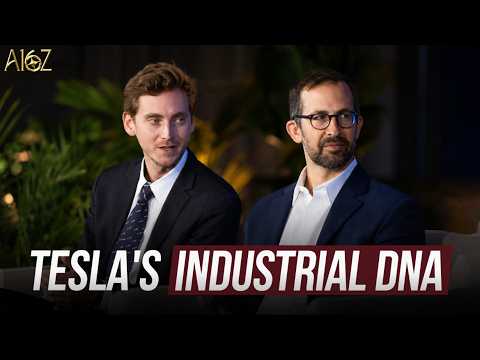
Turner Caldwell
Frontier Insights
Core Frontier Thesis: AI’s true bottleneck is physical infrastructure. Sustaining compute and electrification demands re-industrializing the US supply chain—specifically critical minerals, grid-scale power conversion, and advanced hardware manufacturing.
Strategic Decisions: Deploy the Tesla/SpaceX playbook to heavy industry: flatten hierarchies, compress cycles through aggressive milestones, and modernize century-old physical assets with software control. Vertically integrate selectively—only when supply chain vulnerabilities threaten survival or massive scale.
Risks & Warnings: Execution faces severe headwinds from decade-long permitting delays, multi-spreadsheet operational inertia, volatile commodity cycles, and deep overseas labor advantages. Policy stability and capital duration will dictate success.
Key Views & Dialogues
The Founders Who Left Tesla to Rebuild America | a16z
- 🗓️ Date:
2026-05-13| 🎙️ Show:The a16z Show
AI’s constraint is increasingly physical: Mariana Minerals targets mines and refineries, while Heron Power applies silicon and software to grid-scale power conversion. Mariana’s software-first operating model spans design through autonomous operation, but projects can take five years to build and another three to five years to reach operating rate; durable permitting, financing, and grid policy remain catalysts for scaling.
View Dialogue Notes & Key Takeaways
America’s AI constraint is increasingly “atoms and not algorithms”: minerals, power conversion, factories, and transmission must scale alongside models and chips. Turner Caldwell says the US is “50 years behind” China on critical-mineral supply, while Drew Baglino sees a century-old grid that remains largely mechanical, overbuilt, fragile, and dependent on overseas suppliers.
Permitting alone cannot close the minerals gap because execution after approval is still painfully slow. A project can take five years to build and another three to five years to reach operating rate; Mariana Minerals therefore targets design, construction, procurement, and ramp-up, aiming to build 10 projects in 10 years.
Both founders are embedding software in physical-asset operations rather than merely selling standalone software. Mariana uses agentic workflows and reinforcement learning across mines and refineries, including an effort to “remove humans from the loop,” while Heron Power uses silicon and software to replace “steel, oil, and copper” in grid-scale power conversion.
US manufacturing’s central disadvantage is supply-chain geography, not factory wages. Baglino estimates labor represents less than 10%—and potentially less than 5%—of cost of goods sold in a modern automated factory; China’s advantage is that the roughly 7,000 parts needed for a car can sit within a three-hour drive.
The Tesla operating model offers industrial startups a combination incumbents struggle to reproduce: techno-optimism, risk tolerance, mission, and persistence. Caldwell’s sharpest formulation was that Tesla keeps “barreling through the challenges as long as the outcome is worth it”; Baglino added the concentrating effect of knowing “whether or not the paycheck will clear” depends on execution.
The requested policy is durability and planning certainty. Caldwell wants the minerals equivalent of the tools built for oil and gas over the past 50 years; Baglino wants manufacturing zones, aligned jurisdictions, and a “federal highway trust fund for the grid” so private capital and suppliers can plan confidently.
🔗 Original source & video: The Founders Who Left Tesla to Rebuild America | a16z
What Tesla and SpaceX Teach Founders About Building Hardware | a16z
- 🗓️ Date:
2026-03-27| 🎙️ Show:The a16z Show
Tesla and SpaceX accelerate hardware by combining direct information flow, decisive technical leadership, aggressive milestones and factory-style measurement. The model favors vertical integration only when non-integration threatens survival, while deep technical apprenticeships and critical-path execution determine whether Galvadyne and Mariana Minerals can scale.
View Dialogue Notes & Key Takeaways
Tesla and SpaceX compress hardware timelines by pairing flat information flow with decisive technical leadership. Junior engineers can reach decision-makers directly, while leaders absorb the risk of imperfect information and say, “Go.” The operating loop is to gather as much evidence as the deadline permits, place the bet, test it, and iterate.
Aggressive milestones are diagnostic tools for exposing the few constraints that actually govern schedule. Price-Wright’s framing, endorsed by Caldwell: if 1,000 things must happen and 900 fit inside six months, the team should attack—or delete—the 100 that do not. Chandler Luzsicza applies that logic to Galvadyne’s goal of getting a rocket airborne by June.
Long hours are not the primary cause of burnout; organizational churn is. Luzsicza argues that politics, erratic priorities, data silos, and teams “hoarding your Legos” destroy motivation by separating effort from visible progress. Impossible goals can energize a mission-aligned team, but only when a credible technical path makes them aggressive rather than imaginary.
The factory mindset extends beyond production lines into design, laboratories, construction, refineries, and mines. Luzsicza’s Starship lesson is to question requirements until “simple is fast, simple is cheap”; Caldwell’s is to give every activity a takt-time analysis and measurable daily or hourly output. Mariana Minerals sees the missing software backbone for that control layer as the opportunity in major players that are 50 to 100 years old.
Vertical integration should clear an existential test, not merely promise lower component costs. Caldwell would not integrate early to save 5%, 10%, 20%, or even 50% unless the company otherwise cannot exist; Luzsicza prioritizes assemblies that would bottleneck Galvadyne’s path toward 10,000 missiles per year. Integration also internalizes the supplier’s operational risk and upstream supply chain.
Talent density is manufactured through unusually deep technical screening and extended trial periods. Tesla candidates may face six engineers, a technical test, and eight to 10 conversations; SpaceX’s internships provide a three-month proof period that repeatedly converts into critical full-time talent. Caldwell, who interned there four times, calls that funnel “so freaking crucial.”
Future founders should accumulate complete execution cycles before trading technical learning for company-building risk. Caldwell recommends seeing projects through the early, middle, and deployment “messy phases” multiple times, learning “what good looks like,” and building credibility to recruit exceptional people. His closing hierarchy is clear: over-index on technical depth before learning fundraising and hiring; Luzsicza agrees that founders should not try to learn how to build rockets on the job.
🔗 Original source & video: What Tesla and SpaceX Teach Founders About Building Hardware | a16z
The U.S. Can’t Build AI Without These Materials
- 🗓️ Date:
2025-07-23| 🎙️ Show:The a16z Show
Critical minerals are physical inputs to AI, grids, batteries, data-center infrastructure, vehicles, and defense systems. Turner Caldwell’s mass-flow call is emphatic: “We need a lot of aluminum. We need an insane amount of copper. We need more iron. We need more zinc,” while lithium production capacity must roughly 4× over the next 10 years if…
View Dialogue Notes & Key Takeaways
Critical minerals are physical inputs to AI, grids, batteries, data-center infrastructure, vehicles, and defense systems. Turner Caldwell’s mass-flow call is emphatic: “We need a lot of aluminum. We need an insane amount of copper. We need more iron. We need more zinc,” while lithium production capacity must roughly 4× over the next 10 years if planned batteries are to be built.
A mineral project is a site-specific chain from sub-1% ore to high-purity metal, not a fungible factory template. Ore bodies change grade and impurity mix as mining proceeds—“the Earth is heterogeneous”—so every flowsheet is bespoke and needs flexibility. That makes recovery and adaptability economically decisive because every lost atom must be mined again.
The venture thesis is to own the mine-to-refinery operating system because selling point technology into incumbent miners has become a “death spiral.” Multi-billion-dollar plants resist changes that might create multimillion-dollar downtime, pilots can miss commercial builds that arrive perhaps once every five years, and operators distrust outsiders touching their “cash register.” Mariana, emerging with $85 million raised, is betting vertical integration can capture efficiencies that point-solution SaaS vendors cannot capture on their own—but it also imports the partner’s risk into its expanded risk profile.
Mariana’s software bet targets two large sources of wasted time: a roughly three-week construction-information lag and refinery-control problems with about 1,000 interacting variables. Capital Project OS would automate engineering and procurement workflows; Plant OS would use reinforcement learning to optimize refinery operations, including recovery, energy, and reagents, across 24–48-hour feedback loops. Caldwell wants to remove humans from many operating decisions.
China’s moat is skilled execution capacity as much as policy or capital. Caldwell saw 13,000 people mobilized at a Chinese-backed Indonesian nickel refinery during construction and commissioning; a U.S. project might struggle to field one-tenth as many. Indonesia now supplies “something like 70%” of global nickel, illustrating how labor depth and downstream buildout compound geopolitical leverage.
The portfolio call is countercyclical: diversify, navigate frothy markets, and build at commodity troughs. In the rare-earth discussion, Caldwell calls the market “a little bit of a frothy market,” while focusing on lithium and regarding copper demand and declining grades as “pretty hard to ignore.” The operating bet is that software-controlled circuits can process lower-grade copper without meaningful cost inflation.
U.S. supply security needs faster exploration, permitting, and demand support. Exploration over more than five acres on federal land can require BLM approval, while price floors or fixed-price offtakes—like the cited MP Materials arrangement—could unlock infrastructure capital that will not underwrite commodity volatility. Mariana’s mission is concrete but hedged: build 10 increasingly large projects in 10 years, expand overseas and perhaps underwater, and restore confidence that complex minerals infrastructure can be built “cost-effectively, time-effectively and responsibly.”
🔗 Original source & video: The U.S. Can’t Build AI Without These Materials