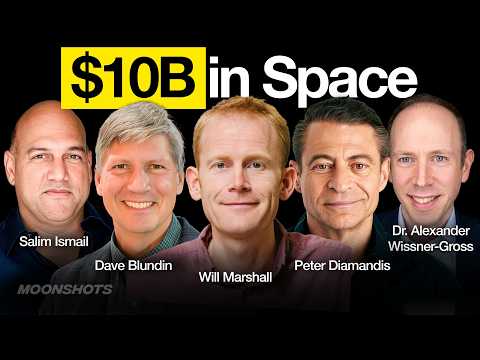
Will Marshall
Frontier Insights
Core Frontier Thesis: Orbital AI represents the next computing horizon. Planet’s 150PB, decade-long planetary time-series provides the proprietary foundation for training multimodal Earth models, turning raw observation into predictive intelligence.
Strategic Decisions: Decouple from launch-centric dependency: competitive advantage shifts from rocket costs ($200–$300/kg) to chip-level inference efficiency and orbital data processing. Go public early to compound value post-listing, treating public markets as an engine for long-horizon capital deployment.
Risks & Warnings: Orbital data centers face a 2–3 year cost inflection, but viable scaling remains constrained by unsolved cluster networking, thermal dissipation, and space-grade power management.
Key Views & Dialogues
The $10B Satellite Empire Putting AI in Orbit, Why Chips Beat Rockets & China’s #1 Open Model | #266
- 🗓️ Date:
2026-06-26| 🎙️ Show:Moonshots
Planet’s roughly 200 satellites generate 25 TB daily and a 150-PB, ten-year archive with 3,000 observations per land point, creating an irreproducible data moat as AI makes Earth searchable. Owl, Pelican, and Tanager add resolution, revisit rate, latency, and spectral depth, while orbital compute could become cost-competitive at $200-$300 per kilogram; inference efficiency, export policy, and GLM-5.2 remain key variables.
View Dialogue Notes & Key Takeaways
Planet’s investment case is a proprietary time series, not merely a constellation: PL operates roughly 200 satellites, generates 25 TB of imagery daily, and holds a 150-PB archive covering every land point about 3,000 times over ten years. Marshall calls it “indexing the Earth to make it searchable.” Because competitors cannot retroactively recreate that history, the archive is presented as a durable moat alongside the $10 billion valuation and 450% one-year share-price gain cited on-air.
Large Earth models could turn Planet’s pixels into natural-language answers and, eventually, forecasts of physical activity. The near-term product joins LLMs with current and historical sensing for farmers, governments, journalists, insurers, and traders; the next step is “tokenizing the Earth” through embeddings so models can predict changes. A prototype trained on US data-center construction reportedly located Chinese projects and forecast completion dates within days.
Planet’s sensor roadmap compounds resolution, revisit rate, latency, and spectral depth rather than optimizing a single dimension. Its daily scanner moves from 3-meter to 1-meter resolution while cutting latency below an hour; Pelican targets “30 by 30 by 30”—30 centimeters, 30 revisits daily, and 30-minute delivery—while Tanager’s 400 spectral bands can identify gases, tree species, and which tank site built a vehicle.
Orbital computing becomes cost-competitive around $200-$300 per kilogram of launch cost, according to Planet and Google’s study, but launch is only the opening constraint. Google is spending about $200 billion annually on compute—roughly the size of the whole space industry as characterized on-air—and Project Suncatcher is testing TPUs, radiators, radiation management, optical links, and tightly coordinated satellite clusters. Marshall’s long-arc claim: “Within 10 years we expect most compute to be put into space.”
Chips, not rockets, may ultimately decide who wins orbital AI. “Everyone apart from SpaceX has to pay the SpaceX launch tax,” Marshall argues, while almost everyone except NVIDIA and Google pays the “NVIDIA tax”; launch dominates near term, but compute efficiency dominates later because FLOPS per watt determines solar-array, radiator, and spacecraft mass. With inference already described as roughly 70% of AI compute, Marshall expects inference to move into orbit before large training runs.
China’s GLM-5.2 suggests frontier intelligence is becoming harder to monopolize. The 753-billion-parameter, one-million-token-context open-weight mixture-of-experts model reportedly approaches top Western models on selected reasoning, coding, agentic, and design tasks while using roughly twice the reasoning tokens at half the total price. The investor-relevant mechanism is that “you can burn tokens to get more intelligence,” making inference efficiency, local control, and export policy one interconnected contest.
AI institutions are lagging both capability and capital formation. Milei’s proposed non-human corporations would let AI entities own assets, contract, hire, and be sued, while Harari warns they could become shields for unaccountable humans; the panel’s strongest middle ground was machine-native accountability rather than a binary personhood test. Marshall paired that debate with a claimed 10,000-fold imbalance between present AI development and safety allocation versus the Manhattan Project era: “This is not a moment to muddle through.”
Intelligence is getting cheaper while its manufacturing base gets more capital-intensive. Orin’s compute-price indices aim to make intelligence observable and hedgeable like oil, supporting futures and derivatives around more than $7 trillion of prospective infrastructure. Blundin rejects capex-versus-cash-flow alarmism—hyperscalers can finance durable assets and potentially raise 10-100 times more—but the discussion preserves the tension: cheap outputs do not make GPU capacity, power, or cooling a low-cost business.
🔗 Original source & video: The $10B Satellite Empire Putting AI in Orbit, Why Chips Beat Rockets & China’s #1 Open Model | #266
The IPO Comeback: Why Tech Giants Are Finally Going Public | All-In Liquidity IPO Panel
- 🗓️ Date:
2026-06-06| 🎙️ Show:All-In
The IPO pendulum is shifting toward companies listing at $1 billion to $5 billion, with Planet creating roughly 90% of its post-SPAC value in years three and four. Cerebras’s $18.50 IPO followed a difficult 9.5 years, while its chip targets 15–18-times faster OpenAI workloads; orbital data centers offer a potential two-to-three-year cost catalyst, but distributed clustering remains unresolved.
View Dialogue Notes & Key Takeaways
The panel’s capital-markets call is that the IPO pendulum is swinging back toward companies listing at $1 billion, $3 billion, or $5 billion instead of “stay private forever.” Planet went public at $2 billion via SPAC in 2021, with roughly 90% of its subsequent value created in years three and four. Earlier listings can transfer more upside—and more operating scrutiny—to public investors.
Cerebras demonstrates both IPO friction and its payoff: Andrew Feldman says “not a damn thing changes in the important parts of your business,” while Brad Gerstner described 9.5 difficult years followed by 12 easy months. The IPO priced at $18.50 after the range was taken up twice, Brad said he thought the stock opened at $32, and it was later at $23, implying a $5–6 billion market cap.
Planet’s thesis is that daily, global satellite imagery becomes substantially more valuable when AI turns it into answers rather than another specialized dataset. Its roughly 200-satellite fleet images the entire Earth every day, creating a historical time series for agriculture, energy, disaster response, and security; Marshall estimates a $75 billion-$100 billion Earth-observation opportunity, with AI on top.
Marshall expects orbital data centers to become cheaper than terrestrial facilities once launch costs fall from just over $1,000 per kilogram to roughly $200-$300, potentially within two to three years. Constant sunlight could produce five times more energy per solar panel without batteries, but Feldman cautions that distributed clustering may be a “last 10%” problem that consumes 80% of the development time.
Cerebras’s silicon bet is that beating NVIDIA materially requires abandoning GPU-like architecture, because the odds of building a better GPU are “approximately zero.” Its dinner-plate-sized chip places fast memory beside compute to attack AI’s data-movement bottleneck; Feldman says OpenAI workloads run 15-18 times faster than on a GPU.
The liquidity debate does not end at an IPO because, as Feldman put it, “more money’s made after IPO than before.” Most early Planet investors retained shares through its public-market re-rating, while Cerebras investors—including Altimeter—were still under lockup and had adopted a six-month “dribble lockup” tied to performance hurdles.
Gerstner challenged the idea that Anthropic, OpenAI, and SpaceX’s enormous private valuations are the new normal. Chamath contrasted SpaceX’s prospective scale with historical tech companies that went public at a few billion rather than a few trillion, saying an equivalent post-IPO liftoff would require “quadrillion valuations.” The alternative is an earlier return to public ownership, where “iron sharpens iron” and more investors participate in the upside.
🔗 Original source & video: The IPO Comeback: Why Tech Giants Are Finally Going Public | All-In Liquidity IPO Panel