Zach Lloyd
Frontier Insights
Frontier Thesis: As coding agents commoditize junior-level execution, defensibility shifts upstream to context, harness design, and UX, making interface layers more commercially viable than underlying foundation models.
Strategic Pivot: Warp’s transition from an AI terminal to a full coding platform monetized agentic workflows, driving explosive ARR growth and capturing developer workflow surface area.
Risks & Warnings: As Big Tech dangles billion-dollar acqui-hire packages, lean AI teams face extreme defection risk. Investors and founders must price in talent poaching, lengthen vesting, and protect critical architectural governance as agentic code generation accelerates technical debt and security exposure.
Key Views & Dialogues
No Priors Ep. 137 | With Warp Co-Founder & CEO Zach Lloyd
- 🗓️ Date:
2025-10-23| 🎙️ Show:No Priors
Warp’s move from an AI terminal into coding accelerated adoption, reaching nearly 1 million monthly active users and roughly $1 million in new revenue every 7–10 days. Developer tooling may consolidate around whoever owns the interface, agent harness, and codebase context, while the terminal, IDE, and GitHub remain competing distribution points. Lloyd sees automation in CI as easier to value than productivity uplift, but studies on real codebases still leave coding-assistant ROI “kind of unclear.”
View Dialogue Notes & Key Takeaways
Warp’s commercial inflection came from moving into coding while retaining its terminal-first approach, rather than staying known mainly as an “AI terminal.” Elad Gil cites nearly 1 million monthly active users and roughly $1 million in new revenue every 7–10 days; Zach Lloyd says growth accelerated after the coding agent arrived just three or four months earlier because “the action is in coding.”
Lloyd separates today’s machine intelligence from consciousness: next-token prediction has produced recognizably intelligent behavior without, in his view, consciousness. “The Turing test has passed,” he argues, yet “we just passed it and no one seemed to care.” Lloyd cannot specify a satisfactory replacement test, especially if understanding a system’s mechanism makes people unwilling to credit it with consciousness.
Warp is targeting developers building economically meaningful, heavily used software rather than the long tail of vibe-coded applications. Agents can generate a basic web app from a few prompts, but applying them safely to mature codebases is much harder. Lloyd’s market thesis is that software value remains concentrated in “a relatively small number of apps that are super heavily used.”
Development is moving from “develop by hand” to “develop by prompt,” with partial automation following—but Lloyd would be surprised if everything disappeared into background agents soon. He expects everyone to work by prompt within a couple of years while selected tasks, such as responding to tickets or server errors, run autonomously.
Senior engineering expertise becomes more valuable in the short term because coding agents behave like junior engineers. Without architectural judgment and review, they can introduce bugs, security flaws, and unmaintainable code. Lloyd warns that being “perpetually in the junior engineer state” is the exposed position. He also expects automatic security analysis, verification, and safer-by-default languages such as Rust to matter more, though he has no strong view on whether they will be bundled.
Developer tooling is likely to consolidate around products that own the interface, agent harness, and context—not necessarily around model providers. Foundation-model companies are moving aggressively into code, but Lloyd questions whether they possess a Windows- or Google-like distribution advantage; the terminal, IDE, and potentially GitHub remain competing “front doors.” On the consumer side, he sees ChatGPT’s default behavior as a major advantage, while the developer dynamic is less clear.
The stronger business model may be automation rather than measured productivity uplift. A programmable, headless agent can sit in CI and keep documentation current whenever code changes, creating an outcome that is easier to value without being limited by keyboard time. That matters because Lloyd concedes that studies on real codebases leave the ROI of coding assistants “kind of unclear.”
🔗 Original source & video: No Priors Ep. 137 | With Warp Co-Founder & CEO Zach Lloyd
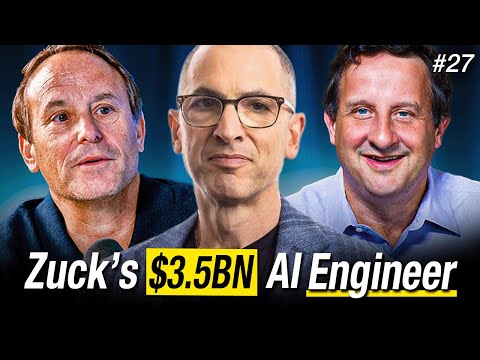
Thinking Machines Co-Founder Joins Meta for $3.5BN, Industry Venture’s $665M Acquisition
- 🗓️ Date:
2025-10-17| 🎙️ Show:20VC
A Thinking Machines co-founder reportedly left a $10B-post company for Meta’s $3.5B offer, exposing how extreme liquidity can turn founder loyalty into a one-and-done game that investors must price. Six-year vesting, cliffs, repurchase rights, diversification, and staged follow-ons become more important as AI demand drives capital intensity, seed windows compress, and IPO thresholds rise from $200M to $400M ARR.
View Dialogue Notes & Key Takeaways
The week’s flashpoint: a Thinking Machines co-founder (likely Andrew Tulloch) walked away from the company he helped raise $2B for at $10B post to rejoin Meta for a reported $3.5B. Jason opens with “in the face of unprecedented wealth, I’m shocked to discover that most people behave badly”; Harry adds that “the loyalty conversation erodes pretty quickly when you enter the third comma.” Once someone offers you $3.5B, you’re playing a one-and-done game, not a multi-period one — so investors must price defection, not assume loyalty.
The practical fixes are unglamorous: six-year vesting, cliffs, repurchase rights, penalties for leaving to a competitor — and a bigger fund, because diversification is the proposed hedge when a $10B-post “raw startup” is seven poachable minds. Jason’s seed-stage protection — “knowing the founder would never quit” — is under pressure at these sums; Rory calls the new reality “quite terrifying.”
AI capex will be stopped by economics or nothing: scaling insiders treat “1% of GDP” for compute as a matter-of-fact to-do list (per likely Dwarkesh Patel’s oral history of scaling, which Rory read over the weekend), while Jason testifies demand is insatiable — 8 vibe-coded apps in 100 days, 12 AI agents running at SaaStr, “I could use 100x the tokens” — and only 0.1% of Salesforce customers really use AI yet. Harry’s brake: at some point “capitalism is going to say… you can’t have your $1 trillion dream.”
Seed’s investable sweet spot “may have declined to like half an hour”: companies are “born almost instantly,” Lovable passed $170M ARR at its first anniversary, so you either invest into acute uncertainty or at $2B pre. The emerging edge: calibrate to Aaron Levie’s “diffusion rates” by industry, or hide in legal/regulatory complexity that better code alone can’t disrupt.
Polymarket ($2B at $9B) and likely Kalshi ($5B from a16z and Accel that week) are, per Roger, “the purest regulatory arbitrage play of all time” — 90% of the business is sports betting “we’re not calling it that,” racing to get too big to regulate, with striking Trump-family proximity. And it’s proof kingmaking has limits: bettors “don’t give a damn” who funded the book, provided it pays out.
Founders Fund’s shift from 31 growth investments to a planned 10 surprised Rory only in that “they weren’t there already” — if you can call the shots, concentrate. Roger’s counter-playbook for early stage: 20–25 names as “the farm team,” then 75% of capital into the 3–5 that prove out — justified by Rory’s data that hitting the first two underwritten revenue years lifts the odds of a 5x+ from 30% to mid-70s, in a world where the IPO bar has moved from $200M to $400M ARR.
Goldman’s purchase of Industry Ventures — $665M plus up to ~$300M earnout against $7B AUM, roughly 10% of AUM and ~10x revenue — is a fair market price and a structural lesson: only productized GP businesses (secondaries, fund-of-funds, platforms) can be sold 100%. “The only asset in Roger’s new fund is Roger’s IQ as a stock picker.”
Masa’s $5B margin loan against ARM to fund OpenAI is “a relatively low octane Masa move”: SoftBank still owns 90% of ARM (~$90B position), and Harry reckons he could take $25B against it “easily.” Jason’s caveat from 2002: individual Nasdaq stocks fell 90% — “it is possible the loan will get called. It’s just unlikely.”
🔗 Original source & video: Thinking Machines Co-Founder Joins Meta for $3.5BN, Industry Venture’s $665M Acquisition