AI in Basic Science and Materials Discovery
Explores breakthroughs and closed-loop lab automation across physics, chemistry, and advanced materials science.
1 sourcesVoices in this topic
All paragraphs
Oct 23, 2026
Oct 21, 2026

Oct 19, 2026


Oct 17, 2026

Oct 15, 2026

Oct 9, 2026

Oct 8, 2026
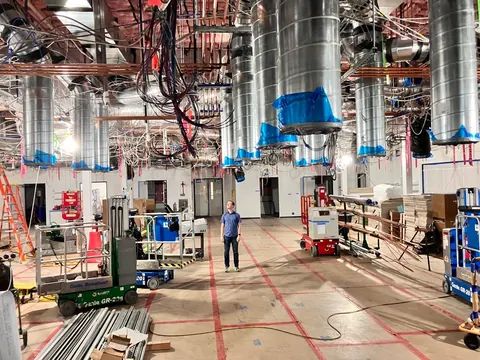
- Liam Fedus Periodic is betting that frontier scientific AI becomes most useful when its conjectures are forced through simulations, high-throughput experiments, and noisy physical measurements. Fedus summarizes the premise as “you can’t just think your way to a solution”: papers and pretrained knowledge can generate hypotheses, but …
- The core technical asset is not merely experimental data, but timestamped lineage showing how entire scientific campaigns progressed from failed attempts to working processes. That record includes computations, instrument data, code, discussions, intuitions, negative results, and eventual successes—data that …
- Ekin Dogus Cubuk Periodic sees automated characterization as a major bottleneck to scaling materials discovery, rather than simply mixing more powders. X-ray diffraction patterns can contain multiple phases, distinct structures can fit the same signal, and neither synthesized materials nor …
- Liam Fedus Lab automation is being optimized for data volume, quality, and reproducibility rather than humanoid spectacle or autonomy for its own sake. Periodic puts context-aware intelligence directly on instruments, redesigns hardware when off-the-shelf equipment creates bottlenecks or …
- The near-term commercial wedge is secure, on-site deployment into semiconductor companies, with a longer-term path from researcher copilots to outcome pricing. Forward-deployed teams integrate AI and simulation systems locally, train them on partner data, and let customers “own their own …
- Ekin Dogus Cubuk More simulation compute cannot remove the need for laboratories because perfect crystals, approximate theory, and inaccessible physical state omit the variables that govern actual materials. Cubuk invokes “More is different”: known microscopic laws do not make strongly correlated systems, microstructure, kinetics, or …

- Latent Space Periodic Labs’ central bet is that intelligence alone cannot create physical knowledge. Its operating maxim is, “Intelligence is necessary but not sufficient. New knowledge is created when ideas are found to be consistent with …
- Physical science demands a different AI regime from math or coding because observations are noisy, incomplete, expensive, and slow. Furnaces degrade, temperature varies by position, vibrations disturb optical equipment, and finished samples do not arrive labeled; unlike …
- Periodic’s potentially differentiated asset is not merely experimental data, but timestamped lineage of how science gets done. It captures failed attempts, computations, code, conversations, intuitions, instrument readings, and the sequence by which a campaign moves …
- Automated characterization—not humanoid robotics—is the near-term bottleneck with the highest leverage. Mixing powders is relatively easy; identifying what was produced, reconciling multiple instruments, and selecting the next experiment …
- Simulation is a high-volume filter, not a replacement for reality. Density functional theory can estimate material stability, but practical approximations struggle with strong correlations, microstructure, …
- Scaling requires simultaneous investment in laboratories, compute, instrumentation, and an unusually multidisciplinary organization. Off-the-shelf equipment eventually exposes bottlenecks and contamination risks, forcing custom hardware; additional labs can also access …
Oct 3, 2026

Oct 2, 2026
Sep 22, 2026

- John Platt Platt says ERA became practical only after recent Gemini improvements. He says it “would have been impossible under Gemini 2.0”; after experiments began working, progress across major and half versions was …
- ERA’s core insight is that many scientific problems can become “scorable tasks”: code that maximizes a defined score. Its Monte Carlo research loop mutates notebooks using Gemini, which can read papers, propose code, and exploit useful model-building …
- Humans still have to define and police the objective. Scoring functions can contain loopholes, and both agents and people will reward-hack them. Platt cites Kaggle competitors finding a …
- Persistent contrails contribute about 1% of anthropogenic warming and may be avoidable at relatively low cost. Ice-supersaturated regions can amplify emitted water, ice, or soot by roughly 10,000 to 1; avoiding them may require only dropping two …
- Platt thinks commercially relevant fusion could be “three years away, not 30,” but presents that as a probability, not a certainty. The Lawson criterion requires density, temperature, and confinement time to clear a threshold, and every approach has an Achilles heel. He …
- Weather has benefited from a major machine-learning step change, while climate remains much harder. Weather predicts the atmosphere’s trajectory; climate concerns statistics of an attractor that is itself changing. With limited future data …