Autonomous Agents Reshaping Enterprise SaaS
Exploring how AI agents overhaul traditional SaaS workflows, user interfaces, and software distribution.
5 sourcesVoices in this topic
All paragraphs
Oct 27, 2026
Oct 26, 2026
- Latent Space Supabase’s billion-database thesis requires cheaper starting points and a credible path to large production workloads. The founders report launching five million databases monthly and expect to need billions; acquiring Turso supplies technology for smaller, …
- Paul Copplestone Enterprise expansion remains a greenfield strategy because production databases are exceptionally difficult to displace. Paul expects almost all enterprise attention over the next five years to go toward new workloads. Coding agents might simplify rewriting …

Oct 24, 2026
- Parag Agrawal Agrawal sees 5,000–10,000x further growth in agent web use if his original 1,000x thesis holds. He estimates current agent usage at 10–20% of human usage, distinguishing it from crawler activity and headline bot traffic. His own agents …
- Agrawal argues that agent browsing breaks attention-based web economics even when purchases survive. “You can’t monetize attention anymore,” so he calls advertising and per-seat subscriptions non-durable. Parallel is building payments to …
Oct 21, 2026


Oct 20, 2026

Oct 19, 2026
- Jean-Denis Greze Town is betting that horizontal distribution can produce increasingly personalized vertical workflows. Interviews with power users feed reusable “routines,” while better models should reduce manual customization. Greze expects that approach to …
- The a16z Show The adoption bottleneck is turning existing intelligence into demonstrated, recurring outcomes. “You don’t need more intelligence,” Greze argues; users need products that identify useful work and perform it. Town also trusts agents with …
- Jean-Denis Greze Agents threaten advertising and aggregation economics by automating the attention those businesses monetize. Greze argues for agents funded by users, while acknowledging free agents could monetize indirectly through better advertising elsewhere. …
Oct 18, 2026

- 石天鑫 Another conclusion was to build around the Claude Code and Codex ecosystems—Jason compares the opportunity to Facebook for Zynga and eBay for PayPal. A Codex plugin with almost no promotion changed Super Design’s growth curve, bringing in many users who also churned less. 石天鑫 noticed the …
- The ecosystem opportunity also shows up in model subscriptions and demand for tools: 石天鑫 says Codex and Claude Code users can get $6,000-$7,000 worth of API Token usage through a $200 coding plan. Guests cited Apify, DataForSEO, Exa, and Firecrawl as examples of ecosystem opportunities. 石天鑫 says Exa should be at Series C by now; Jason …
Oct 16, 2026
Oct 15, 2026
Oct 12, 2026

Oct 10, 2026

Oct 8, 2026


Oct 7, 2026
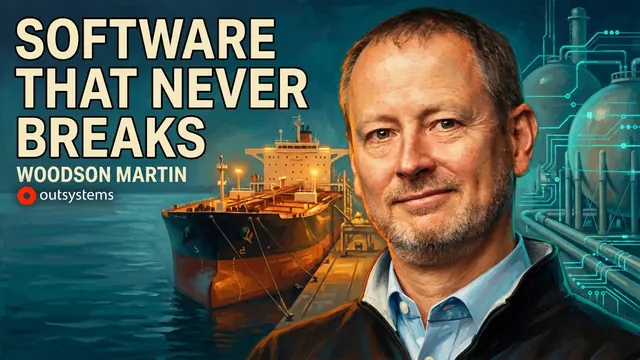
- Woodson Martin AI is turning legacy modernization from a six-year proposition into a six-month one, potentially unlocking a backlog that enterprises previously refused even to contemplate. AI can help interpret COBOL, AS/400, and Lotus Notes systems, rewrite requirements, build replacements, test them, and support deployment. …
- Martin expects software interfaces to fragment rather than collapse into a universal chatbot. Conversational agents may invoke small, contextual interface elements, but maps, regulated bank workflows, and other visual or …
- As every software vendor accumulates the same AI primitives, competitive advantage should migrate toward specialization and execution inside particular industries. Martin calls the current market an “ocean of the same,” where Highway 101 billboards contain the same five words under different logos. …
Oct 2, 2026

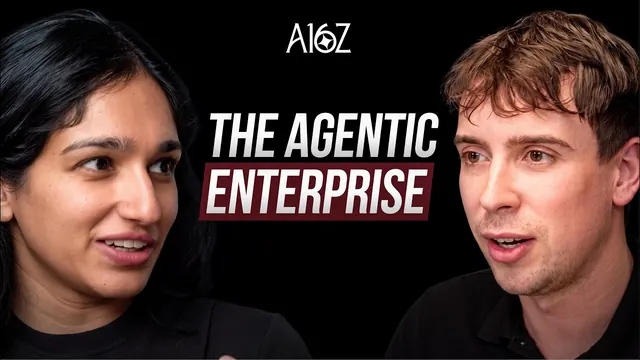
- Seema Amble The startup advantage is not a better chatbot; it is ownership of an end-to-end job that incumbent systems of record do not capture. Procurement’s apparent “$8,000” result can conceal 30 stakeholder meetings, 500 emails, 20 spreadsheets, engineering analysis and supplier …
- AI agents progress from retrieving information to exercising increasingly consequential judgment. Seema separates search, process, policy and principal agents: confirm an outage, issue contractually required credit, decide whether 20 …
- The a16z Show Procurement turns seemingly trivial information failures into material operational risk. A two-week delay buried among 500 emails can postpone an airplane or data-center project and cause hundreds of millions of dollars in …
- Seema Amble Durability comes from proprietary workflow context, specialized evaluation and customer dependence—not a confidently predeclared moat. General models can read PDFs and create spreadsheets, but they may stall at 80% on cost engineering or price benchmarking because the …
- Vladimir Keil Two-sided procurement agents could expand Lio from buyer automation into the infrastructure through which companies transact. Price remains zero-sum, but Vlad Keil argues it is merely the output of “5,000 other tasks” where buyers and suppliers share incentives to …
Sep 28, 2026
- Diogo Almeida Jev’s core bet is that AI’s missing layer is not intelligence but reliable automation embedded inside software. Diogo Almeida’s question is “where the hell is all that automation?”: models are extraordinarily smart, yet the default fix is still to bolt …
- The a16z Show Coding agents make conventional software faster to produce; Jev is meant to make the software itself more capable. Claude Code, Codex, and Cursor still generate “the same as code from 10 years ago,” while Jev adds a natural-language primitive that …
- Diogo Almeida Reliability—not raw benchmark performance—is the economic unlock. Almeida defines it as “the same intelligence every time,” distinct from uptime or identical outputs: equivalent inputs, even with irrelevant …
- Martin Casado Almeida once thought generalized RLHF might lead toward SHGI, then confronted the gap between impressive intelligence and broad automation. Martin Casado highlights the mismatch by invoking GPQA questions described as ones even Google does not know the answers to, while Almeida’s …
- Diogo Almeida The long tail is real, but Almeida rejects it as an excuse for automating almost nothing. His pragmatic answer is to automate high-return, routine work before hard edge cases; even support operations claiming to respond to 95% of …
- The opportunity thesis is a potential “reverse SaaS apocalypse.” Established SaaS vendors know which workflows matter and have distribution across large customer bases; if Jev-like primitives upgrade the …
Sep 24, 2026
Sep 23, 2026

Sep 21, 2026

- Daniel Dines The durable enterprise asset is not the model but the “map of work”: the workflows, exceptions, systems, relationships, and unwritten judgment that make a company function. Models are interchangeable, so enterprises need portable documentation that lets them switch providers, train internal models, and preserve …
- Dines sees Europe as technologically “largely irrelevant” despite possessing the talent and chipmaking machinery, because US companies make faster, larger bets. He advises builders of universal technology to move to America, while identifying European demand for on-prem software, model sovereignty, …