Compute Cloud Debt and Macro Liquidity
Tracking leveraged AI compute infrastructure, widening CDS spreads, and liquidity squeeze risks.
4 sources · ↑1.1×Voices in this topic
All paragraphs
Oct 27, 2026
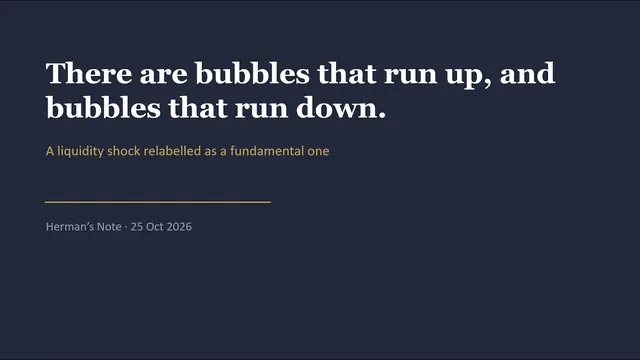
- Shanghao Jin Shanghao Jin attributes most of the AI selloff to a liquidity shock in rates and credit markets. His chain of causation runs from energy volatility to higher rate volatility, bond buyers pulling back, wider CCC spreads, and then pressure …
- He sees little chance of an AI funding gap this year or next; the real debt test comes in late 2027 to 2028. He puts neocloud financing at about $230B this year and $420B next year, and says hyperscalers still have roughly $500B of funding capacity. …
- Simultaneous fundraising intensified the market’s liquidity drain, while stable rates and lighter issuance after early December offer a path to relief. Anthropic, OpenAI, Meta, and others raising at the same time amounted to “taking a few more buckets out of an already fairly dry well” (“比较枯 …
Oct 24, 2026


Oct 22, 2026
Oct 21, 2026

Oct 20, 2026

- 高能量 Evidence of a liquidity peak is piling up. US tech stocks can only rotate: when one group rises, another has to fall. Since August, new data-center debt issuance has fallen sharply …
- The US is competing against itself: data-center debt and Treasuries are drawing from the same pool. A strong dollar is pulling in money, but Treasury auctions still need high bid-to-cover ratios to clear, and yields have not fallen; primary …
Oct 18, 2026
- Shanghao Jin He attributes this selloff to liquidity transmission from rate volatility and rejects inferring a demand peak from falling share prices. The sequence was rising rate volatility, stress in credit, sovereign credit and FX, then transmission from credit into CDS and equities. He …
- He does not think CDS alone can force CoreWeave into another Lehman. By his account, the company has about $46B in PP&E, $30B in net debt and $8–10B in cash; operating cash flow is positive and roughly covers …
Oct 17, 2026

- Ben Horowitz The CoreWeave scare is a credit-market story, not a demand story: Chamath walked through why credit default swaps on CoreWeave spiked to 953 basis points this week — an implied ~16% annual default risk and roughly 55% over five years. “It’s a coin flip whether they default or not. That’s not what I’m saying, that’s what the insurance market was saying.” With ~$35B of debt …
- Sacks’s call: this is volatility, not evidence that the bubble has popped, because demand hasn’t budged. His checklist: compute demand is off the charts, old H100s/A100s are still renting at premium prices, and physical and regulatory …
- Chamath’s macro kill switch: if the bond market walks the 10-year to 5.5–6%, “any business model that thrives on a financing spread gets cornholeed... you’re gonna be roadkill.” He identified variable-rate financing against the risk-free rate as the Achilles’ heel for these businesses; …
Oct 16, 2026

Oct 13, 2026
- Shanghao Jin AI financing has a risk mismatch: a compute center might recoup its investment in about 10 months by selling tokens, or in about 2 to 2.5 years by selling compute directly, while creditors face risks closer to equity risk if AI demand is disproven. In an Apollo project-finance example, 75% of the funding is debt and 25% equity. If AI demand does not materialize, the chips’ use and the …
- 2027 will test K-shaped funding demand, with financing needs and refinancing risk converging from 2028; the key is whether CSP cash flow improves. About $140B of debt matures in 2026, while 2027 financing needs are about $700B versus roughly $400B in 2026; those needs do not overlap …
Oct 9, 2026

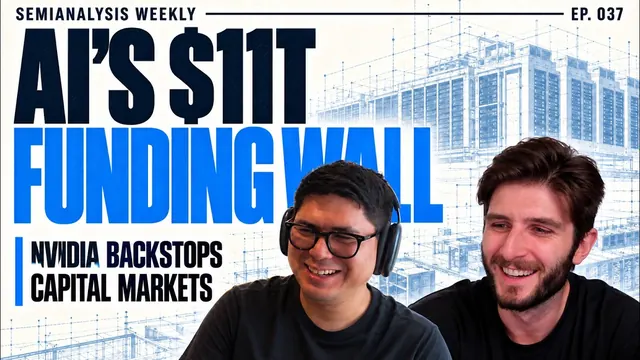
- Dan Nishball The buildout could leave roughly $7 trillion of debt outstanding by 2029, with about $1 trillion of net funding needed in the current year alone. From June through October 7, Nishball counted roughly $400 billion of AI loans and bonds either raised or announced, including $260 billion …
- Hyperscalers and NVIDIA are turning investment-grade credit into “balance sheet as a service” for labs and neoclouds that cannot finance projects independently. Microsoft can backstop Nscale capacity ultimately used by OpenAI, while managed-service treatment may keep commitments outside conventional …
- NVIDIA’s backstops can expand the market, educate lenders and generate revenue, but they cannot fund the entire buildout. Its AICP structure offers a six-year rental floor and takes 50% of revenue above that backstop; other arrangements secure NVIDIA deployments …
- The investable endgame is a much broader debt-financing market able to underwrite AI projects without investment-grade guarantees. SemiAnalysis expects AI debt to become the second-largest debt-financing market after the U.S. mortgage-backed market and says 2026 is the …