Lessons from the SVB Collapse
Examining bank runs, regulatory takeovers, and the viability of full-reserve banking models.
0 sourcesVoices in this topic
All paragraphs
Sep 25, 2026
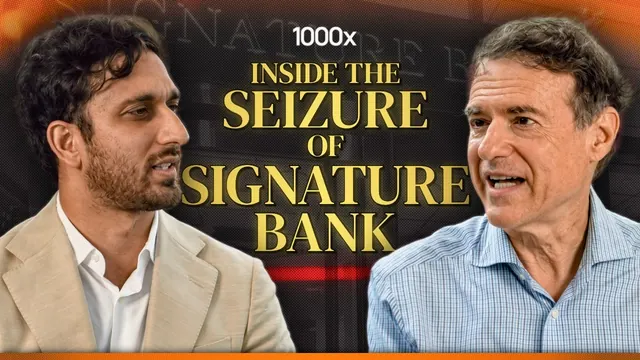
- Scott Shay Scott Shay's central claim is that Signature Bank had ample liquidity and capital when the government took it, and the arithmetic is deliberately simple: “we had $34 billion in cash and liquidity, and on Friday we had an $18 billion run… even cavemen could probably do 34 minus 18 equals 16.” Over the weekend the bank raised another $20 billion, “and astonishingly, the bank was taken.” His challenge to listeners: “you tell me what …
- Shay says the Fed’s rate hikes had nothing to do with Signature’s failure. Signature’s March 1, 2023 balance-sheet filing—less than two weeks before the takeover—was mark-to-market positive, because “one thing that …
- The discussion points toward hostility to crypto as a possible regulatory backdrop, but Shay does not state a definitive cause for the takeover. He says Silvergate was shut because “they didn’t like crypto”; Signature had made itself crypto-friendly, and its Signet system processed …
- His new venture, N3XT, is a nonfractional bank built as the lesson of the takeover. All deposits sit in very short Treasuries—“not repo, not anything else”—with direct government credit on all deposits, so, in his design, …
- The thesis Shay presents is that “non-fractional banking is a revolution whose time has come.” Where some conference participants are integrating with TradFi mega-banks, N3XT uses a blockchain core ledger and claims to follow Satoshi’s …
- The career backstory is pedigree for the claim. Shay started Bank United of Texas with Lou Ranieri in 1988, bought it as a distressed roughly $1.5 billion bank at effectively zero after …